
Cornelia Hughes Dayton – författare
Visar alla böcker från författaren Cornelia Hughes Dayton. Handla med fri frakt och snabb leverans.
3 produkter
3 produkter
E-bok
Engelska, 2019684 kr
Läs direkt efter köp
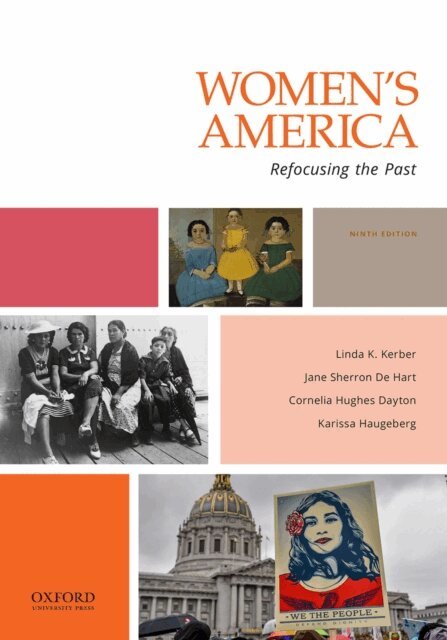
Featuring a streamlined single-volume format, Women's America: Refocusing the Past is more teachable, accessible, and affordable than ever before. The ninth edition incorporates insights from new coeditor Karissa Haugeberg and appears at a time of anxiety about the meaning of equality in the twenty-first century. Some of the inequalities with which women have long struggled have been eliminated, while others have emerged or reemerged. Coinciding with the 100th anniversary of the passage of the 19th Amendment, Women's America is an indispensable text for the study of US women's history.Digital Learning Tools to Enrich Your CourseAll print and electronic versions of Women's America: Refocusing the Past come with access to a full suite of engaging digital learning tools that work with the text to bring content to life and build critical skills. Podcasts, web-based research, books and journal articles, and films provide additional resources for students to further their understanding of the text. Interactive timelines summarize the important events covered in the text.
Häftad, Engelska, 1995
533 kr
Skickas inom 10-15 vardagar
Women before the Bar is the first study to investigate changing patterns of women's participation in early American courts across a broad range of legal actions--including proceedings related to debt, divorce, illicit sex, rape, and slander. Weaving the stories of individual women together with systematic analysis of gendered litigation patterns, Cornelia Dayton argues that women's relation to the courtroom scene in early New England shifted from one of integration in the mid-seventeenth century to one of marginality by the eve of the Revolution. Using the court records of New Haven, which originally had the most Puritan-dominated legal regime of all the colonies, Dayton argues that Puritanism's insistence on godly behavior and communal modes of disputing initially created unusual opportunities for women's voices to be heard within the legal system. But women's presence in the courts declined significantly over time as Puritan beliefs lost their status as the organizing principles of society, as legal practice began to adhere more closely to English patriarchal models, as the economy became commercialized, and as middle-class families developed an ethic of privacy. By demonstrating that the early eighteenth century was a crucial locus of change in law, economy, and gender ideology, Dayton's findings argue for a reconceptualization of women's status in colonial New England and for a new periodization of women's history. |Little explores the stormy American relationship with the Middle East from World War II through the war in Iraq, focusing particularly on the complex and often inconsistent attitudes and interests that helped put the United States on a collision course with radical Islam early in the new millennium. After documenting the persistence of ""orientalist"" stereotypes in American popular culture, Little examines oil, Israel, and other aspects of U.S. policy. For this updated third edition, Little covers events through 2007, including a new chapter on the Bush Doctrine, demonstrating that in many important ways, George W. Bush's Middle Eastern policies mark a sharp break with the past.
E-bok
PDF, Engelska, 2012385 kr
Läs direkt efter köp
Women before the Bar is the first study to investigate changing patterns of women’s participation in early American courts across a broad range of legal actions — including proceedings related to debt, divorce, illicit sex, rape, and slander. Weaving the stories of individual women together with systematic analysis of gendered litigation patterns, Cornelia Dayton argues that women’s relation to the courtroom scene in early New England shifted from one of integration in the mid-seventeenth century to one of marginality by the eve of the Revolution.Using the court records of New Haven, which originally had the most Puritan-dominated legal regime of all the colonies, Dayton argues that Puritanism’s insistence on godly behavior and communal modes of disputing initially created unusual opportunities for women’s voices to be heard within the legal system. But women’s presence in the courts declined significantly over time as Puritan beliefs lost their status as the organizing principles of society, as legal practice began to adhere more closely to English patriarchal models, as the economy became commercialized, and as middle-class families developed an ethic of privacy. By demonstrating that the early eighteenth century was a crucial locus of change in law, economy, and gender ideology, Dayton’s findings argue for a reconceptualization of women’s status in colonial New England and for a new periodization of women’s history.