Cyrus C. M. Mody – författare
435 kr
Läs direkt efter köp
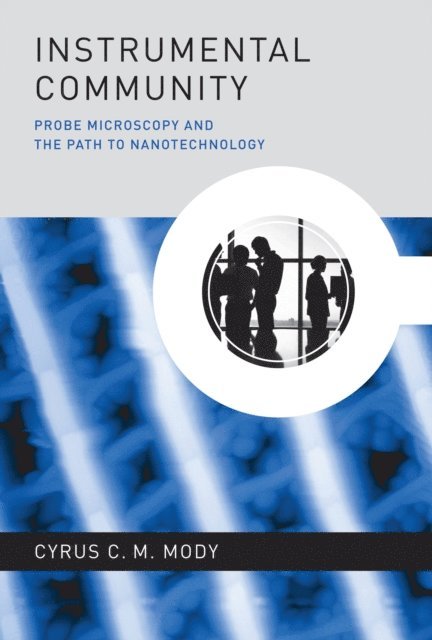
How networked structures of collaboration and competition within a community of researchers led to the invention, spread, and commercialization of scanning probe microscopy.
The scanning tunneling microscope (STM) has been hailed as the “key enabling discovery for nanotechnology,” the catalyst for a scientific field that attracts nearly $20 billion in funding each year. In Instrumental Community, Cyrus Mody argues that this technology-centric view does not explain how these microscopes helped to launch nanotechnology—and fails to acknowledge the agency of the microscopists in making the STM and its variants critically important tools. Mody tells the story of the invention, spread, and commercialization of scanning probe microscopy in terms of the networked structures of collaboration and competition that came into being within a diverse, colorful, and sometimes fractious community of researchers. By forming a community, he argues, these researchers were able to innovate rapidly, share the microscopes with a wide range of users, and generate prestige (including the 1986 Nobel Prize in Physics) and profit (as the technology found applications in industry).
Mody shows that both the technology of probe microscopy and the community model offered by the probe microscopists contributed to the development of political and scientific support for nanotechnology and the global funding initiatives that followed. In the course of his account, Mody charts the shifts in U.S. science policy over the last forty years—from the decline in federal basic research funding in the 1970s through the rise in academic patenting in the 1980s to the emergence of nanotechnology discourse in the 1990s—that have resulted in today''s increasing emphasis on the commercialization of academic research.
512 kr
Läs direkt efter köp
How, beginning in the mid 1960s, the US semiconductor industry helped shape changes in American science, including a new orientation to the short-term and the commercial.
Since the mid 1960s, American science has undergone significant changes in the way it is organized, funded, and practiced. These changes include the decline of basic research by corporations; a new orientation toward the short-term and the commercial, with pressure on universities and government labs to participate in the market; and the promotion of interdisciplinarity. In this book, Cyrus Mody argues that the changes in American science that began in the 1960s co-evolved with and were shaped by the needs of the “civilianized” US semiconductor industry.
In 1965, Gordon Moore declared that the most profitable number of circuit components that can be crammed on a single silicon chip doubles every year. Mody views “Moore''s Law” less as prediction than as self-fulfilling prophecy, pointing to the enormous investments of capital, people, and institutions the semiconductor industry required—the “long arm” of Moore''s Law that helped shape all of science.
Mody offers a series of case studies in microelectronics that illustrate the reach of Moore''s Law. He describes the pressures on Stanford University''s electrical engineers during the Vietnam era, IBM''s exploration of alternatives to semiconductor technology, the emergence of consortia to integrate research across disciplines and universities, and the interwoven development of the the molecular electronics community and associated academic institutions as the vision of a molecular computer informed the restructuring of research programs.
789 kr
Läs direkt efter köp
428 kr
Tillfälligt slut
187 kr
Tillfälligt slut