D. Jewitt – författare
Visar alla böcker från författaren D. Jewitt. Handla med fri frakt och snabb leverans.
5 produkter
Minor Bodies in the Outer Solar System
Proceedings of the ESO Workshop Held at Garching, Germany, 2-5 November 1998
Av A. Fitzsimmons, D. Jewitt m. fl.
Inbunden, 2000
442 kr
Lägg i varukorg
This volume tries to summarize the status of observational knowledge of the Kuiper Belt. Its recent discovery has revitalized the astromomical study of the Solar System and is beginning to open new and unexpected windows on the physics of planetesimal accretion. With more and better observational …
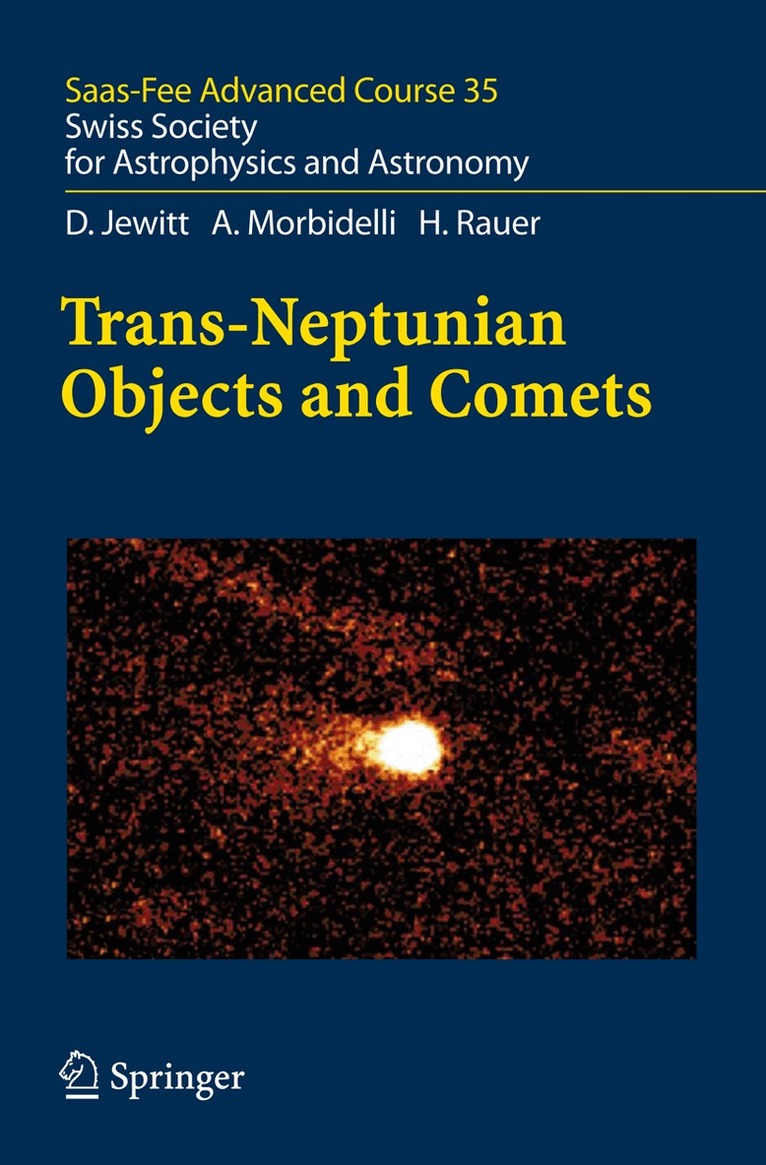
Trans-Neptunian Objects and Comets
Saas-Fee Advanced Course 35. Swiss Society for Astrophysics and Astronomy
Av D. Jewitt, A. Morbidelli m. fl.
Inbunden, 2007
1095 kr
Lägg i varukorg
The study of the Solar system, particularly of its newly discovered outer parts, is one of the hottest topics in modern astrophysics with great potential for revealing fundamental clues about the origin of planets and even the emergence of life.The three lecturers of the 35th Saas-Fee Advanced …
Trans-Neptunian Objects and Comets
Saas-Fee Advanced Course 35. Swiss Society for Astrophysics and Astronomy
Av H. Rauer, A. Morbidelli m. fl.
E-bok, 2007
1459 kr
Lägg i varukorg
The study of the Solar system, particularly of its newly discovered outer parts, is one of the hottest topics in modern astrophysics with great potential for revealing fundamental clues about the origin of planets and even the emergence of life.The three lecturers of the 35th Saas-Fee Advanced …
Minor Bodies in the Outer Solar System
Proceedings of the ESO Workshop Held at Garching, Germany, 2-5 November 1998
Av A. Fitzsimmons, D. Jewitt m. fl.
Häftad, 2010
442 kr
Lägg i varukorg
This volume tries to summarize the status of observational knowledge of the Kuiper Belt. Its recent discovery has revitalized the astromomical study of the Solar System and is beginning to open new and unexpected windows on the physics of planetesimal accretion. With more and better observational …
Trans-Neptunian Objects and Comets
Saas-Fee Advanced Course 35. Swiss Society for Astrophysics and Astronomy
Av D. Jewitt, A. Morbidelli m. fl.
Häftad, 2010
1125 kr
Lägg i varukorg
The study of the Solar system, particularly of its newly discovered outer parts, is one of the hottest topics in modern astrophysics with great potential for revealing fundamental clues about the origin of planets and even the emergence of life.The three lecturers of the 35th Saas-Fee Advanced …