D. Shoenberg – författare
Visar alla böcker från författaren D. Shoenberg. Handla med fri frakt och snabb leverans.
4 produkter
4 produkter
E-bok
PDF, Engelska, 2012672 kr
Läs direkt efter köp
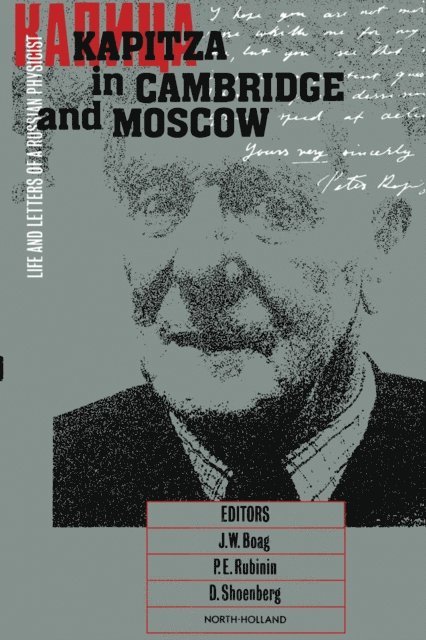
The unusual career of the famous Soviet physicist Peter Kapitza was divided between Cambridge and Moscow. In Cambridge he was a protegé of Rutherford and while studying there he opened up a new area of research in magnetism and low temperature physics. However, in 1934, during a summer visit to the Soviet Union, Kapitza was prevented from returning to Cambridge and remained in Moscow for the rest of his long life. In spite of many ups and downs and considerable difficulties in his relations with top political figures in the Kremlin, he continued to enhance his scientific reputation and late in life was awarded the Nobel Prize.After an introductory biographical memoir, the greater part of the book consists of extracts from the numerous letters Kapitza wrote throughout his life, letters which are distinguished by their eloquence, the originality of his opinions and his forthrightness. His very interesting correspondence with Rutherford and above all his many letters to top political figures in the Soviet Union such as Molotov, Stalin and Khrushchev on questions of scientific and industrial policy are all included in this unique document. Together they provide a rounded picture of a remarkable personality who contributed so much to the scientific and cultural life of both England and the Soviet Union.This fascinating book is illustrated with an impressive collection of historical photographs and should be of interest to science historians, to low temperature physicists and to `Sovietologists'', but above all the book should appeal to the general reader for its human interest. Some of the letters reveal his emotional reactions to the major blows he had to suffer on several occasions, while others provide penetrating and often amusing comments on English life and institutions as seen by a Russian, and on Soviet life from the inside.
E-bok
PDF, Engelska, 20091 023 kr
Läs direkt efter köp
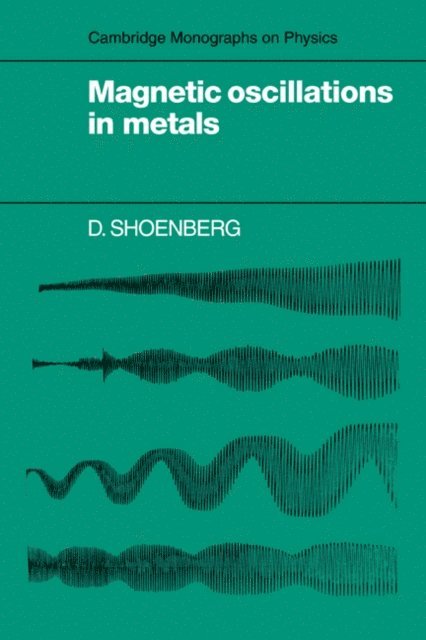
It is just over 80 years ago that a striking oscillatory field dependence was discovered in the magnetic behaviour of bismuth at low temperatures. This book was first published in 1984 and gives a systematic account of the nature of the oscillations, of the experimental techniques for their study and of their connection with the electronic structure of the metal concerned. Although the main emphasis is on the oscillations themselves and their many peculiarities, rather than on the theory of the electronic structure they reveal, sufficient examples are given in detail to illustrate the kind of information that has been obtained and how this information agrees with theoretical prediction.
Häftad, Engelska, 1952
617 kr
Skickas inom 7-10 vardagar
The phenomenon of superconductivity, fist discovered by Kamerlingh Onnes in 1911, offers considerable fundamental interest as an unusual example of quantum effects on a macroscopic scale and of interest also in respect of its possible technological applications. Although Dr Shoenberg's classic monograph was written in 1938, before the great burst of activity which followed the development of a fundamental theory of superconductivity, its phenomenological description of the magnetic and thermodynamic properties and of size effects in superconductors, which are taken for granted in most accounts, are essential parts of the subject which must be properly understood before the newer ideas can really be appreciated. Reissued in 1952 and again in 2010, the book will continue to serve therefore as an intriguing study in this field and for those interested in superconductivity.
Häftad, Engelska, 2009
877 kr
Skickas inom 7-10 vardagar
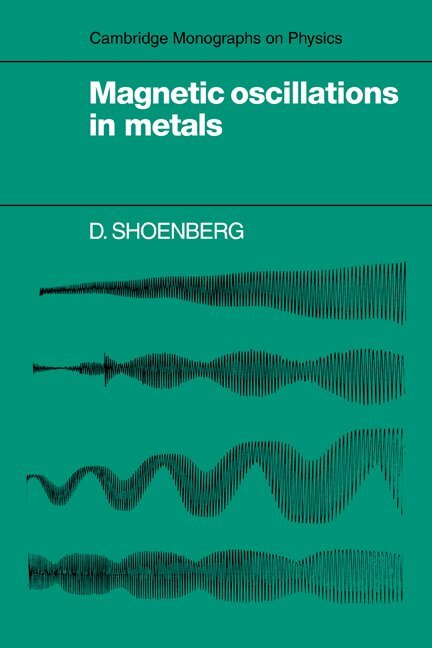
It is just over 80 years ago that a striking oscillatory field dependence was discovered in the magnetic behaviour of bismuth at low temperatures. This book was first published in 1984 and gives a systematic account of the nature of the oscillations, of the experimental techniques for their study and of their connection with the electronic structure of the metal concerned. Although the main emphasis is on the oscillations themselves and their many peculiarities, rather than on the theory of the electronic structure they reveal, sufficient examples are given in detail to illustrate the kind of information that has been obtained and how this information agrees with theoretical prediction.