Dan Craigen – författare
Visar alla böcker från författaren Dan Craigen. Handla med fri frakt och snabb leverans.
3 produkter
3 produkter
E-bok
PDF, Engelska, 2012692 kr
Läs direkt efter köp
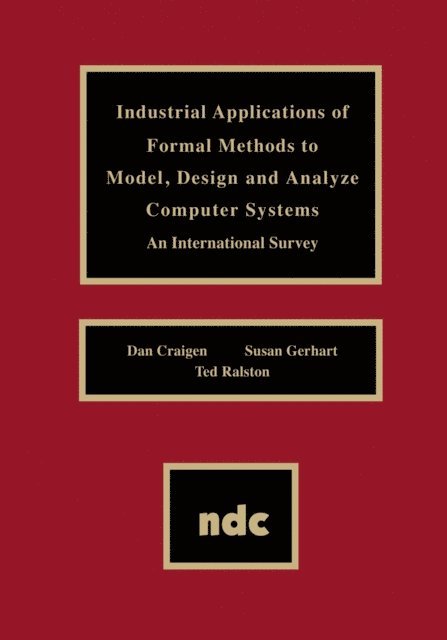
Formal methods are mathematically-based techniques, often supported by reasoning tools, that can offer a rigorous and effective way to model, design and analyze computer systems. The purpose of this study is to evaluate international industrial experience in using formal methods. The cases selected are representative of industrial-grade projects and span a variety of application domains. The study had three main objectives: · To better inform deliberations within industry and government on standards and regulations; · To provide an authoritative record on the practical experience of formal methods to date; and À To suggest areas where future research and technology development are needed. This study was undertaken by three experts in formal methods and software engineering: Dan Craigen of ORA Canada, Susan Gerhart of Applied Formal Methods, and Ted Ralston of Ralston Research Associates. Robin Bloomfield of Adelard was involved with the Darlington Nuclear Generating Station Shutdown System case. Support for this study was provided by organizations in Canada and the United States. The Atomic Energy Control Board of Canada (AECB) provided support for Dan Craigen and for the technical editing provided by Karen Summerskill. The U.S. Naval Research Laboratories (NRL), Washington, DC, provided support for all three authors. The U.S. National Institute of Standards and Technology (NIST) provided support for Ted Ralston.
E-bok
PDF, Engelska, 2013734 kr
Läs direkt efter köp
The 1989 Workshop on the Assessment of Formal Methods for Trustworthy Com puter Systems (FM89} was an invitational workshop that brought together repre sentatives from the research, commercial and governmental spheres of Canada, the United Kingdom, and the United States. The workshop was held in Halifax, Nova Scotia, Canada, from July 23 through July 27, 1989. This document reports the activities, observations, recommendations and conclusions resulting. from FM89. 1. 1 Purpose of Workshop The primary purpose for holding FM89 was to assess the role of formal methods in the development and fielding of trustworthy critical systems. The need for this assessment was predicated upon four observations: 1. Critical systems are increasingly being controlled by computer systems; 2. Existing techniques for developing, assuring and certifying computer-based critical systems are inadequate; 3. Formal methods have the potential for playing the same role in the devel opment of computer-based systems as applied mathematics does for other engineering disciplines; and 4. Formal methods have had limited impact on the development of comput- based systems and supporting technologies. · The goal of the workshop was to complete the following tasks: 1. Assess the problems retarding the development of trustworthy critical systems; 2. Determine the (potential) impact of applying formal methods techniques to the development of trustworthy critical systems; 3. Determine the research and development required to facilitate a broader ap plication of formal methods techniques; 4.
Häftad, Engelska, 1990
566 kr
Skickas inom 10-15 vardagar
The 1989 Workshop on the Assessment of Formal Methods for Trustworthy Com puter Systems (FM89} was an invitational workshop that brought together repre sentatives from the research, commercial and governmental spheres of Canada, the United Kingdom, and the United States. The workshop was held in Halifax, Nova Scotia, Canada, from July 23 through July 27, 1989. This document reports the activities, observations, recommendations and conclusions resulting. from FM89. 1. 1 Purpose of Workshop The primary purpose for holding FM89 was to assess the role of formal methods in the development and fielding of trustworthy critical systems. The need for this assessment was predicated upon four observations: 1. Critical systems are increasingly being controlled by computer systems; 2. Existing techniques for developing, assuring and certifying computer-based critical systems are inadequate; 3. Formal methods have the potential for playing the same role in the devel opment of computer-based systems as applied mathematics does for other engineering disciplines; and 4. Formal methods have had limited impact on the development of comput- based systems and supporting technologies. · The goal of the workshop was to complete the following tasks: 1. Assess the problems retarding the development of trustworthy critical systems; 2. Determine the (potential) impact of applying formal methods techniques to the development of trustworthy critical systems; 3. Determine the research and development required to facilitate a broader ap plication of formal methods techniques; 4.