Daniel Albright - Böcker
Visar alla böcker från författaren Daniel Albright. Handla med fri frakt och snabb leverans.
16 produkter
16 produkter
404 kr
Skickas inom 7-10 vardagar
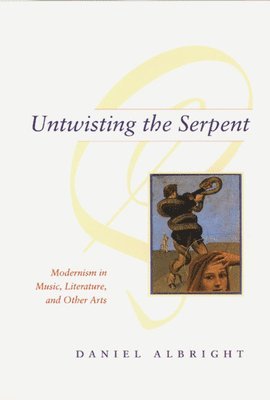
From its dissonant musics to its surrealist spectacles (the urinal is a violin!), Modernist art often seems to give more frustration than pleasure to its audience. In this text Daniel Albright shows that this perception arises partly because we usually consider each art form in isolation, even though many of the most important artistic experiments of the Modernists were collaborations involving several media - Igor Stravinsky's "The Rite of Spring" is a ballet, Gertrude Stein's "Four Saints in Three Acts" is an opera, and Pablo Picasso turned his cubist paintings into costumes for "Parade." Focusing on collaborations with a musical component, Albright views these works as either figures of dissonance that try to retain the distinctness of their various media (e.g. Guillaume Apollinaire's "Les Mamelles de Tiresias") or figures of consonance that try to lose themselves in some total effect (such as Arnold Schoenberg's "Erwartung"). In so doing he offers a fresh picture of Modernism, and provides a model for the analysis of all artistic collaborations.
424 kr
Skickas inom 7-10 vardagar
If in earlier eras music may have seemed slow to respond to advances in other artistic media, during the modernist age it asserted itself in the vanguard. Modernism and Music provides a rich selection of texts on this moment, some translated into English for the first time. It offers not only important statements by composers and critics, but also musical speculations by poets, novelists, philosophers, and others-all of which combine with Daniel Albright's extensive, interlinked commentary to place modernist music in the full context of intellectual and cultural history.
409 kr
Skickas
Daniel Albright was one of the preeminent scholars of musical and literary modernism, leaving behind a rich body of work before his untimely passing. In Music’s Monisms, he shows how musical and literary phenomena alike can be fruitfully investigated through the lens of monism, a philosophical conviction that does away with the binary structures we use to make sense of reality. Albright shows that despite music’s many binaries—diatonic vs. chromatic, major vs. minor, tonal vs. atonal—there is always a larger system at work that aims to reconcile tension and resolve conflict. Albright identifies a “radical monism” in the work of modernist poets such as T. S. Eliot and musical works by Wagner, Debussy, Britten, Schoenberg, and Stravinsky. Radical monism insists on the interchangeability, even the sameness, of the basic dichotomies that govern our thinking and modes of organizing the universe. Through a series of close readings of musical and literary works, Albright advances powerful philosophical arguments that not only shed light on these specific figures but also on aesthetic experience in general. Music’s Monisms is a revelatory work by one of modernist studies’ most distinguished figures.
886 kr
Skickas inom 5-8 vardagar
While comparative literature is a well-recognized field of study, the notion of comparative arts remains unfamiliar to many. In this fascinating book, Daniel Albright addresses the fundamental question of comparative arts: Are there many different arts, or is there one art which takes different forms? He considers various artistic media, especially literature, music, and painting, to discover which aspects of each medium are unique and which can be “translated” from one to another. Can a poem turn into a symphony, or a symphony into a painting? Albright explores how different media interact, as in a drama, when speech, stage decor, and music are co-present, or in a musical composition that employs the collage method of the visual arts. Tracing arguments and questions about the relations among the arts from Aristotle’s Poetics to the present day, he illuminates the understudied discipline of comparative arts and urges new attention to its riches.
644 kr
Skickas inom 7-10 vardagar
Quantum Poetics examines the way modernist poets appropriated scientific metaphors as part of a general search for the pre-verbal origins of poetry. Daniel Albright traces Modernism's search for the elementary particles from which poems were constructed. The poetic possibilities offered by developments in scientific discourse intrigued Yeats, Eliot and Pound, writers intent on remapping the general theory of poetry. Using models supplied by physicists, Yeats sought for the basic units of poetic force, both through his sequence A Vision and through his belief in, and defence of, the purity of symbols. Pound's whole critical vocabulary, Albright claims, aims at drawing art and science together in a search for poetic precision, the tiniest textual particles that held poems together. Through a series of patient and original readings, Quantum Poetics demonstrates how modernists created a whole new way of thinking about poetry and science as two different aspects of the same quest.
1 371 kr
Skickas inom 7-10 vardagar
Quantum Poetics examines the way modernist poets appropriated scientific metaphors as part of a general search for the pre-verbal origins of poetry. Daniel Albright traces Modernism's search for the elementary particles from which poems were constructed. The poetic possibilities offered by developments in scientific discourse intrigued Yeats, Eliot and Pound, writers intent on remapping the general theory of poetry. Using models supplied by physicists, Yeats sought for the basic units of poetic force, both through his sequence A Vision and through his belief in, and defence of, the purity of symbols. Pound's whole critical vocabulary, Albright claims, aims at drawing art and science together in a search for poetic precision, the tiniest textual particles that held poems together. Through a series of patient and original readings, Quantum Poetics demonstrates how modernists created a whole new way of thinking about poetry and science as two different aspects of the same quest.
1 431 kr
Skickas inom 7-10 vardagar
Beckett and Aesthetics, first published in 2003, examines Samuel Beckett's struggle with the recalcitrance of artistic media, their refusal to yield to his artistic purposes. As a young man Beckett hoped that writing could provide psychic authenticity and true representation of the physical world; instead he found himself immersed in artificialities and self-enclosed word games. Daniel Albright argues that Beckett escaped from this bind through allegories of artistic frustration and through an art of non-representation, estrangement and general failure. He arrived, Albright shows, at some grasp of fact through the most indirect route available. Albright explores Beckett's experimentation with the notion that an artistic medium might itself be made to speak. This powerful and highly original book explores Beckett's own engagement with radio, film, and television, prose and drama as part of an attempt to escape the confines of the aesthetic. Albright's Beckett becomes a sophisticated theorist of the very notion of the aesthetic.
743 kr
Skickas inom 10-15 vardagar
Albright contends that Tennyson's ``aesthetic goals were . . . in conflict'' and that his poetry attempts to ``unite two incompatible poetics,'' one governed by a heavenly muse, the other by an earthly muse suspicious of the idealizations and abstractions held dear by the first. The result is a poetry of ``myopia and astigmatism.'' With its neatly pursued argument and jargon-free text, this study offers many insights, though a readership fluently conversant with the Tennysonian opus (not just the major poems) is assumed. This is a good beginning for the Virginia Victorian Studies series, which will deal in literary topics from 1830 to 1914. Presumably the series, like this book, will be aimed at an audience at the advanced undergraduate level or above. The book is recommended, accordingly.
482 kr
Skickas inom 10-15 vardagar
Albright contends that Tennyson's ``aesthetic goals were . . . in conflict'' and that his poetry attempts to ``unite two incompatible poetics,'' one governed by a heavenly muse, the other by an earthly muse suspicious of the idealizations and abstractions held dear by the first. The result is a poetry of ``myopia and astigmatism.'' With its neatly pursued argument and jargon-free text, this study offers many insights, though a readership fluently conversant with the Tennysonian opus (not just the major poems) is assumed. This is a good beginning for the Virginia Victorian Studies series, which will deal in literary topics from 1830 to 1914. Presumably the series, like this book, will be aimed at an audience at the advanced undergraduate level or above. The book is recommended, accordingly.
170 kr
Skickas inom 7-10 vardagar
767 kr
Skickas inom 7-10 vardagar
How do you rationally connect the diverse literature, music, and painting of an age? Throughout the modernist era-which began roughly in 1872 with the Franco-Prussian War, climaxed with the Great War, and ended with a third catastrophe, the Great Depression-there was a special belligerence to this question. It was a cultural period that envisioned many different models of itself: to the Cubists, it looked like a vast jigsaw puzzle; to the Expressionists, it resembled a convulsive body; to the Dadaists, it brought to mind a heap of junk following an explosion. In Putting Modernism Together, Daniel Albright searches for the center of the modernist movement by assessing these various artistic models, exploring how they generated a stunning range of creative work that was nonetheless wound together aesthetically, and sorting out the cultural assumptions that made each philosophical system attractive.Emerging from Albright's lectures for a popular Harvard University course of the same name, the book investigates different methodologies for comparing the evolution and congruence of artistic movements by studying simultaneous developments that occurred during particularly key modernist years. What does it mean, Albright asks, that Joseph Conrad's Heart of Darkness, published in 1899, appeared at the same time as Claude Debussy's Nocturnes-beyond the fact that the word "Impressionist" has been used to describe each work? Why, in 1912, did the composer Arnold Schoenberg and the painter Vassily Kandinsky feel such striking artistic kinship? And how can we make sense of a movement, fragmented by isms, that looked for value in all sorts of under- or ill-valued places, including evil (Baudelaire), dung heaps (Chekhov), noise (Russolo), obscenity (Lawrence), and triviality (Satie)? Throughout Putting Modernism Together, Albright argues that human culture can best be understood as a growth-pattern or ramifying of artistic, intellectual, and political action.Going beyond merely explaining how the artists in these genres achieved their peculiar effects, he presents challenging new analyses of telling craft details which help students and scholars come to know more fully this bold age of aesthetic extremism.
471 kr
Skickas inom 5-8 vardagar
How do you rationally connect the diverse literature, music, and painting of an age? Throughout the modernist era-which began roughly in 1872 with the Franco-Prussian War, climaxed with the Great War, and ended with a third catastrophe, the Great Depression-there was a special belligerence to this question. It was a cultural period that envisioned many different models of itself: to the Cubists, it looked like a vast jigsaw puzzle; to the Expressionists, it resembled a convulsive body; to the Dadaists, it brought to mind a heap of junk following an explosion. In Putting Modernism Together, Daniel Albright searches for the center of the modernist movement by assessing these various artistic models, exploring how they generated a stunning range of creative work that was nonetheless wound together aesthetically, and sorting out the cultural assumptions that made each philosophical system attractive.Emerging from Albright's lectures for a popular Harvard University course of the same name, the book investigates different methodologies for comparing the evolution and congruence of artistic movements by studying simultaneous developments that occurred during particularly key modernist years. What does it mean, Albright asks, that Joseph Conrad's Heart of Darkness, published in 1899, appeared at the same time as Claude Debussy's Nocturnes-beyond the fact that the word "Impressionist" has been used to describe each work? Why, in 1912, did the composer Arnold Schoenberg and the painter Vassily Kandinsky feel such striking artistic kinship? And how can we make sense of a movement, fragmented by isms, that looked for value in all sorts of under- or ill-valued places, including evil (Baudelaire), dung heaps (Chekhov), noise (Russolo), obscenity (Lawrence), and triviality (Satie)? Throughout Putting Modernism Together, Albright argues that human culture can best be understood as a growth-pattern or ramifying of artistic, intellectual, and political action.Going beyond merely explaining how the artists in these genres achieved their peculiar effects, he presents challenging new analyses of telling craft details which help students and scholars come to know more fully this bold age of aesthetic extremism.
561 kr
Skickas inom 10-15 vardagar
We are used to thinking of critical discourse on Shakespeare as occurring in the realm of language. But music has interpretive powers of its own. In this volume we see how the powerful dramatic intelligences of four exceedingly gifted composers – Berlioz, Verdi, Wagner, and Britten – provide insights into the Shakespearean canon not easily attained by non-musical means.
Del 14 - Eastman Studies in Music
Berlioz's Semi-Operas
Roméo et Juliette and La damnation de Faust
Inbunden, Engelska, 2001
1 083 kr
Skickas inom 10-15 vardagar
A full-length study of two of Berlioz's most unique works, which combine the highest goals of both symphony and opera and incorporate two of the greatest classics of Western literature into a total fusion of the arts.This work studies two works that are among the most challenging of the entire Romantic Movement, not least because they assault the notion of genre: they take place in a sort of limbo between symphony and opera, and try to fulfillthe highest goals of each simultaneously. Berlioz was a composer who strenuously resisted any impediments that stood in the way of complete compositional freedom. Most of his large-scale works nevertheless obey the strictures of some preexistent form, whether opera or symphony or mass or cantata; it is chiefly in these two experiments that Berlioz allowed himself to be Berlioz.One of the central characteristics of Romanticism is the belief that all arts are one, that literature, painting, and music have a common origin and a common goal; and this book tries to show that Berlioz achieved a Gesamtkunstwerk, a fusion of arts, in a manner even more impressive (in certain respects) than that of Wagner, in that Berlioz implicated into his total-art-work texts by two of the greatest poets of Western literature, Shakespeare and Goethe.The method of this book is unusual in that it pays equally close attention to the original text [Romeo and Juliet and Faust] as well as to the musical adaptation; furthermore, it suggests many analogues in the operatic world which Berlioz knew -- the world of Gluck, Mozart, Mehul, Spontini, Cherubini -- in order to show exactly how Berlioz followed or flouted the dramatic conventions of his age. This book aims to contribute to Berlioz studies, to studies of the Romantic Movement, and to the rapidly growing field of comparative arts.Daniel Albright is Richard L. Turner Professor in the Humanities at the University of Rochester.
Del 45 - Eastman Studies in Music
Musicking Shakespeare
A Conflict of Theatres
Inbunden, Engelska, 2007
1 246 kr
Skickas inom 10-15 vardagar
Demonstrates how Purcell, Berlioz, Verdi, and Britten, responding to Shakespeare's juxtaposition of contrasting theatrical styles, devised music dramas that call opera into question.In this book, Daniel Albright, one of today's most intrepid and vividly communicative explorers of the border territory between literature and music, offers insights into how composers of genius can help us to understand Shakespeare.Musicking Shakespeare demonstrates how four composers -- Purcell, Berlioz, Verdi, and Britten -- respond to the distinctive features of Shakespeare's plays: their unwieldiness, their refusal to fit into interpretive boxes, their ranting quality, their arbitrary bursts of gorgeousness. The four composers break the normal forms of opera -- of music altogether -- in order to come to terms with the challenges that Shakespeare presents to the music dramatist.Musicking Shakespeare begins with an analysis of Shakespeare's play The Tempest as an imaginary Jacobean opera and as a real Restoration opera. It then discusses works that respond with wit and sophistication to Shakespeare's irony, obscurity, contortion, and heft: Berlioz's Roméo et Juliette, Verdi's Macbeth, Purcell's The Fairy Queen, and Britten's A Midsummer Night's Dream.These works are problematic in the ways that Shakespeare's plays are problematic. Shakespeare's favorite dramatic device is to juxtapose two kinds of theatres within a single play, such as the formal masque and the loose Elizabethan stage. Thefour composers studied here respond to this aspect of Shakespeare's art by going beyond the comfort zone of the operatic medium. The music dramas they devise call opera into question.Daniel Albright is the Ernest Bernbaum Professor of Literature at Harvard University.
Del 69 - Eastman Studies in Music
Music Speaks
On the Language of Opera, Dance, and Song
Inbunden, Engelska, 2009
958 kr
Tillfälligt slut
Explores the meaning[s] of music, the most intricate and significant language invented by our culture.From Daniel Albright, author of Musicking Shakespeare and Berlioz's Semi-Operas, comes a collection of essays on music and on dance, probing the problems of articulating the meaning[s] of music; the larger question of how music and language interact; how text-setting highlights certain areas of meter, theme, or ironic undertone, and leaves others in darkness; how a musical composition can behave as a critique of a previous composition; and how one might rehabilitate certain underappreciated or much-scorned figures, such as Meyerbeer, by showing that the very terms of invective used against them can be seen, from another angle, as an indication of what is exciting in their work.Albright shows that music history has an aesthetic of its own, and how music history interacts with intellectual history (from Rousseau to Paul de Man). By abutting music against literature and painting, and by juxtaposing the musics of different centuries, Albright frames a particular work, isolating what is arresting and important in it.The essays range widely, but they rarely stray far from opera, for the opera house is the venue where the performances speak the most intricate and significant language invented by our culture -- a language that speaks in music, words, pictures, and light.Daniel Albright teaches courses in the English, ComparativeLiterature, and Music departments at Harvard University.