Daniel D. Joseph - Böcker
Visar alla böcker från författaren Daniel D. Joseph. Handla med fri frakt och snabb leverans.
10 produkter
10 produkter
909 kr
Skickas inom 10-15 vardagar
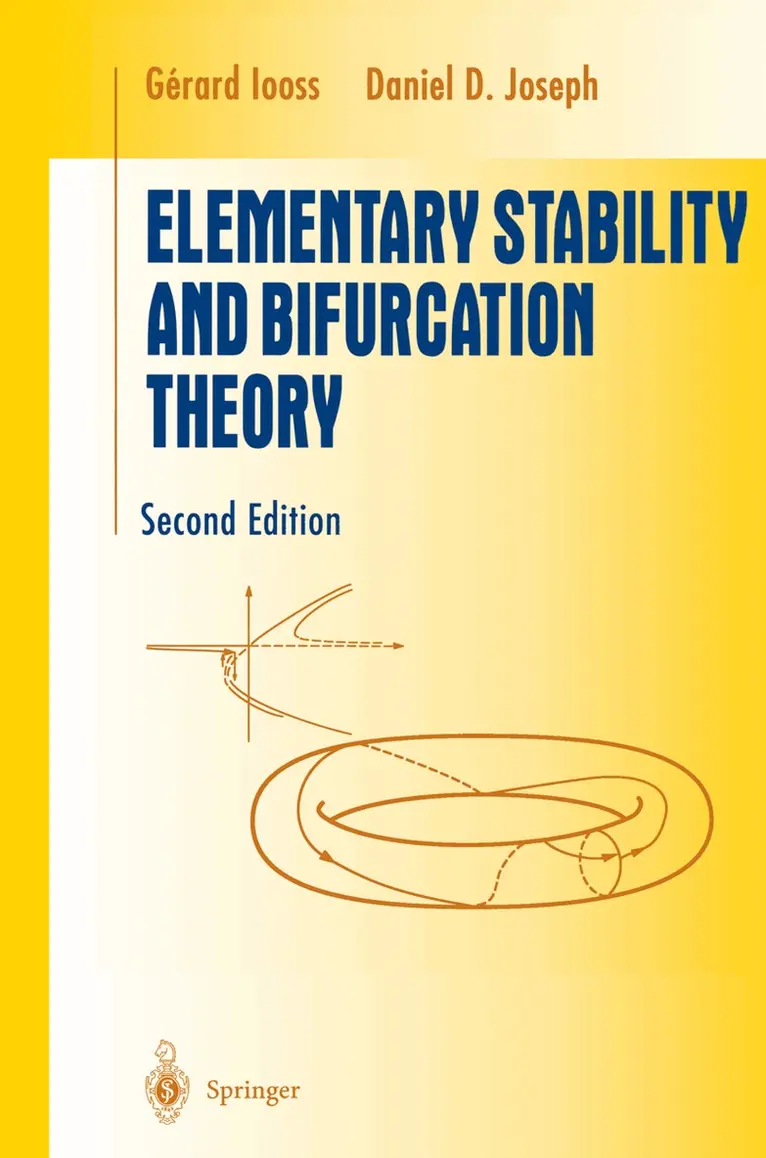
In its most general form bifurcation theory is a theory of asymptotic solutions of nonlinear equations. By asymptotic solutions we mean, for example, steady solutions, time-periodic solutions, and quasi-periodic solutions. The purpose of this book is to teach the theory of bifurcation of asymptotic solutions of evolution problems governed by nonlinear differential equations. We have written this book for the broadest audience of potentially interested learners: engineers, biologists, chemists, physicists, mathematicians, economists, and others whose work involves understanding asymptotic solutions of nonlinear differential equations. To accomplish our aims, we have thought it necessary to make the analysis: (1) general enough to apply to the huge variety of applications which arise in science and technology; and (2) simple enough so that it can be understood by persons whose mathe matical training does not extend beyond the classical methods of analysis which were popular in the nineteenth century. Of course, it is not possible to achieve generality and simplicity in a perfect union but, in fact, the general theory is simpler than the detailed theory required for particular applications. The general theory abstracts from the detailed problems only the essential features and provides the student with the skeleton on which detailed structures of the applications must rest. lt is generally believed that the mathematical theory of bifurcation requires some functional analysis and some ofthe methods of topology and dynamics.
1 069 kr
Skickas inom 10-15 vardagar
This text develops a mathematical and physical theory which takes a proper account of the elasticity of liquids. This leads to systems of partial differential equations of composite type in which some variables are hyperbolic and others elliptic. It turns out that the vorticity is usually the key hyperbolic variable. The relevance of this type of mathematical structure for observed dynamics of viscoelastic motions is evaluated in detail. Much attention was paid to observations - most of which are not older than five years - following the attitude that experiments are the ultimate court of truth for physical theories. Readers will find their understanding of all problems involved highly enriched.
644 kr
Skickas inom 10-15 vardagar
In its most general form bifurcation theory is a theory of asymptotic solutions of nonlinear equations. By asymptotic solutions we mean, for example, steady solutions, time-periodic solutions, and quasi-periodic solutions. The purpose of this book is to teach the theory of bifurcation of asymptotic solutions of evolution problems governed by nonlinear differential equations. We have written this book for the broadest audience of potentially interested learners: engineers, biologists, chemists, physicists, mathematicians, economists, and others whose work involves understanding asymptotic solutions of nonlinear differential equations. To accomplish our aims, we have thought it necessary to make the analysis: (1) general enough to apply to the huge variety of applications which arise in science and technology; and (2) simple enough so that it can be understood by persons whose mathe matical training does not extend beyond the classical methods of analysis which were popular in the nineteenth century. Of course, it is not possible to achieve generality and simplicity in a perfect union but, in fact, the general theory is simpler than the detailed theory required for particular applications. The general theory abstracts from the detailed problems only the essential features and provides the student with the skeleton on which detailed structures of the applications must rest. lt is generally believed that the mathematical theory of bifurcation requires some functional analysis and some ofthe methods of topology and dynamics.
1 868 kr
Skickas inom 10-15 vardagar
R.S. Rivlin is one of the principal architects of nonlinear continuum mechanics: His work on the mechanics of rubber (in the 1940s and 50s) established the basis of finite elasticity theory. These volumes make most of his scientific papers available again and show the full scope and significance of his contributions.
909 kr
Skickas inom 10-15 vardagar
This book is about two special topics in rheological fluid mechanics: the elasticity of liquids and asymptotic theories of constitutive models. The major emphasis of the book is on the mathematical and physical consequences of the elasticity of liquids; seventeen of twenty chapters are devoted to this. Constitutive models which are instantaneously elastic can lead to some hyperbolicity in the dynamics of flow, waves of vorticity into rest (known as shear waves), to shock waves of vorticity or velocity, to steady flows of transonic type or to short wave instabilities which lead to ill-posed problems. Other kinds of models, with small Newtonian viscosities, give rise to perturbed instantaneous elasticity, associated with smoothing of discontinuities as in gas dynamics. There is no doubt that liquids will respond like elastic solids to impulses which are very rapid compared to the time it takes for the molecular order associated with short range forces in the liquid, to relax. After this,all liquids look viscous with signals propagating by diffusion rather than by waves. For small molecules this time of relaxation is estimated as lQ-13 to 10-10 seconds depending on the fluids. Waves associated with such liquids move with speeds of 1 QS cm/s, or even faster. For engineering applications the instantaneous elasticity of these fluids is of little interest; the practical dynamics is governed by diffusion, ·say, by the Navier-Stokes equations. On the other hand, there are other liquids which are known to have much longer times of relaxation.
Del 26 - IMA Volumes in Mathematics and its Applications
Two Phase Flows and Waves
Häftad, Engelska, 2011
1 069 kr
Skickas inom 10-15 vardagar
This IMA Volume in Mathematics and its Applications TWO PHASE FLOWS AND WAVES is based on the proceedings of a workshop which was an integral part of the 1988-89 IMA program on NONLINEAR WAVES. The workshop focussed on the development of waves in flowing composites. We thank the Coordinating Commit tee: James Glimm, Daniel Joseph, Barbara Keyfitz, Andrew Majda, Alan Newell, Peter Olver, David Sattinger and David Schaeffer for planning and implementing the stimulating year-long program. We especially thank the Workshop Organizers, Daniel D. Joseph and David G. Schaeffer for their efforts in bringing together many of the major figures in those research fields in which modelling of granular flows and suspensions is used. Avner Friedman Willard Miller, Jr. PREFACE This Workshop, held from January 3-10,1989 at IMA, focused on the properties of materials which consist of many small solid particles or grains. Let us distinguish the terms granular material and suspension. In the former, the material consists exclusively of solid particles interacting through direct contact with one another, either sustained frictional contacts in the case of slow shearing or collisions in the case of rapid shearing. In suspensions, also called two phase flow, the grains interact with one another primarily through the influence of a viscous fluid which occupies the interstitial space and participates in the flow. (As shown by the lecture of I. Vardoulakis (not included in this volume), the distinction between these two idealized cases is not always clear.
Del 3 - Interdisciplinary Applied Mathematics
Fundamentals of Two-Fluid Dynamics
Part I: Mathematical Theory and Applications
Häftad, Engelska, 2013
538 kr
Skickas inom 10-15 vardagar
Two-fluid dynamics is a challenging subject rich in physics and prac tical applications. Many of the most interesting problems are tied to the loss of stability which is realized in preferential positioning and shaping of the interface, so that interfacial stability is a major player in this drama. Typically, solutions of equations governing the dynamics of two fluids are not uniquely determined by the boundary data and different configurations of flow are compatible with the same data. This is one reason why stability studies are important; we need to know which of the possible solutions are stable to predict what might be observed. When we started our studies in the early 1980's, it was not at all evident that stability theory could actu ally work in the hostile environment of pervasive nonuniqueness. We were pleasantly surprised, even astounded, by the extent to which it does work. There are many simple solutions, called basic flows, which are never stable, but we may always compute growth rates and determine the wavelength and frequency of the unstable mode which grows the fastest. This proce dure appears to work well even in deeply nonlinear regimes where linear theory is not strictly valid, just as Lord Rayleigh showed long ago in his calculation of the size of drops resulting from capillary-induced pinch-off of an inviscid jet.
Del 4 - Interdisciplinary Applied Mathematics
Fundamentals of Two-Fluid Dynamics
Part II: Lubricated Transport, Drops and Miscible Liquids
Häftad, Engelska, 2013
538 kr
Skickas inom 10-15 vardagar
Two-fluid dynamics is a challenging subject rich in physics and prac tical applications. Many of the most interesting problems are tied to the loss of stability which is realized in preferential positioning and shaping of the interface, so that interfacial stability is a major player in this drama. Typically, solutions of equations governing the dynamics of two fluids are not uniquely determined by the boundary data and different configurations of flow are compatible with the same data. This is one reason why stability studies are important; we need to know which of the possible solutions are stable to predict what might be observed. When we started our studies in the early 1980's, it was not at all evident that stability theory could actu ally work in the hostile environment of pervasive nonuniqueness. We were pleasantly surprised, even astounded, by the extent to which it does work. There are many simple solutions, called basic flows, which are never stable, but we may always compute growth rates and determine the wavelength and frequency of the unstable mode which grows the fastest. This proce dure appears to work well even in deeply nonlinear regimes where linear theory is not strictly valid, just as Lord Rayleigh showed long ago in his calculation of the size of drops resulting from capillary-induced pinch-off of an inviscid jet.
Del 98 - IMA Volumes in Mathematics and its Applications
Particulate Flows
Processing and Rheology
Häftad, Engelska, 2012
538 kr
Skickas inom 10-15 vardagar
This IMA Volume in Mathematics and its Applications PARTICULATE FLOWS: PROCESSING AND RHEOLOGY is based on the proceedings of a very successful one-week workshop with the same title, which was an integral part of the 1995-1996 IMA program on "Mathematical Methods in Materials Science." We would like to thank Donald A. Drew, Daniel D. Joseph, and Stephen L. Passman for their excellent work as organizers of the meeting. We also take this opportunity to thank the National Science Foun dation (NSF), the Army Research Office (ARO) and the Office of Naval Research (ONR), whose financial support made the workshop possible. A vner Friedman Robert Gulliver v PREFACE The workshop on Particulate Flows: Processing and Rheology was held January 8-12, 1996 at the Institute for Mathematics and its Applications on the University of Minnesota Twin Cities campus as part of the 1995- 96 Program on Mathematical Methods in Materials Science. There were about forty participants, and some lively discussions, in spite of the fact that bad weather on the east coast kept some participants from attending, and caused scheduling changes throughout the workshop. Heterogeneous materials can behave strangely, even in simple flow sit uations. For example, a mixture of solid particles in a liquid can exhibit behavior that seems solid-like or fluid-like, and attempting to measure the "viscosity" of such a mixture leads to contradictions and "unrepeatable" experiments. Even so, such materials are commonly used in manufacturing and processing.
Breadth and Depth of Continuum Mechanics
A Collection of Papers Dedicated to J.L. Ericksen on His Sixtieth Birthday
Häftad, Engelska, 1986
1 584 kr
Skickas inom 10-15 vardagar
This volume collects papers dedicated to Jerry Ericksen on his sixtieth birthday, December 20, 1984. They first appeared in Volumes 82-90 (1983-1985) of the Archive for Rational Mechanics and Analysis. At the request of the Editors the list of authors to be invited was drawn up by C. M. Dafermos, D. D. Joseph, and F. M. Leslie. The breadth and depth of the works here reprinted reflect the corresponding qualities in Jerry Ericksen's research, teaching, scholarship, and inspiration. His interests and expertness center upon the mechanics of materials and extend to everything that may contribute to it: pure analysis, algebra, geometry, through all aspects of theoretical mechanics to fundamental experiment, all of these illumi nated by an intimate and deep familiarity with the sources, even very old ones. He is independent of school and contemptuous of party spirit; his generosity in giving away his ideas is renowned, but not everyone is capable of accepting what is offered. His writings are totally free of broad claims and attributions beyond his own study. Some are decisive, some are prophetic, and all are forthright. His work has served as a beacon of insight and simple honesty in an age of ever more trivial and corrupt science. The authors of the memoirs in this volume are his students, colleagues, admirers, and (above all) his friends.