Daniel Kandray - Böcker
Visar alla böcker från författaren Daniel Kandray. Handla med fri frakt och snabb leverans.
2 produkter
2 produkter
1 286 kr
Skickas inom 3-6 vardagar
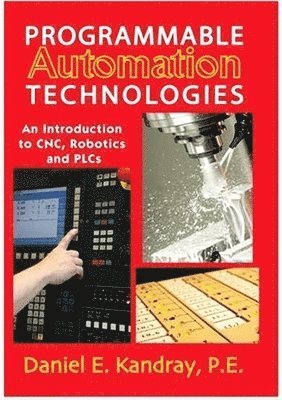
Divided into four parts, Programmable Automation focuses on programmable automation technologies used in industry. Comprehensive yet concise, this unique textbook provides a solid foundation of analytical techniques to justify automation and the knowledge and instruction of how to program computer numerical controlled (CNC) equipment, industrial robots and programmable logic controllers (PLC). Through a very practical approach, readers will learn specific programming languages related to each technology including G code and ladder logic. And it is sure to be found useful by electrical, industrial, mechanical and/or manufacturing engineering technology undergraduate students, in addition to anyone in industry interested in learning about programmable automation and developing the corresponding programming skills. Each chapter begins with an overview of chapter material with emphasis on desired outcomes and concludes with a summary, questions, and problems where appropriate.Presents explicit skills and methodologies to aid in the programming process.Features a good use of examples with numerous illustrations.Uses computer simulation and actual lab equipment extensively in learning activities.Introduction to Programmable Automation Introduction to Programmable Automation The Manufacturing Process Automation Manufacturing Performance Measures Benefits of Automation Automation StrategiesAutomation Justification and Productivity Concepts Automation Justification and Productivity Productivity Calculations Process Outputs and Mathematical Concepts for Quantifying Production Process Inputs and Manufacturing Costs Comparing Alternatives with Productivity Calculations The Impact of Production Volume on Alternatives Productivity and the USA PrincipleIntroduction to Computer Numerical Introduction to CNC Technology CNC System Components Coordinate Systems and Reference Points The Ten Steps of CNC Programming Advantages and Disadvantages of CNC Technology When to Use CNC TechnologyCNC Programming Overview of CNC Programming Program Code Cutting Parameters Program Organization Programming Process Turning ProgramsCNC Simulation Software Overview of CNC Simulation Software Installation and Setup of CNCSimulator® User Interface Simulation ExamplesIntroduction to Robotic Technology Industrial Robotics Robot Hardware Robot Applications Robot Safety Robot Selection ConsiderationsRobot Programming Robot Programming Concepts Programming Methods Robot Programming Languagues Robot Program Development, Organization and Structure Writing Robot Program of Instructions Robot Simulation Robot Program Simulation ExampleIntroduction to Programmable Logic Controllers (PLCs) Progammable Logic Control Overview Industrial Process Control PLC Terminology PLC Hardware Components PLC Applications Sensors and Actuators Implementing Automation with PCLsPLC Programming Logic Control, Sequencing, and Ladder Logic Diagrams Ladder Logic Terminology Typical PLC Instruction Set PLC Programming Process PLC Program Simulation PLC Programming ExampleAutomated Work Cells Automated Workstations and Work Cells Workstation and Work Cell Components Automated Workstation and Work Cell Examples
447 kr
Skickas inom 5-8 vardagar
Written in simple, easy-to-understand language by a skilled programmer with many years of experience teaching CNC machining to industry and in the classroom, this book provides thorough descriptions of many operation and programming functions and illustrates their practical applications through examples. It includes in-depth information on how to program turning and milling machines that is applicable to almost all control systems and presents detailed coverage of subjects not addressed by the majority of existing texts. Hundreds of drawings, screen shots, and photos are used to improve clarity. It keeps all theoretical explanations to a minimum so as to not detract from a full understanding of practical programming skills and strategies. With its wide range of data about the selection of tools, cutting speeds, and the technology of machining, this book would be a handy on-the-job reference for engineers, programmers, supervisors, and machine operators, besides serving as a proven and effective textbook for anyone learning CNC programming for the first time.It contains expanded sections on CAD/CAM and Conversational Programming that offer insight into the modern methods of CNC programming. It includes a modern CNC controller representation in the Operation Section. It thoroughly describes mathematical formula usage necessary for creating programs manually. It provides many practical examples and study questions throughout, allowing users to demonstrate their proficiency. It offers a glossary of terminology and useful technical data and charts needed for effective programming. It illustrates how to create each programming example through clear step-by-step presentations.