David Braybrooke – författare
Visar alla böcker från författaren David Braybrooke. Handla med fri frakt och snabb leverans.
16 produkter
16 produkter
Häftad, Engelska, 1970
195 kr
Skickas inom 5-8 vardagar
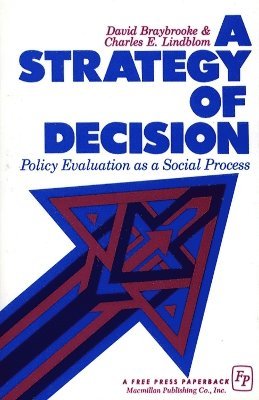
Examining policy evaluation as a social process, David Braybrooke and Charles E. Lindblom analyze differences in decision-making and problem-solving, providing readers what “a new definition of what it means to be rational” (American Political Science Review).A Strategy of Decision explores and explains some striking discrepancies between theories of decision-making and the observed practices of people who successfully cope with the complex problem-solving required in matters of public policy.
Inbunden, Engelska, 1995
673 kr
Skickas inom 5-8 vardagar
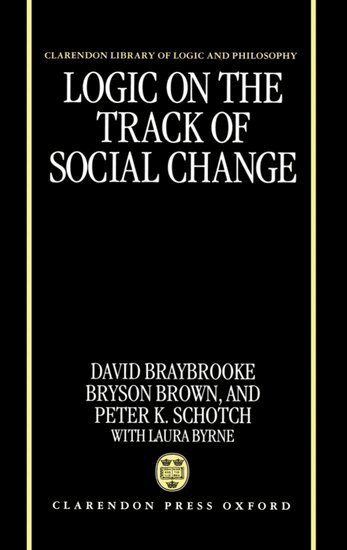
The book sets out a new logic of rules, developed to demonstrate how such a logic can contribute to the clarification of historical questions about social rules. The authors illustrate applications of this new logic in their extensive treatments of a variety of accounts of social changes, analysing in these examples the content of particular social rules and the course of changes in them.
Inbunden, Engelska, 2019
2 438 kr
Skickas inom 10-15 vardagar
This collection is a pioneering effort to bring together in fruitful interaction the two dominant perspectives on social rules. One, shared by philosophers, lawyers, anthropologists, and sociologists, directly invites formalization by a logic of rules. The other, originating with economists, emphasizes cost considerations and invites mathematical t
E-bok
PDF, Engelska, 2018795 kr
Läs direkt efter köp
This collection is a pioneering effort to bring together in fruitful interaction the two dominant perspectives on social rules. One, shared by philosophers, lawyers, anthropologists, and sociologists, directly invites formalization by a logic of rules. The other, originating with economists, emphasizes cost considerations and invites mathematical treatment, often in game-theoretical models for problems of coordination?models that some philosophers have taken up as well.Each perspective is represented by new and recent work that moves this important topic toward increased conceptual precision and deeper insight. As a whole, the collection strikes a balance between historical illustrations and theoretical argument, offering in both a rich body of suggestions for further work.
E-bok
Engelska, 2018795 kr
Läs direkt efter köp
This collection is a pioneering effort to bring together in fruitful interaction the two dominant perspectives on social rules. One, shared by philosophers, lawyers, anthropologists, and sociologists, directly invites formalization by a logic of rules. The other, originating with economists, emphasizes cost considerations and invites mathematical treatment, often in game-theoretical models for problems of coordination?models that some philosophers have taken up as well.Each perspective is represented by new and recent work that moves this important topic toward increased conceptual precision and deeper insight. As a whole, the collection strikes a balance between historical illustrations and theoretical argument, offering in both a rich body of suggestions for further work.
Häftad, Engelska, 2014
1 075 kr
Skickas inom 3-6 vardagar
The concept of needs works to sort out social policies. Yet the idea is in disrepute with many thinkers who, led by economists, accuse it of being too fluid, or too narrow, or of serving no purpose that the concept of preferences does not serve better. David Braybrooke refutes these charges by providing a model of how the concept of needs works when it is working well. Originally published in 1987. The Princeton Legacy Library uses the latest print-on-demand technology to again make available previously out-of-print books from the distinguished backlist of Princeton University Press. These editions preserve the original texts of these important books while presenting them in durable paperback and hardcover editions. The goal of the Princeton Legacy Library is to vastly increase access to the rich scholarly heritage found in the thousands of books published by Princeton University Press since its founding in 1905.
Inbunden, Engelska, 2016
2 567 kr
Skickas inom 3-6 vardagar
The concept of needs works to sort out social policies. Yet the idea is in disrepute with many thinkers who, led by economists, accuse it of being too fluid, or too narrow, or of serving no purpose that the concept of preferences does not serve better. David Braybrooke refutes these charges by providing a model of how the concept of needs works when it is working well. Originally published in 1987. The Princeton Legacy Library uses the latest print-on-demand technology to again make available previously out-of-print books from the distinguished backlist of Princeton University Press. These editions preserve the original texts of these important books while presenting them in durable paperback and hardcover editions. The goal of the Princeton Legacy Library is to vastly increase access to the rich scholarly heritage found in the thousands of books published by Princeton University Press since its founding in 1905.
Häftad, Engelska, 1998
405 kr
Skickas inom 5-8 vardagar
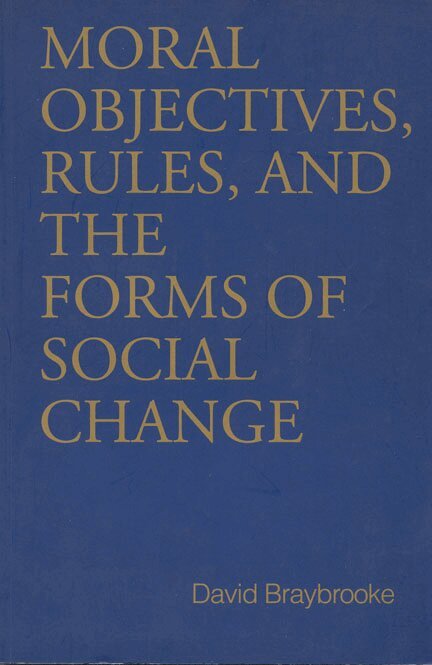
Assorted fruit from forty years' writing, these essays by David Braybrooke discuss (in Part One of the book) a variety of concrete, practical topics that ethical concerns bring into politics: people's interests; their needs as well as their preferences; their work and their commitment to work; their participation in politics and in other group activities. Essays follow on the justice with which theme matters are arranged for and on the common good in which they are consolidated. Justice here inspires a 'departures' approach, which moves from agreement on departures from commutative justice to agreement on measures of distributive justice needed to forestall such departures. Another essay (first published here) radically undermines the odd but entrenched belief that utilitarianism classically licenced, even prescribed, systematically sacrificing the happiness of some people to give others greater pleasure. Part II and Part III of the book concentrate upon the subject of settled social rules, which are devices for securing the objectives treated in Part I. Part II shows that rules are ubiquitous in ethics, since there are no virtues without rules, just as there are no (justified) rules; without virtues. Part Two also shows that rules are as ubiquitous in social phenomena as the causal regularities sought by one school of social science. Part III captures the dialectic of history at least in part by a logical analysis of changes in rules following the onset of quandaries. It then considers how political choices can be both prudent, by keeping within duly considered incremental limits, and yet imaginative enough to escape the recent embarrassments generated by social choice theory.Characteristically versatile in topic and style, Braybrooke offers original light on all theme subjects. One reader has commented, '[His] prose is elegant and always a pleasure to read. Some of the pieces are nothing short of brilliant.' Which did the reader have in mind? Readers may differ (they already have) on just which pieces they would rank highest.
Inbunden, Engelska, 2004
769 kr
Skickas inom 11-20 vardagar
Utilitarianism, belaboured by repeated counterexamples, has fallen out of favour as an ethical theory. In Utilitarianism: Restorations; Repairs; Renovations, noted Canadian philosopher David Braybrooke revisits Jeremy Bentham's master idea that statistical evidence should determine social policies, and – perhaps surprisingly, given Braybooke's recent championship of natural law – dispels the discredit that standard versions of utilitarianism have invited.On the issue between rule-utilitarianism (which gives due weight to rules) and act-utilitarianism (which does not), Braybrooke argues that act-utilitarianism cannot be carried out even in principle except under the auspices of rules. He shows that the problem with not knowing all consequences ahead of time vanishes if decisions are subject to continual rounds of revision. Invoking the elementary statistical principle that groups should not be changed in membership just to get more favourable results, he disposes of the accusation that utilitarianism prescribes gratuitous life-sacrifices.Substituting comparative censuses for the hedonistic calculus that figures in standard utilitarianism, Braybrooke excludes gratuitous sacrifices also of happiness short of life-sacrifices. The census notion is proof against the self-contradictory advice that the calculus sometimes supplies. Moreover, it readily accommodates evidence about happiness and needs, both better pursued by dropping the notion of utility. Recast in these ways, utilitarianism takes on a very different guise from the standard versions; it is notwithstanding a guise congenial to Bentham's master idea, and its affinity with the utilitarian tradition and ordinary language shows up in the full intelligibility that it gives to the slogan, "the greatest happiness of the greatest number."
Häftad, Engelska, 1998
728 kr
Skickas inom 10-15 vardagar
This collection is a pioneering effort to bring together in fruitful interaction the two dominant perspectives on social rules. One, shared by philosophers, lawyers, anthropologists, and sociologists, directly invites formalization by a logic of rules. The other, originating with economists, emphasizes cost considerations and invites mathematical treatment, often in game-theoretical models for problems of coordination?models that some philosophers have taken up as well.Each perspective is represented by new and recent work that moves this important topic toward increased conceptual precision and deeper insight. As a whole, the collection strikes a balance between historical illustrations and theoretical argument, offering in both a rich body of suggestions for further work.
Häftad, Engelska, 1989
867 kr
Skickas inom 10-15 vardagar
With the help of this book, readers can gain practice asking moral questions about actions in business and finding answers to those questions. Asked frequently enough, readers will no longer take for granted the answers to questions like “Is this deception?” or “Is it oppression?”.
E-bok
PDF, Engelska, 2014803 kr
Läs direkt efter köp
The concept of needs works to sort out social policies. Yet the idea is in disrepute with many thinkers who, led by economists, accuse it of being too fluid, or too narrow, or of serving no purpose that the concept of preferences does not serve better. David Braybrooke refutes these charges by providing a model of how the concept of needs works when it is working well.Originally published in 1987.The Princeton Legacy Library uses the latest print-on-demand technology to again make available previously out-of-print books from the distinguished backlist of Princeton University Press. These editions preserve the original texts of these important books while presenting them in durable paperback and hardcover editions. The goal of the Princeton Legacy Library is to vastly increase access to the rich scholarly heritage found in the thousands of books published by Princeton University Press since its founding in 1905.
E-bok
PDF, Engelska, 20061 140 kr
Läs direkt efter köp
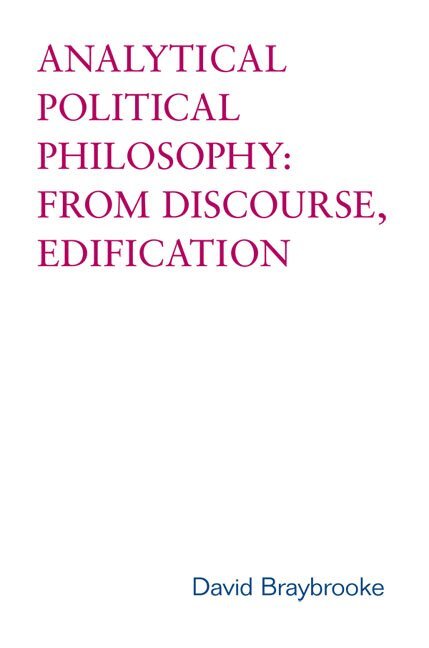
The analytic movement has long been the dominant philosophical tradition in English-speaking countries. In Analytical Political Philosophy: From Discourse, Edification, distinguished Canadian philosopher David Braybrooke explores this movement by bringing together some of his earlier free-standing studies of the concepts of needs, rights, and rules. He combines the results with an analytical account of how to deal with consequences and thus, arrives at a program for public policy, comparable in generality at least and in trenchancy to the programs offered by Rawls, Nozick, and Gauthier.Braybrooke illustrates how his program can deal robustly with the worst evils of recent politics, which on point after point defy and reverse what the program calls for. An essay that relates the program to utilitarianism and natural law theory brings to an end, not only the present book, but the series of books, all published by University of Toronto Press, beginning with Moral Objectives, Rules, and the Forms of Social Change (1998), and continuing with Natural Law Modernized (2001) and Utilitarianism: Restorations; Repairs; Renovations (2004). The four books, which embrace all the main themes of Braybrooke's life-work, form a mutually reinforcing whole that invites being called the author's Summa Philosophica.
E-bok
PDF, Engelska, 1998602 kr
Läs direkt efter köp
Assorted fruit from forty years' writing, these essays by David Braybrooke discuss (in Part One of the book) a variety of concrete, practical topics that ethical concerns bring into politics: people's interests; their needs as well as their preferences; their work and their commitment to work; their participation in politics and in other group activities. Essays follow on the justice with which theme matters are arranged for and on the common good in which they are consolidated. Justice here inspires a 'departures' approach, which moves from agreement on departures from commutative justice to agreement on measures of distributive justice needed to forestall such departures. Another essay (first published here) radically undermines the odd but entrenched belief that utilitarianism classically licenced, even prescribed, systematically sacrificing the happiness of some people to give others greater pleasure. Part II and Part III of the book concentrate upon the subject of settled social rules, which are devices for securing the objectives treated in Part I. Part II shows that rules are ubiquitous in ethics, since there are no virtues without rules, just as there are no (justified) rules; without virtues. Part Two also shows that rules are as ubiquitous in social phenomena as the causal regularities sought by one school of social science. Part III captures the dialectic of history at least in part by a logical analysis of changes in rules following the onset of quandaries. It then considers how political choices can be both prudent, by keeping within duly considered incremental limits, and yet imaginative enough to escape the recent embarrassments generated by social choice theory.Characteristically versatile in topic and style, Braybrooke offers original light on all theme subjects. One reader has commented, '[His] prose is elegant and always a pleasure to read. Some of the pieces are nothing short of brilliant.' Which did the reader have in mind? Readers may differ (they already have) on just which pieces they would rank highest.
E-bok
PDF, Engelska, 20011 222 kr
Läs direkt efter köp
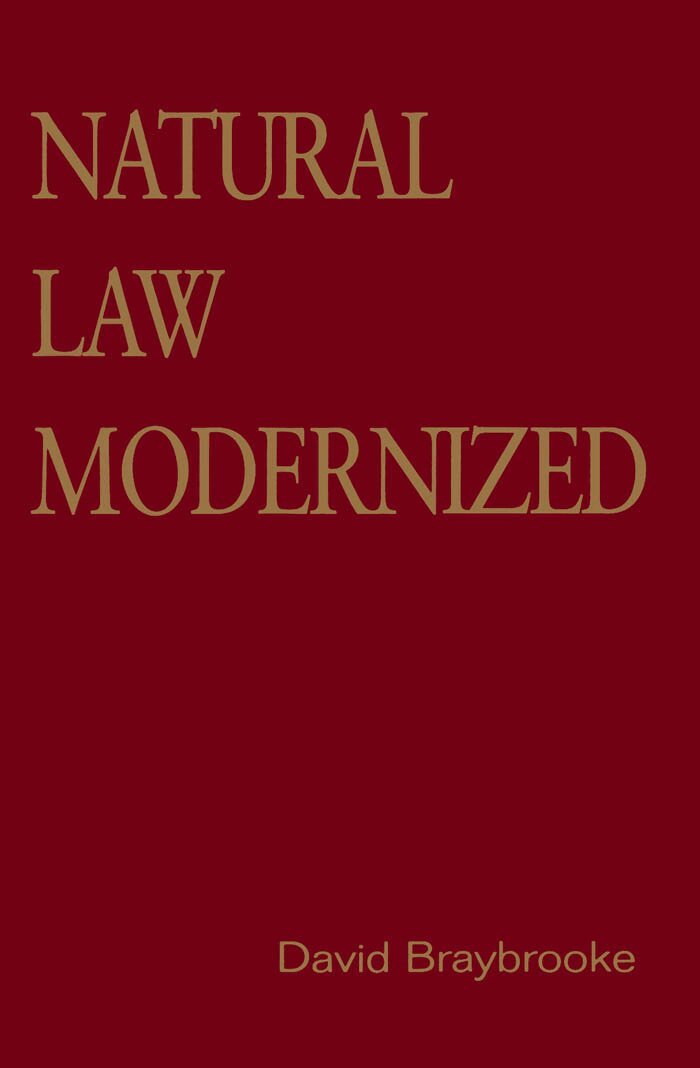
Hobbes, Locke, Hume, and Rousseau are classic modern philosophers, widely consulted in matters of ethics and political theory. In this provocative study David Braybrooke challenges received scholarly opinion by arguing that these canonical theorists took St Thomas Aquinas as their point of reference, reinforcing rather than departing from his natural law theory.The natural law theory of St Thomas Aquinas is essentially a secular theory, says Braybrooke. He argues that Hobbes, Locke, Hume, and Rousseau share a core of thought that not only has roots in St Thomas but offers an alternative to other ethical theories now current. According to Braybrooke, this surviving and reinforced core qualifies as an ethical theory viable by the most sophisticated standards, meeting the main challenges of analytical metaethics, and thus standing up to the scrutiny that any ethical theory must undergo in contemporary philosophical discussions. Braybrooke's study takes the reader into a rich and compelling intellectual universe, one in which medieval natural law theory, widely ignored as obsolete, survives robustly through the modern canon and into the third millennium.
E-bok
PDF, Engelska, 2004977 kr
Läs direkt efter köp
Utilitarianism, belaboured by repeated counterexamples, has fallen out of favour as an ethical theory. In Utilitarianism: Restorations; Repairs; Renovations, noted Canadian philosopher David Braybrooke revisits Jeremy Bentham's master idea that statistical evidence should determine social policies, and – perhaps surprisingly, given Braybooke's recent championship of natural law – dispels the discredit that standard versions of utilitarianism have invited.On the issue between rule-utilitarianism (which gives due weight to rules) and act-utilitarianism (which does not), Braybrooke argues that act-utilitarianism cannot be carried out even in principle except under the auspices of rules. He shows that the problem with not knowing all consequences ahead of time vanishes if decisions are subject to continual rounds of revision. Invoking the elementary statistical principle that groups should not be changed in membership just to get more favourable results, he disposes of the accusation that utilitarianism prescribes gratuitous life-sacrifices.Substituting comparative censuses for the hedonistic calculus that figures in standard utilitarianism, Braybrooke excludes gratuitous sacrifices also of happiness short of life-sacrifices. The census notion is proof against the self-contradictory advice that the calculus sometimes supplies. Moreover, it readily accommodates evidence about happiness and needs, both better pursued by dropping the notion of utility. Recast in these ways, utilitarianism takes on a very different guise from the standard versions; it is notwithstanding a guise congenial to Bentham's master idea, and its affinity with the utilitarian tradition and ordinary language shows up in the full intelligibility that it gives to the slogan, "the greatest happiness of the greatest number."