David Hyder - Böcker
Visar alla böcker från författaren David Hyder. Handla med fri frakt och snabb leverans.
4 produkter
4 produkter
928 kr
Skickas inom 10-15 vardagar
This book is a collection of essays on Husserl's Crisis of European Sciences by leading philosophers of science and scholars of Husserl. Published and ignored under the Nazi dictatorship, Husserl's last work has never received the attention its author's prominence demands. In the Crisis, Husserl considers the gap that has grown between the "life-world" of everyday human experience and the world of mathematical science. He argues that the two have become disconnected because we misunderstand our own scientific past—we confuse mathematical idealities with concrete reality and thereby undermine the validity of our immediate experience. The philosopher's foundational work in the theory of intentionality is relevant to contemporary discussions of qualia, naive science, and the fact-value distinction. The scholars included in this volume consider Husserl's diagnosis of this "crisis" and his proposed solution. Topics addressed include Husserl's late philosophy, the relation between scientific and everyday objects and "worlds," the history of Greek and Galilean science, the philosophy of history, and Husserl's influence on Foucault.

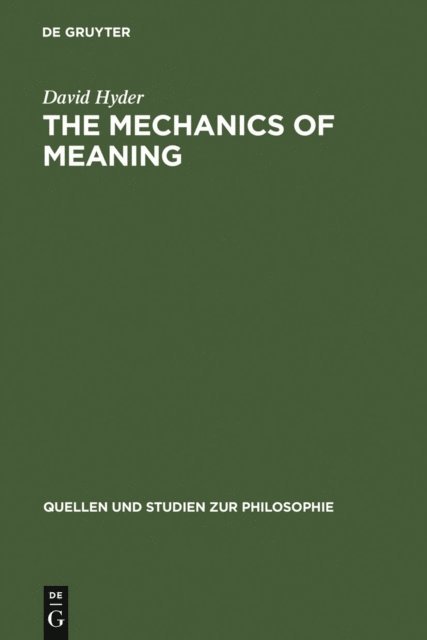
Mechanics of Meaning
Propositional Content and the Logical Space of Wittgenstein's Tractatus
Inbunden, Engelska, 2002
1 521 kr
Skickas inom 7-10 vardagar
This analysis of Wittgenstein's concept of a Spielraum, in which the author approaches the Tractatus Logico-philosophicus both systematically and from the perspective of the history of philosophy and knowledge, opens up a new and important perspective in Wittgenstein research.In establishing unexpected cross-connections between physics, the theory of perception, and logic, Hyder also makes a valuable contribution to the history of 19th century science. In particular, the links he establishes between early sensory physiology and the logicism of Russell and Frege yield a sharper and more plausible account of the notion of a "space" of possible meanings than has hitherto been available in the secondary literature. In showing this notion to be a formal precursor to that of a language game, the study also provides important pointers for the interpretation of Wittgenstein's late work.
1 672 kr
Skickas inom 5-8 vardagar
This book offers a new interpretation of Hermann von Helmholtz’s work on the epistemology of geometry. A detailed analysis of the philosophical arguments of Helmholtz’s Erhaltung der Kraft shows that he took physical theories to be constrained by a regulative ideal. They must render nature “completely comprehensible”, which implies that all physical magnitudes must be relations among empirically given phenomena. This conviction eventually forced Helmholtz to explain how geometry itself could be so construed. Hyder shows how Helmholtz answered this question by drawing on the theory of magnitudes developed in his research on the colour-space. He argues against the dominant interpretation of Helmholtz’s work by suggesting that for the latter, it is less the inductive character of geometry that makes it empirical, and rather the regulative requirement that the system of natural science be empirically closed.
Del 69 - Quellen und Studien zur Philosophie
Determinate World
Kant and Helmholtz on the Physical Meaning of Geometry
Häftad, Engelska, 2016
250 kr
Skickas inom 3-6 vardagar
This book offers a new interpretation of Hermann von Helmholtz’s work on the epistemology of geometry. A detailed analysis of the philosophical arguments of Helmholtz’s Erhaltung der Kraft shows that he took physical theories to be constrained by a regulative ideal. They must render nature “completely comprehensible”, which implies that all physical magnitudes must be relations among empirically given phenomena. This conviction eventually forced Helmholtz to explain how geometry itself could be so construed. Hyder shows how Helmholtz answered this question by drawing on the theory of magnitudes developed in his research on the colour-space. He argues against the dominant interpretation of Helmholtz’s work by suggesting that for the latter, it is less the inductive character of geometry that makes it empirical, and rather the regulative requirement that the system of natural science be empirically closed.