David M. Mark - Böcker
Visar alla böcker från författaren David M. Mark. Handla med fri frakt och snabb leverans.
7 produkter
7 produkter
1 063 kr
Skickas inom 5-8 vardagar
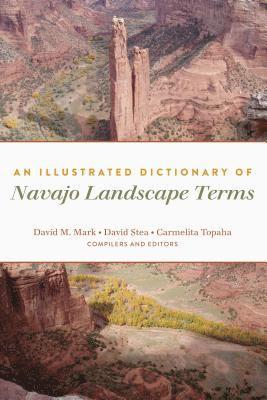
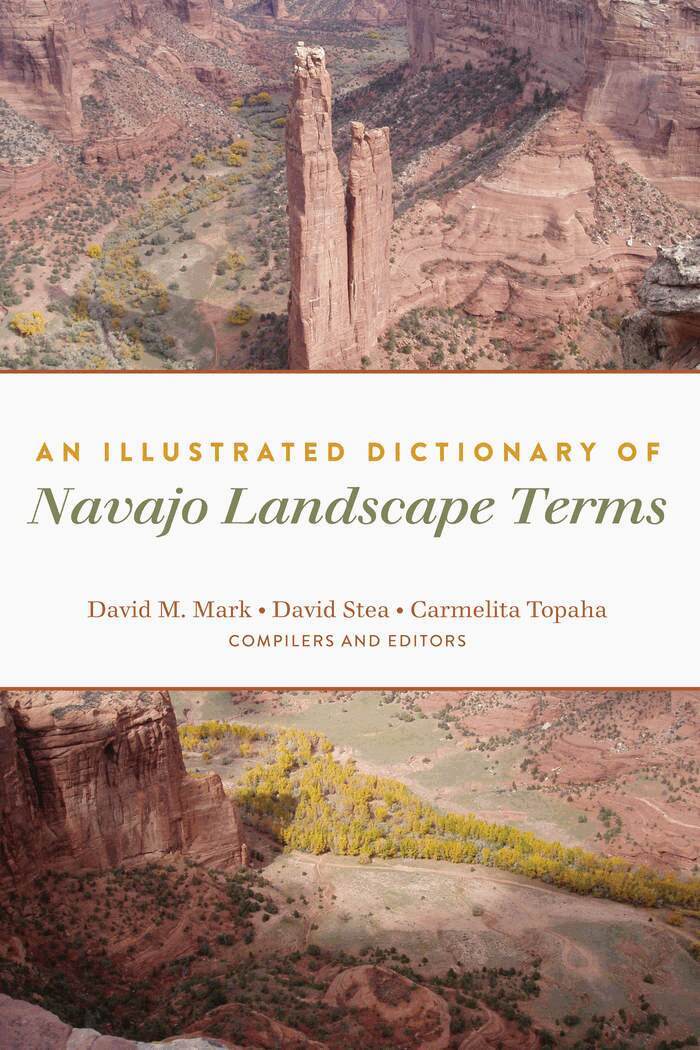
The Navajo language (Diné bizaad) has a vocabulary of landscape terms that allows speakers to communicate about their environment. This book documents that vocabulary and provides photographic illustration of many of the terms. The meanings of these terms seldom match the English-language terms one-to-one. Terms include explicit reference to earth materials such as water or rock/stone. Rather than alphabetically, this book is organized by material and form categories.This dictionary is a valuable resource for language preservation in schools and elsewhere, and for linguists, anthropologists, geographers, and earth scientists interested in indigenous conceptualization of landscape and environment.
453 kr
Skickas inom 5-8 vardagar
The Navajo language (Diné bizaad) has a vocabulary of landscape terms that allows speakers to communicate about their environment. This book documents that vocabulary and provides photographic illustration of many of the terms. The meanings of these terms seldom match the English-language terms one-to-one. Terms include explicit reference to earth materials such as water or rock/stone. Rather than alphabetically, this book is organized by material and form categories.This dictionary is a valuable resource for language preservation in schools and elsewhere, and for linguists, anthropologists, geographers, and earth scientists interested in indigenous conceptualization of landscape and environment.
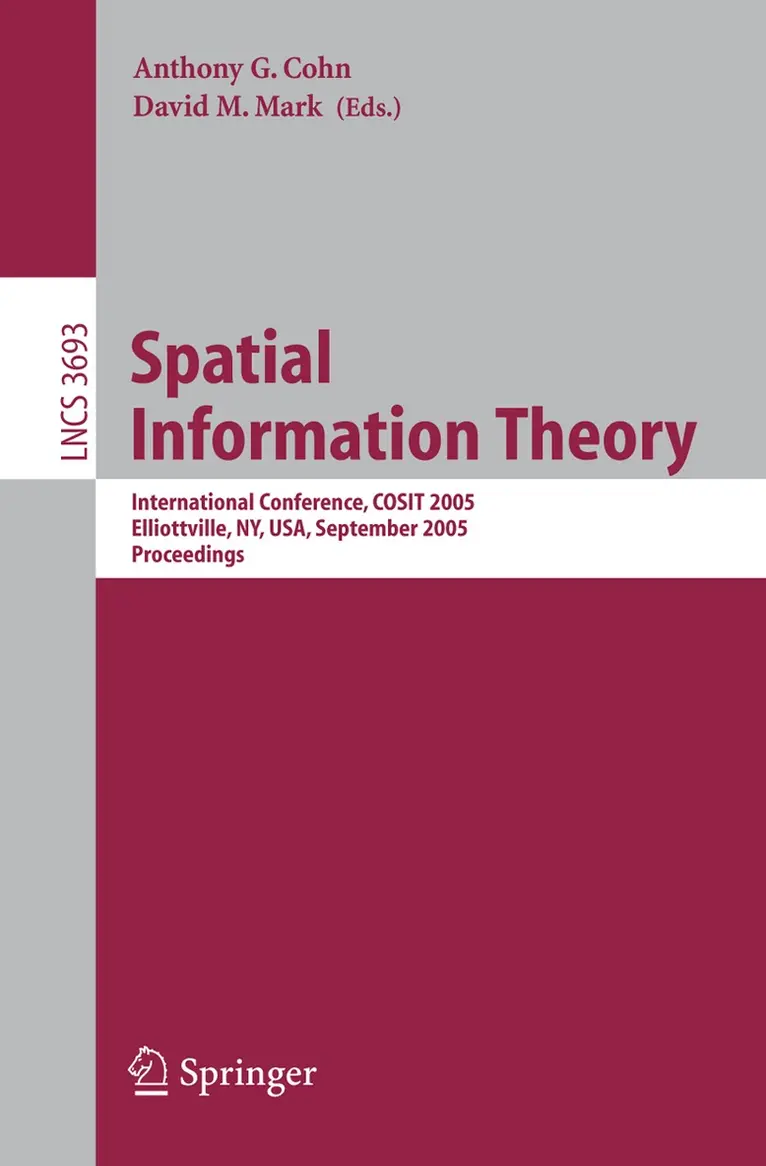
Spatial Information Theory
International Conference, COSIT 2005, Ellicottville, NY, USA, September 14-18, 2005, Proceedings
Häftad, Engelska, 2005
535 kr
Skickas inom 10-15 vardagar
This volume contains the papers presented at the "Conference on Spatial Inf- mationTheory",heldinEllicottville,NewYorkinSeptember 2005.COSIT2005 was the 7th International Conference held under the COSIT name. When - drewFrankandhiscolleaguesorganizedthe?rstCOSITconferenceontheisland of Elba, Italy, in 1993, it represented the maturing of an international research community that had already met four or ?ve times in the United States, Spain, and Italy. Of course, cognitive and computational approaches to space and s- tial phenomena werenot themselves new topics,but a contextof providingth- retical underpinning for geographicinformation systems refocused some of these researchers and brought them up against practical and conceptual challenges. A second international symposium under the COSIT name, held in Semmering, Austria in 1995, established COSIT as a biennial conference series that cont- ued at Laurel Highlands, Pennsylvania, USA (1997), Stade, Germany (1999), Morro Bay, California, USA (2001) and Ittingen, Switzerland (2003).A prod- tive partnership with Springer's Lecture Notes in Computer Science has ensured that the papers from every COSIT meeting have been widely disseminated, and the COSIT community has contributed signi?cantly to the development of G- graphic Information Science, Geoinformatics and Spatial Information Theory in general.
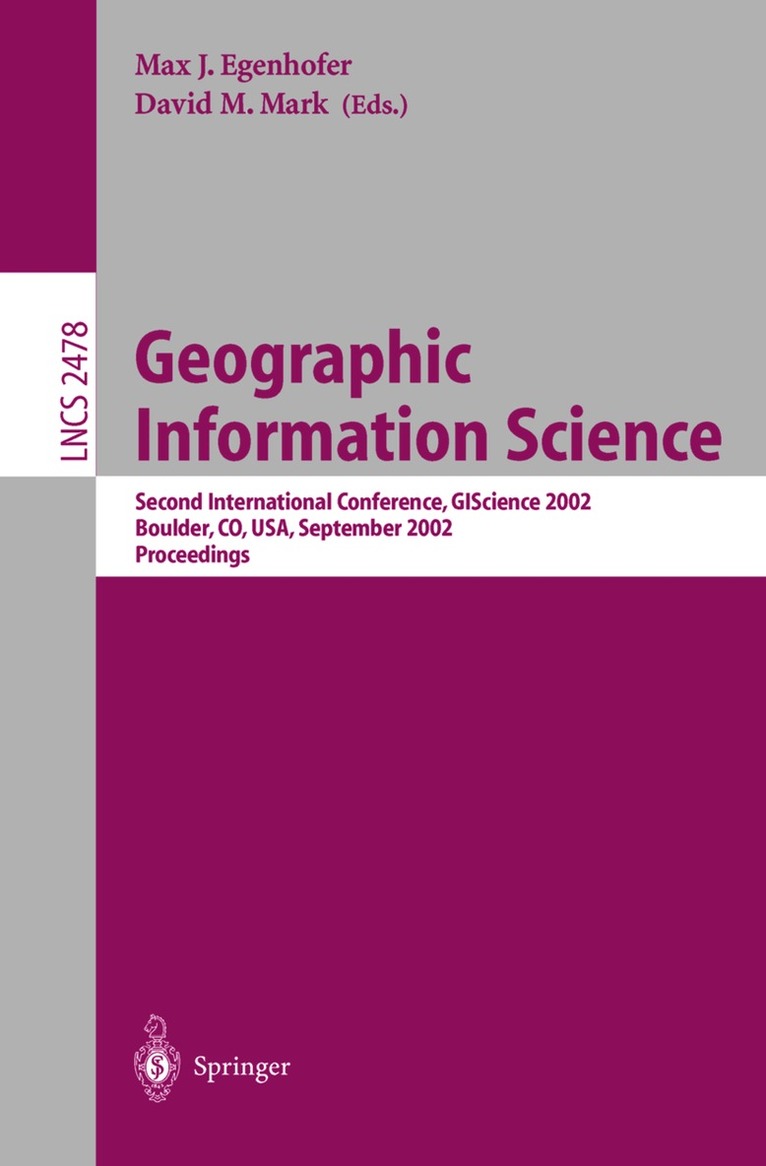
Geographic Information Science
Second International Conference, GIScience 2002, Boulder, CO, USA, September 25-28, 2002. Proceedings
Häftad, Engelska, 2002
535 kr
Skickas inom 10-15 vardagar
The initiation of the GIScience conference series came with the observation that the GIScience ?eld has a widely fragmented conference landscape. Many papers on geographic information science are presented not only at such specialized meetings as the biennial Conferences on Spatial Information Theory (COSIT), the Symposia on Spatial and Temporal databases (SSTD), the International Symposia on Spatial Accuracy, the Symposia on Spatial Data Handling (SDH), or the ACM Workshop on Geographic Information Systems (ACM GIS), but also at the large meetings of the professional organizations that deal with - ographic information systems. The lack of an opportunity to exchange ideas across the disciplinary specializations led to the creation of the GIScience c- ference series as a forum for all GIScience researchers who are interested in the advances in research in the fundamental aspects of geographic information s- ence. The ?rst meeting was held in Savannah, Georgia, USA, in October 2000 (www. giscience. org/GIScience2000) with 120 paper presentations (selected from the submission of extended abstracts) and over 300 attendees.GIScience 2002 in Boulder, Colorado, USA followed this highly successful inaugural meeting. Atrademarkoftheresearch?eldofgeographicinformationscienceisthed- ciplinary mixture of researchers contributing the advancement of our knowledge. One typically ?nds cognitive scientists, computer scientists, engineers, geog- phers,informationscientists,mathematicians,philosophers,psychologists,social scientists,andstatisticians. Ofcourse,thislistisneitherexhaustivenorexclusive. Acriticalaspectforthesuccessofthe?eldisthedialogamongtheseresearchers, becauseadvancesalongthemanyintersectionsofthecontributingdisciplinesare paramount for geographic information science, requiring the concurrent att- tionfromresearchersfrommultipledisciplines. TheGIScienceconferencesaimto serve as the disciplinary melting pot for geographic information science research.
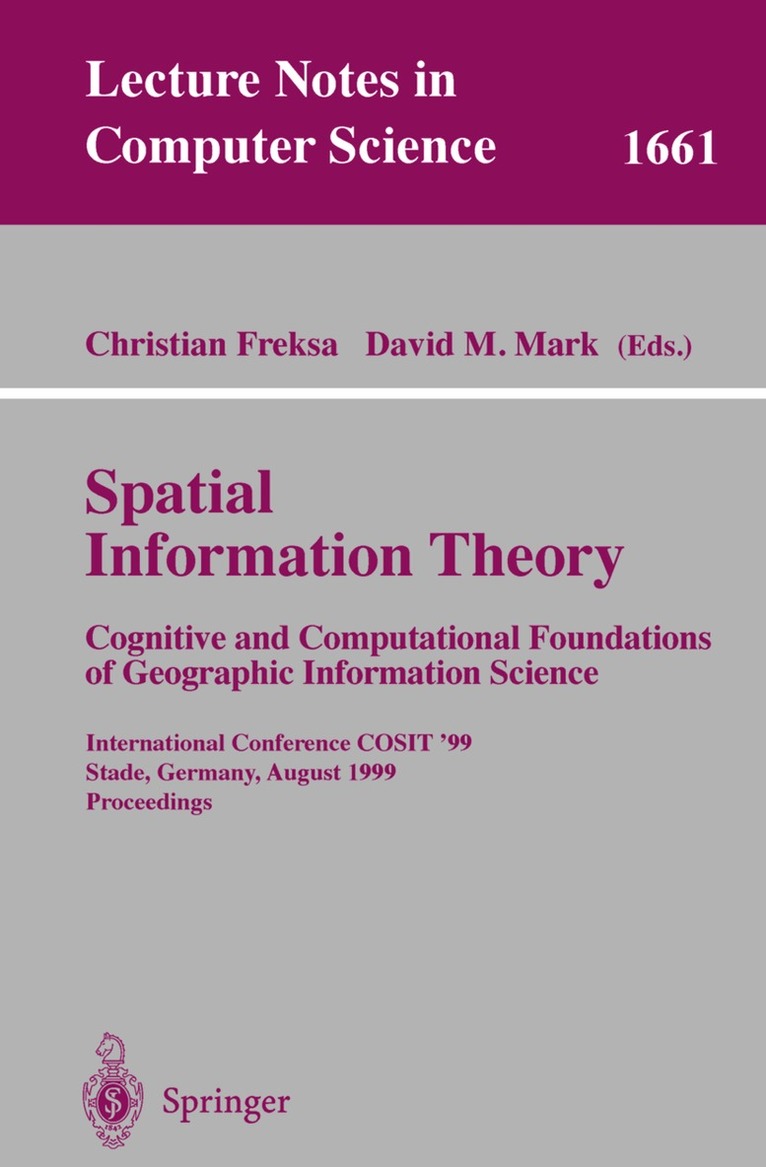
Spatial Information Theory. Cognitive and Computational Foundations of Geographic Information Science
International Conference COSIT'99 Stade, Germany, August 25-29, 1999 Proceedings
Häftad, Engelska, 1999
535 kr
Skickas inom 10-15 vardagar
This book constitutes the refereed proceedings of the International Conference on Spatial Information Theory, COSIT '99, held in Stade, Germany, in August 1999.The 30 revised full papers presented were carefully reviewed and selected from 70 submissions. The book is divided into topical sections on landmarks and navigation, route directions, abstraction and spatial hierarchies, spatial reasoning calculi, ontology of space, visual representation and reasoning, maps and routes, and granularity and qualitative abstraction.
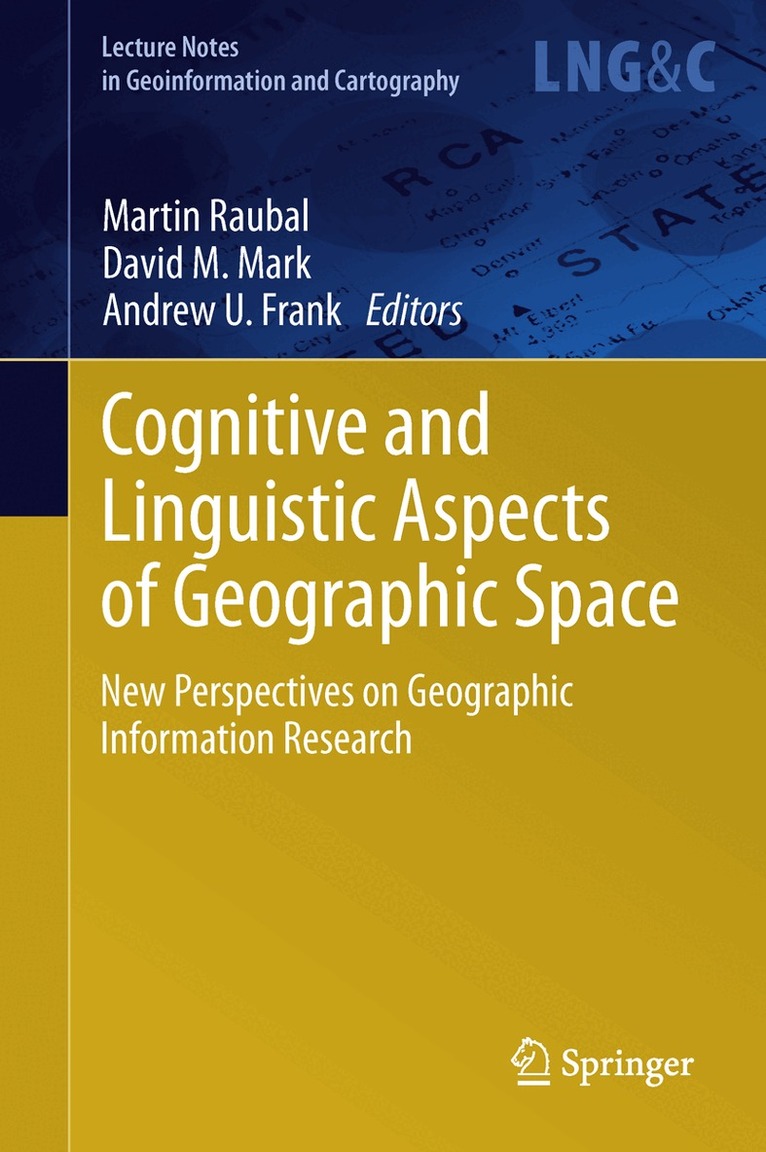
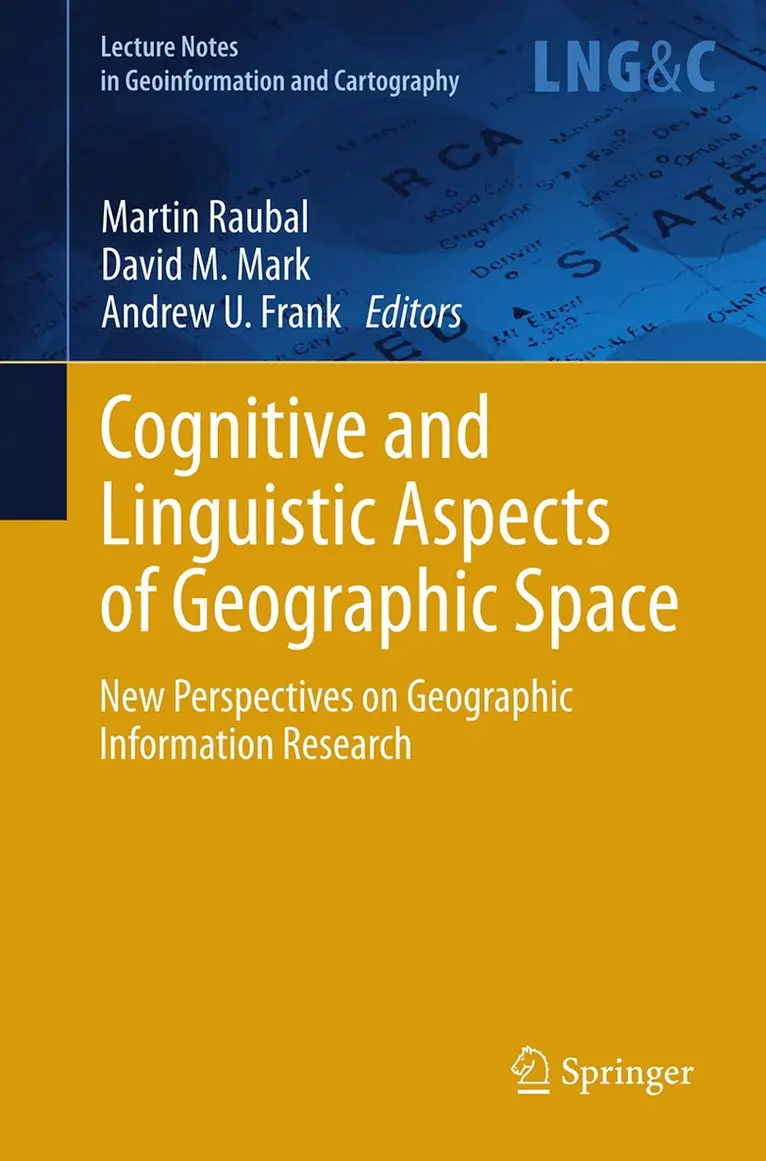
Cognitive and Linguistic Aspects of Geographic Space
New Perspectives on Geographic Information Research
Inbunden, Engelska, 2013
1 064 kr
Skickas inom 10-15 vardagar
20 years ago, from July 8 to 20, 1990, 60 researchers gathered for two weeks at Castillo-Palacio Magalia in Las Navas del Marques (Avila Province, Spain) to discuss cognitive and linguistic aspects of geographic space. This meeting was the start of successful research on cognitive issues in geographic information science, produced an edited book (D. M. Mark and A. U. Frank, Eds., 1991, Cognitive and Linguistic Aspects of Geographic Space. NATO ASI Series D: Behavioural and Social Sciences 63. Kluwer, Dordrecht/Boston/London), and led to a biannual conference (COSIT), a refereed journal (Spatial Cognition and Computation), and a substantial and still growing research community. It appeared worthwhile to assess the achievements and to reconsider the research challenges twenty years later. What has changed in the age of computational ontologies and cyber-infrastructures? Consider that 1990 the web was only about to emerge and the very first laptops had just appeared! The 2010 meeting brought together many of the original participants, but was also open to others, and invited contributions from all who are researching these topics. Early-career scientists, engineers, and humanists working at the intersection of cognitive science and geographic information science were invited to help with the re-assessment of research needs and approaches. The meeting was very successful and compared the research agenda laid out in the 1990 book with achievements over the past twenty years and then turned to the future: What are the challenges today? What are worthwhile goals for basic research? What can be achieved in the next 20 years? What are the lessons learned? This edited book will assess the current state of the field through chapters by participants in the 1990 and 2010 meetings and will also document an interdisciplinary research agenda for the future.
Cognitive and Linguistic Aspects of Geographic Space
New Perspectives on Geographic Information Research
Häftad, Engelska, 2015
1 064 kr
Skickas inom 10-15 vardagar
20 years ago, from July 8 to 20, 1990, 60 researchers gathered for two weeks at Castillo-Palacio Magalia in Las Navas del Marques (Avila Province, Spain) to discuss cognitive and linguistic aspects of geographic space. This meeting was the start of successful research on cognitive issues in geographic information science, produced an edited book (D. M. Mark and A. U. Frank, Eds., 1991, Cognitive and Linguistic Aspects of Geographic Space. NATO ASI Series D: Behavioural and Social Sciences 63. Kluwer, Dordrecht/Boston/London), and led to a biannual conference (COSIT), a refereed journal (Spatial Cognition and Computation), and a substantial and still growing research community. It appeared worthwhile to assess the achievements and to reconsider the research challenges twenty years later. What has changed in the age of computational ontologies and cyber-infrastructures? Consider that 1990 the web was only about to emerge and the very first laptops had just appeared! The 2010 meeting brought together many of the original participants, but was also open to others, and invited contributions from all who are researching these topics. Early-career scientists, engineers, and humanists working at the intersection of cognitive science and geographic information science were invited to help with the re-assessment of research needs and approaches. The meeting was very successful and compared the research agenda laid out in the 1990 book with achievements over the past twenty years and then turned to the future: What are the challenges today? What are worthwhile goals for basic research? What can be achieved in the next 20 years? What are the lessons learned? This edited book will assess the current state of the field through chapters by participants in the 1990 and 2010 meetings and will also document an interdisciplinary research agenda for the future.