David M. O'Brien – författare
Visar alla böcker från författaren David M. O'Brien. Handla med fri frakt och snabb leverans.
11 produkter
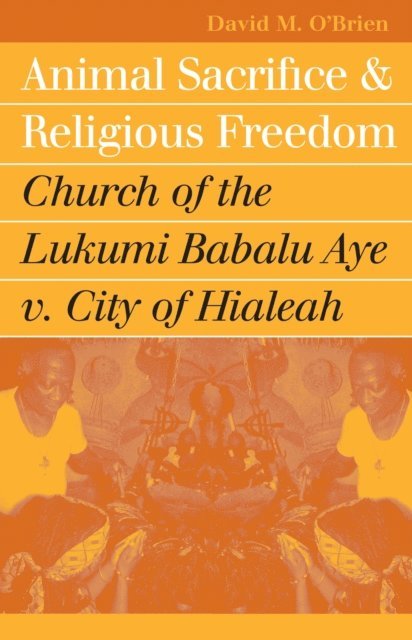
Animal Sacrifice and Religious Freedom
Church of the Lukumi Babalu Aye V. City of Hialeah
Inbunden, 2004
688 kr
Lägg i varukorg
The Santeria religion of Cuba - the Way of the Saints - mixes West African Yoruba culture with Catholicism. Similar to Haitian voodoo, Santeria has long practiced animal sacrifice in certain rites. But when Cuban immigrants brought those rituals to Florida, local authorities were suddenly …
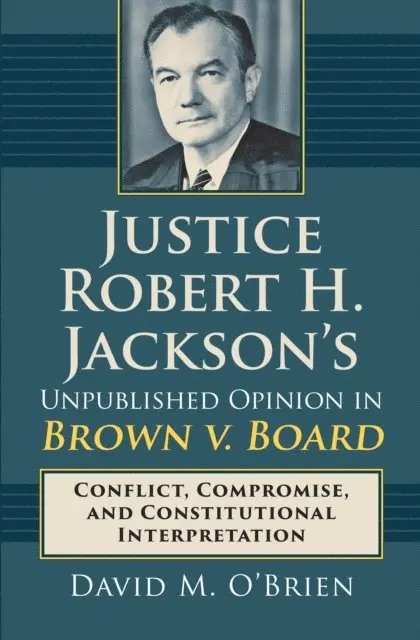
Justice Robert H. Jackson's Unpublished Opinion in Brown v. Board
Conflict, Compromise, and Constitutional Interpretation
E-bok, 2017
399 kr
Lägg i varukorg
Brown v. Board of Education is widely recognized as one of the US Supreme Court’s most important decisions in the twentieth century. Robert H. Jackson, an associate justice on the case, is generally considered one of the Court’s most gifted writers. Though much has been written about Brown , citing …
Animal Sacrifice and Religious Freedom
Church of the Lukumi Babalu Aye v. City of Hialeah
E-bok, 2024
399 kr
Lägg i varukorg
The Santeria religion of Cuba—the Way of the Saints—mixes West AfricanYoruba culture with Catholicism. Similar to Haitian voodoo, Santeria has long practiced animal sacrifice in certain rites. But when Cuban immigrants brought those rituals to Florida, local authorities were suddenly confronted …
Judicial Independence in the Age of Democracy
Critical Perspectives from Around the World
Av Peter H. Russell, David M. O'Brien
Häftad, 2001
344 kr
Lägg i varukorg
This collection of essays by leading scholars of constitutional law looks at a critical component of constitutional democracy - judicial independence - from an international comparative perspective. Peter H. Russell's introduction outlines a general theory of judicial independence, while the …
Abortion and American Politics
Av Barbara Hinkson Craig, David M. O'Brien
Häftad, 1993
1184 kr
Lägg i varukorg
"Although it almost certainly won't get much credit for it, this is a near-perfect example of that rara avis , the impartial report on a white-hot public issue. Each chapter is full of meanigful quotation and value-neutral elucidation, and each is written in a rainwater-clear prose that makes the …
Congress Shall Make No Law
The First Amendment, Unprotected Expression, and the U.S. Supreme Court
Inbunden, 2010
641 kr
Lägg i varukorg
The First Amendment declares that 'Congress shall make no law . . . abridging the freedom of speech, or of the press. . . . ' Yet, in the following two hundred years, Congress and the states have sought repeatedly to curb these freedoms. The Supreme Court of the United States in turn gradually …
Judges on Judging
Views from the Bench
Av David M. O'Brien, David M. O'Brien
Häftad, 2016
995 kr
Lägg i varukorg
Thoroughly revised and updated for this Fifth Edition , Judges on Judging offers insights into the judicial philosophies and political views of those on the bench. Broad in scope, this one-of-a-kind book features “off-the-bench” writings and speeches in which Supreme Court justices, as well as …