Debajyoti Bose – författare
Visar alla böcker från författaren Debajyoti Bose. Handla med fri frakt och snabb leverans.
12 produkter
12 produkter
Häftad, Engelska, 2026
2 034 kr
Skickas inom 10-15 vardagar
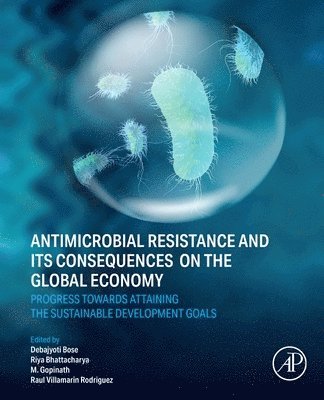
Antimicrobial Resistance and Its Consequences on the Global Economy: Progress towards Attaining the Sustainable Development Goals examines the threat that antimicrobial resistance (AMR) poses to public health, considering its impact upon prolonged illnesses, increased healthcare costs, and higher mortality rates.The book begins with an introduction to the global challenges of AMR before exploring the profound economic repercussions and the role of various sectors, including the pharmaceutical industry, agricultural practices, and food production. It also discusses ethical considerations in tackling AMR, as well as biotechnological and integrative approaches to AMR management. International responses and experiences in low- and middle-income countries are covered, in addition to the Sustainable Development Goals and future directions and recommendations. By promoting responsible antibiotic use, enhancing surveillance systems, and investing in the research and development of new antimicrobial agents, this book aims to preserve the effectiveness of existing treatments and safeguard public health for future generations.Through detailed case studies, policy recommendations, and innovative solutions, Antimicrobial Resistance and Its Consequences on the Global Economy serves as an essential resource for professionals working across microbiology, healthcare, agriculture, and related fields, equipping them with the knowledge and tools needed to implement effective AMR management practices. It also serves as a valuable resource for students across these areas, fostering a new generation of experts dedicated to preserving the efficacy of antimicrobial treatments and combating AMR effectively.Presents actionable strategies for healthcare, agriculture, and policy sectors to combat AMR effectivelyDelivers a multidisciplinary approach, with relevance to researchers working across a range of fields, including healthcare, agriculture, sustainability, and food productionHighlights innovative research and development in new antimicrobial agents and technologies

E-bok
Engelska, 20262 500 kr
Läs direkt efter köp
Antimicrobial Resistance and Its Consequences on the Global Economy: Progress towards Attaining the Sustainable Development Goals examines the threat that antimicrobial resistance (AMR) poses to public health, considering its impact upon prolonged illnesses, increased healthcare costs, and higher mortality rates.The book begins with an introduction to the global challenges of AMR before exploring the profound economic repercussions and the role of various sectors, including the pharmaceutical industry, agricultural practices, and food production. It also discusses ethical considerations in tackling AMR, as well as biotechnological and integrative approaches to AMR management. International responses and experiences in low- and middle-income countries are covered, in addition to the Sustainable Development Goals and future directions and recommendations. By promoting responsible antibiotic use, enhancing surveillance systems, and investing in the research and development of new antimicrobial agents, this book aims to preserve the effectiveness of existing treatments and safeguard public health for future generations.Through detailed case studies, policy recommendations, and innovative solutions, Antimicrobial Resistance and Its Consequences on the Global Economy serves as an essential resource for professionals working across microbiology, healthcare, agriculture, and related fields, equipping them with the knowledge and tools needed to implement effective AMR management practices. It also serves as a valuable resource for students across these areas, fostering a new generation of experts dedicated to preserving the efficacy of antimicrobial treatments and combating AMR effectively. - Presents actionable strategies for healthcare, agriculture, and policy sectors to combat AMR effectively- Delivers a multidisciplinary approach, with relevance to researchers working across a range of fields, including healthcare, agriculture, sustainability, and food production- Highlights innovative research and development in new antimicrobial agents and technologies
E-bok
PDF, Engelska, 2013164 kr
Läs direkt efter köp
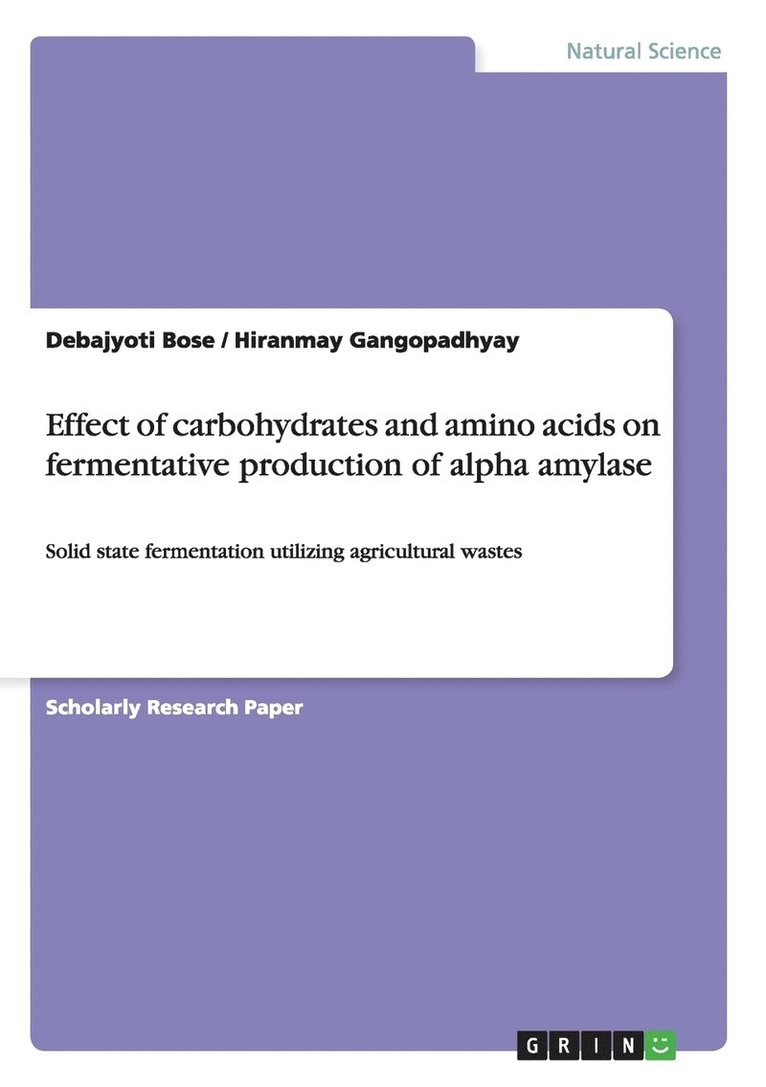
Research Paper (undergraduate) from the year 2012 in the subject Chemistry - Bio-chemistry, grade: "e;-"e;, , language: English, abstract: Extracellular alpha amylase was produced from Aspergillus oryzae under solid state fermentation. House hold agro-wastes were used as medium which were considered as one of the major pollutants due to unfavorable gas production via natural fermentation beside creating disposal problem. Investigations were carried out to evaluate the effect of various carbohydrate sources e.g. glucose, maltose, lactose, sucrose and soluble starch with different concentrations on the production of fungal alpha amylase utilizing agricultural wastes as the fermentation medium. Studies were also carried out to evaluate the effect of various heat stable amino acids e.g. glycine, histidine, proline, leucine and isoleucine with different concentrations on the production of fungal alpha amylase utilizing agricultural wastes as the fermentation medium. The results indicated that maximum activity of alpha amylase (6639.85 U/gds) was obtained at 0.5% concentration of sucrose solution with a r2 of 0.9692 when compared to control (3319.95 U/gds) and other carbohydrates used. Maximum activity of alpha amylase (10407.80 U/gds) was also obtained at 0.75% concentration of proline solution with an r2 of 0.6816 when compared to control (3035.60 U/gds) and other amino acids used in our present study.
Häftad, Engelska, 2013
367 kr
Skickas inom 3-6 vardagar
Häftad, Engelska, 2013
578 kr
Skickas inom 5-8 vardagar
E-bok
PDF, Engelska, 201680 kr
Läs direkt efter köp
Scientific Study from the year 2014 in the subject Biology - Micro- and Molecular Biology, , language: English, abstract: At present, both price and availability of crude oil have motivated a worldwide search for cheap alternatives. Starch is an alternative source of energy because it is both renewable and available throughout the globe in large quantities. There are varieties of products which can be obtained from starch biomass via hydrolysis. Alcohol is one of the largest volumes of products that can be produced from biomass. Recently there has been an active research aimed at attaining an increase in ethanol productivity by fermentation. A large amount of potatoes is wasted every year due to improper cold storage facilities in developing and underdeveloped countries. So, saccharification and conversion of these huge amounts of excess potatoes into alcohol, especially ethanol may generate an employment potential apart from saving a good amount of foreign exchange. In my present research work, the production of alcohol from different varieties of potato, showed a better result after enzymatic hydrolysis of those potatoes followed by alcohol(ethanol) production utilizing Saccharomyces cerevisiae NCIM 3314. Maximum alcohol(ethanol) was obtained utilizing high grade Kufri Jyoti variety when compared to other varieties of potatoes.
E-bok
PDF, Engelska, 2016212 kr
Läs direkt efter köp
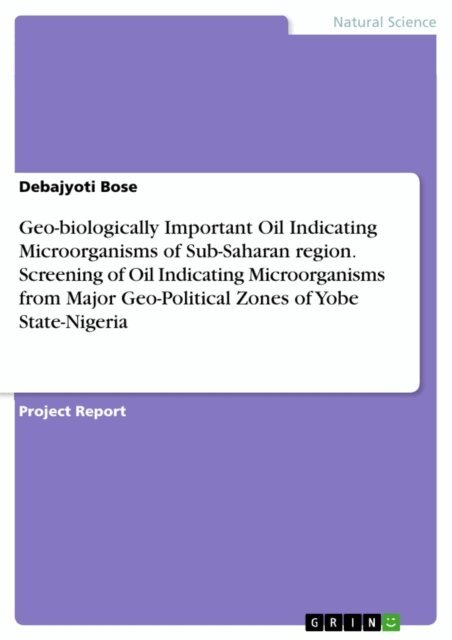
Project Report from the year 2014 in the subject Biology - Micro- and Molecular Biology, grade: PDF, , course: Personal Research Project, language: English, abstract: Ancient rocks and natural oils are rich with abundant and hidden information of ancient organic matters responsible for earth formation, including molecular and isotopic signatures of the organisms that existed at the time the organic matter was formed. Considering the above facts of astrobiology, research study was carried out on screening of oil indicating microorganisms from oil contaminated sites of major geo-political zones of Yobe State, Nigeria including Damaturu, Gashua, Potiskum and Nguru local Government areas. Serial dilution was performed for all soil samples collected from the oil contaminated sites of mentioned local government areas followed by culture isolation and identification techniques for bacterial samples only. Nutrient agar was used for the isolation of the bacteria from the soil samples and mixed cultures were obtained. These bacterial cultures were inoculated in petroleum in order to see their oil utilizing capability. Two types of culture showed positive results among all isolated colonies. Rhizoid shaped gram positive rods isolated from soils of Damaturu, Gashua, Potiskum and Nguru & yellow pigmented gram negative bacterial colony isolated from soils of Potiskum and Nguru showed oil utilizing ability by positive growth in the refined crude oil (Petroleum, Diesel, etc.). The oil utilizing ability of those specific bacteria shows their potentiality in detecting the presence of oil and acting as potential oil indicators in Sub-Saharan region of African Continent caring a long history of bio-geo sciences. Findings from the present research work may create an opening for encouraging the geo-biological potentials of West African Countries in astrobiological aspects.
Häftad, Engelska, 2016
367 kr
Skickas inom 3-6 vardagar
E-bok
PDF, Engelska, 2016251 kr
Läs direkt efter köp
Project Report from the year 2014 in the subject Biology - Micro- and Molecular Biology, , course: Personal Research Project, language: English, abstract: The aim of the present research work was to study a low-cost production of Lactic acid by fermentation of a non-conventional medium e.g. cheese whey, while considering milk medium as a standard using Lactococcus lactics. The effect of different process parameters such as pH of the medium, temperature, inoculums size, age of inoculums and incubation time was monitored to enhance the lactose conversion in cheese whey to lactic acid. Fermentations were performed without any pH control. The optimization of the fermentation conditions resulted in a significant decrease in fermentation time, besides an increase in lactose conversion to lactic acid. The optimized process conditions resulted in high lactose conversion to lactic acid production (0.539%) after an incubation period of 72 hrs at 37 C. The maximum lactic acid production was 0.767% which was observed when milk media (0.767%) was used as the standard fermentation medium, whereas non-conventional cheese whey medium showed 0.539% lactic acid production at pH 5.5.
Häftad, Engelska, 2016
524 kr
Skickas inom 3-6 vardagar
E-bok
PDF, Engelska, 2017238 kr
Läs direkt efter köp
Project Report from the year 2016 in the subject Energy Sciences, grade: 8, University of Petroleum and Energy Studies, language: English, abstract: The Indian subcontinent is blessed with an ample amount of sunlight almost all through the year. There is an urgent need of switching over to a perennial source of energy as an alternative to replace all the quickly depleting fossil fuels. There is much interest in non-conventional energy nowadays, so as to tap energy from unassuming but promising quarters like Solar, Wind and Tidal energy. Of those, tapping the heat and infra-red rays from the sun, using air and water as appropriate mediums, separately and together as a whole, is the most easiest and versatile way of energy capture. This book is concerned with the designing of an efficient solar parabolic collector to trap the solar heat in the receiver through the combination of concave mirrors. A small scale parabolic dish was fabricated with locally available material like stainless steel for the boiler, and painting it black to increase the absorption. As a matter of application of the project, a solar desalination system was integrated with the project to test the feasibility of the research. The desalination system worked successfully in conjunction with the experimental setup and a reduction in the TDS level of the feed water was observed at the condensation end. Thus, the project is feasible for cleaning or purifying the water by renewable sources.
Häftad, Engelska, 2017
524 kr
Skickas inom 3-6 vardagar