Derek Parfit – författare
Visar alla böcker från författaren Derek Parfit. Handla med fri frakt och snabb leverans.
18 produkter
18 produkter
Häftad, Engelska, 1986
361 kr
Skickas inom 5-8 vardagar
This book challenges, with several powerful arguments, some of our deepest beliefs about rationality, morality, and personal identity. The author claims that we have a false view of our own nature; that it is often rational to act against our own best interests; that most of us have moral views that are directly self-defeating; and that, when we consider future generations the conclusions will often be disturbing. He concludes that moral non-religious moral philosophy is a young subject, with a promising but unpredictable future.
Inbunden, Svenska, 2023
302 kr
Skickas
I "Skäl och personer" utmanar Derek Parfit våra invanda föreställningar på en mängd områden. Med hjälp av en konstant ström av snillrika tankeexperiment och argument rubbar han metodiskt grunderna för våra uppfattningar om rationalitet, moral, tid och personlig identitet. Mest känd är han nog för resonemanget i bokens fjärde del där han synliggör vår paradoxala relation till framtida generationer. Det här är en bok som alla som tar moral på allvar är så illa tvungna att fundera över. Parfit var på många områden före sin tid, och resonemangen är i många fall mer aktuella i dag än när boken publicerades. Troligen kommer den att påverka den moralfilosofiska diskussionen under lång tid. Derek Parfit (1942–2017) var en av vår tids mest originella moralfilosofer. Han var knuten till All Souls College i Oxford under hela sin karriär men undervisade även vid Harvard, Rutgers och universitetet i New York. Parfit var ledamot i British Academy och 2014 fick han Rolf Schockpriset för ”banbrytande bidrag rörande personlig identitet, hänsyn till framtida generationer, och analys av moralisk teoribildning.”
1 069 kr
Skickas
On What Matters is a major work in moral philosophy. It is the long-awaited follow-up to Derek Parfit's 1984 book Reasons and Persons, one of the landmarks of twentieth-century philosophy. Parfit now presents a powerful new treatment of reasons, rationality, and normativity, and a critical examination of three systematic moral theories - Kant's ethics, contractualism, and consequentialism - leading to his own ground-breaking synthetic conclusion. Along the way he discusses a wide range of moral issues, such as the significance of consent, treating people as a means rather than an end, and free will and responsibility. On What Matters is already the most-discussed work in moral philosophy: its publication is likely to establish it as a modern classic which everyone working on moral philosophy will have to read, and which many others will turn to for stimulation and illumination.
Inbunden, Engelska, 2017
541 kr
Derek Parfit presents the third volume of On What Matters, his landmark work of moral philosophy. Parfit develops further his influential treatment of reasons, normativity, the meaning of moral discourse, and the status of morality. He engages with his critics, and shows the way to resolution of their differences.This volume is partly about what it is for things to matter, in the sense that we all have reasons to care about these things. Much of the book discusses three of the main kinds of meta-ethical theory: Normative Naturalism, Quasi-Realist Expressivism, and Non-Metaphysical Non-Naturalism, which Derek Parfit now calls Non-Realist Cognitivism. This third theory claims that, if we use the word 'reality' in an ontologically weighty sense, irreducibly normative truths have no mysterious or incredible ontological implications. If instead we use 'reality' in a wide sense, according to which all truths are truths about reality, this theory claims that some non-empirically discoverable truths-such as logical, mathematical, modal, and some normative truths-raise no difficult ontological questions. Parfit discusses these theories partly by commenting on the views of some of the contributors to Peter Singer's collection Does Anything Really Matter? Parfit on Objectivity. Though Peter Railton is a Naturalist, he has widened his view by accepting some further claims, and he has suggested that this wider version of Naturalism could be combined with Non-Realist Cognitivism. Parfit argues that Railton is right, since these theories no longer deeply disagree. Though Allan Gibbard is a Quasi-Realist Expressivist, he has suggested that the best version of his view could be combined with Non-Realist Cognitivism. Parfit argues that Gibbard is right, since Gibbard and he now accept the other's main meta-ethical claim. It is rare for three such different philosophical theories to be able to be widened in ways that resolve their deepest disagreements. This happy convergence supports the view that these meta-ethical theories are true. Parfit also discusses the views of several other philosophers, and some other meta-ethical and normative questions.
Häftad, Engelska, 2013
404 kr
Skickas inom 5-8 vardagar
On What Matters is a major work in moral philosophy. It is the long-awaited follow-up to Derek Parfit's 1984 book Reasons and Persons, one of the landmarks of twentieth-century philosophy. In this first volume Parfit presents a powerful new treatment of reasons and rationality, and a critical examination of three systematic moral theories -- Kant's ethics, contractualism, and consequentialism -- leading to his own ground-breaking synthetic conclusion. Along the way he discusses a wide range of moral issues, such as the significance of consent, treating people as a means rather than an end, and free will and responsibility. On What Matters is already the most-discussed work in moral philosophy: its publication is likely to establish it as a modern classic which everyone working on moral philosophy will have to read, and which many others will turn to for stimulation and illumination.
Häftad, Engelska, 2013
408 kr
Skickas inom 7-10 vardagar
On What Matters is a major work in moral philosophy. It is the long-awaited follow-up to Derek Parfit's 1984 book Reasons and Persons, one of the landmarks of twentieth-century philosophy. Parfit now presents a powerful new treatment of reasons, rationality, and normativity, and a critical examination of three systematic moral theories - Kant's ethics, contractualism, and consequentialism - leading to his own ground-breaking synthetic conclusion. Along the way he discusses a wide range of moral issues, such as the significance of consent, treating people as a means rather than an end, and free will and responsibility. On What Matters is already the most-discussed work in moral philosophy: its publication is likely to establish it as a modern classic which everyone working on moral philosophy will have to read, and which many others will turn to for stimulation and illumination. The second volume of Derek Parfit's magnum opus is in four parts. The first presents critiques of his work by four of the world's leading moral philosophers. The second contains his responses. The third and longest part is a self-contained monograph by Parfit on normativity. The final part comprises seven new essays by Parfit on Kant, reasons, irrationality, autonomy - and why the universe exists.
E-bok
PDF, Engelska, 2016396 kr
Läs direkt efter köp
Derek Parfit presents the third volume of On What Matters, his landmark work of moral philosophy. Parfit develops further his influential treatment of reasons, normativity, the meaning of moral discourse, and the status of morality. He engages with his critics, and shows the way to resolution of their differences.This volume is partly about what it is for things to matter, in the sense that we all have reasons to care about these things. Much of the book discusses three of the main kinds of meta-ethical theory: Normative Naturalism, Quasi-Realist Expressivism, and Non-Metaphysical Non-Naturalism, which Derek Parfit now calls Non-Realist Cognitivism. This third theory claims that, if we use the word ''reality'' in an ontologically weighty sense, irreducibly normative truths have no mysterious or incredibleontological implications. If instead we use ''reality'' in a wide sense, according to which all truths are truths about reality, this theory claims that some non-empirically discoverable truths-such as logical, mathematical, modal, and some normative truths-raise no difficult ontological questions.Parfit discusses these theories partly by commenting on the views of some of the contributors to Peter Singer''s collection Does Anything Really Matter? Parfit on Objectivity. Though Peter Railton is a Naturalist, he has widened his view by accepting some further claims, and he has suggested that this wider version of Naturalism could be combined with Non-Realist Cognitivism. Parfit argues that Railton is right, since these theories no longer deeply disagree. Though Allan Gibbard is aQuasi-Realist Expressivist, he has suggested that the best version of his view could be combined with Non-Realist Cognitivism. Parfit argues that Gibbard is right, since Gibbard and he now accept the other''s main meta-ethical claim. It is rare for three such different philosophical theories to be able to bewidened in ways that resolve their deepest disagreements. This happy convergence supports the view that these meta-ethical theories are true. Parfit also discusses the views of several other philosophers, and some other meta-ethical and normative questions.
E-bok
Engelska, 2017396 kr
Läs direkt efter köp
Derek Parfit presents the third volume of On What Matters, his landmark work of moral philosophy. Parfit develops further his influential treatment of reasons, normativity, the meaning of moral discourse, and the status of morality. He engages with his critics, and shows the way to resolution of their differences.This volume is partly about what it is for things to matter, in the sense that we all have reasons to care about these things. Much of the book discusses three of the main kinds of meta-ethical theory: Normative Naturalism, Quasi-Realist Expressivism, and Non-Metaphysical Non-Naturalism, which Derek Parfit now calls Non-Realist Cognitivism. This third theory claims that, if we use the word ''reality'' in an ontologically weighty sense, irreducibly normative truths have no mysterious or incredibleontological implications. If instead we use ''reality'' in a wide sense, according to which all truths are truths about reality, this theory claims that some non-empirically discoverable truths-such as logical, mathematical, modal, and some normative truths-raise no difficult ontological questions.Parfit discusses these theories partly by commenting on the views of some of the contributors to Peter Singer''s collection Does Anything Really Matter? Parfit on Objectivity. Though Peter Railton is a Naturalist, he has widened his view by accepting some further claims, and he has suggested that this wider version of Naturalism could be combined with Non-Realist Cognitivism. Parfit argues that Railton is right, since these theories no longer deeply disagree. Though Allan Gibbard is aQuasi-Realist Expressivist, he has suggested that the best version of his view could be combined with Non-Realist Cognitivism. Parfit argues that Gibbard is right, since Gibbard and he now accept the other''s main meta-ethical claim. It is rare for three such different philosophical theories to be able to bewidened in ways that resolve their deepest disagreements. This happy convergence supports the view that these meta-ethical theories are true. Parfit also discusses the views of several other philosophers, and some other meta-ethical and normative questions.
E-bok
PDF, Engelska, 1984269 kr
Läs direkt efter köp
This book challenges, with several powerful arguments, some of our deepest beliefs about rationality, morality, and personal identity. The author claims that we have a false view of our own nature; that it is often rational to act against our own best interests; that most of us have moral views that are directly self-defeating; and that, when we consider future generations the conclusions will often be disturbing. He concludes that moral non-religious moralphilosophy is a young subject, with a promising but unpredictable future.
E-bok
PDF, Engelska, 2011181 kr
Läs direkt efter köp
On What Matters is a major work in moral philosophy. It is the long-awaited follow-up to Derek Parfit''s 1984 book Reasons and Persons, one of the landmarks of twentieth-century philosophy. In this first volume Parfit presents a powerful new treatment of reasons and rationality, and a critical examination of three systematic moral theories — Kant''s ethics, contractualism, and consequentialism — leading to his own ground-breaking syntheticconclusion. Along the way he discusses a wide range of moral issues, such as the significance of consent, treating people as a means rather than an end, and free will and responsibility. On What Matters is already the most-discussed work in moral philosophy: its publication is likely to establish it as a modern classic whicheveryone working on moral philosophy will have to read, and which many others will turn to for stimulation and illumination.
E-bok
PDF, Engelska, 2011174 kr
Läs direkt efter köp
On What Matters is a major work in moral philosophy. It is the long-awaited follow-up to Derek Parfit''s 1984 book Reasons and Persons, one of the landmarks of twentieth-century philosophy. Parfit now presents a powerful new treatment of reasons, rationality, and normativity, and a critical examination of three systematic moral theories - Kant''s ethics, contractualism, and consequentialism - leading to his own ground-breaking synthetic conclusion.Along the way he discusses a wide range of moral issues, such as the significance of consent, treating people as a means rather than an end, and free will and responsibility. On What Matters is already the most-discussed work in moral philosophy: its publication is likely to establish it as a modern classic whicheveryone working on moral philosophy will have to read, and which many others will turn to for stimulation and illumination.The second volume of Derek Parfit''s magnum opus is in four parts. The first presents critiques of his work by four of the world''s leading moral philosophers. The second contains his responses. The third and longest part is a self-contained monograph by Parfit on normativity. The final part comprises seven new essays by Parfit on Kant, reasons, irrationality, autonomy - and why the universe exists.
E-bok
Engelska, 2011181 kr
Läs direkt efter köp
On What Matters is a major work in moral philosophy. It is the long-awaited follow-up to Derek Parfit''s 1984 book Reasons and Persons, one of the landmarks of twentieth-century philosophy. Parfit now presents a powerful new treatment of reasons, rationality, and normativity, and a critical examination of three systematic moral theories - Kant''s ethics, contractualism, and consequentialism - leading to his own ground-breaking synthetic conclusion.Along the way he discusses a wide range of moral issues, such as the significance of consent, treating people as a means rather than an end, and free will and responsibility. On What Matters is already the most-discussed work in moral philosophy: its publication is likely to establish it as a modern classic whicheveryone working on moral philosophy will have to read, and which many others will turn to for stimulation and illumination.The second volume of Derek Parfit''s magnum opus is in four parts. The first presents critiques of his work by four of the world''s leading moral philosophers. The second contains his responses. The third and longest part is a self-contained monograph by Parfit on normativity. The final part comprises seven new essays by Parfit on Kant, reasons, irrationality, autonomy - and why the universe exists.
E-bok
Engelska, 2011174 kr
Läs direkt efter köp
On What Matters is a major work in moral philosophy. It is the long-awaited follow-up to Derek Parfit''s 1984 book Reasons and Persons, one of the landmarks of twentieth-century philosophy. In this first volume Parfit presents a powerful new treatment of reasons and rationality, and a critical examination of three systematic moral theories — Kant''s ethics, contractualism, and consequentialism — leading to his own ground-breaking syntheticconclusion. Along the way he discusses a wide range of moral issues, such as the significance of consent, treating people as a means rather than an end, and free will and responsibility. On What Matters is already the most-discussed work in moral philosophy: its publication is likely to establish it as a modern classic whicheveryone working on moral philosophy will have to read, and which many others will turn to for stimulation and illumination.
E-bok
Engelska, 1986269 kr
Läs direkt efter köp
This book challenges, with several powerful arguments, some of our deepest beliefs about rationality, morality, and personal identity. The author claims that we have a false view of our own nature; that it is often rational to act against our own best interests; that most of us have moral views that are directly self-defeating; and that, when we consider future generations the conclusions will often be disturbing. He concludes that moral non-religious moralphilosophy is a young subject, with a promising but unpredictable future.
Inbunden, Engelska, 2011
728 kr
Skickas inom 5-8 vardagar
On What Matters is a major work in moral philosophy. It is the long-awaited follow-up to Derek Parfit's 1984 book Reasons and Persons, one of the landmarks of twentieth-century philosophy. Parfit now presents a powerful new treatment of reasons, rationality, and normativity, and a critical examination of three systematic moral theories - Kant's ethics, contractualism, and consequentialism - leading to his own ground-breaking synthetic conclusion. Along the way he discusses a wide range of moral issues, such as the significance of consent, treating people as a means rather than an end, and free will and responsibility. On What Matters is already the most-discussed work in moral philosophy: its publication is likely to establish it as a modern classic which everyone working on moral philosophy will have to read, and which many others will turn to for stimulation and illumination. The second volume of Derek Parfit's magnum opus is in four parts. The first presents critiques of his work by four of the world's leading moral philosophers. The second contains his responses. The third and longest part is a self-contained monograph by Parfit on normativity. The final part comprises seven new essays by Parfit on Kant, reasons, irrationality, autonomy - and why the universe exists.
E-bok
Spanska, 201979 kr
Läs direkt efter köp
En la medida en que esta obra suya se ha convertido en un punto de referencia ineludible del filosofar actual, podemos considerar a Derek Parfit como un auténtico clásico viviente. En efecto, su planteamiento del problema de la identidad personal a través del tiempo, en una línea que inauguró Hume en la época moderna, pero que puede vincularse sin excesivos problemas, si queremos adoptar una perspectiva transcultural, con lo más incisivo del pensamiento budista, ha venido constituyendo desde hace ya más de veinte años el centro del apasionado debate intelectual que viene desplegándose en torno a esta cuestión tan importante. Cuestión que enlaza directamente con las problemáticas de la racionalidad práctica y de la ética, y cuyo tratamiento filosófico no dejaría de tener significativas repercusiones psicológicas en todos nosotros, por ejemplo, en nuestra actitud ante el envejecimiento y la muerte. En esta edición española de Razones y personas se viene a incluir, a guisa de "epílogo", una definitiva actualización del reduccionismo parfitiano de la identidad personal, redactada más de diez años después. En suma, nos hallaríamos ante una de las obras culminantes del pensamiento de finales del siglo xx: su brillantez y espectacular vigor intelectual no han podido dejar de ser reconocidos ni siquiera por los adversarios más decididos de las sorprendentes tesis que en ella se defienden.
Häftad, Svenska, 2021
145 kr
Skickas
Derek Parfit var en av vår tids mest originella filosofer och hans "Jämlikhet eller prioritet?" är oumbärlig för alla som funderar över jämlikhet och moraliska skyldigheter. På flera sätt gav Parfit moralfilosofin en ny riktning och formulerade nya och ofta oväntade problem. Bland annat gjorde han banbrytande bidrag till diskussionen om personlig identitet, och om våra skyldigheter gentemot framtida generationer. Dessutom synliggjorde han allvarliga misstag i våra moraluppfattningar. I denna text undersöker Parfit vad vi menar med jämlikhet, och framför allt om vi bör värdera jämlikhet, och i så fall hur. Parfit undrar om det inte är viktigare att bistå dem som har det sämst i stället för att bry sig så mycket om skillnader mellan människor. Derek Parfit (1942–2017) var verksam vid All Souls College i Oxford i nära 50 år och undervisade även vid Harvard, Rutgers och universitetet i New York. Han var ledamot i British Academy och fick 2014 Rolf Schockpriset. Hans bok "Reasons and Persons" från 1984 är en modern klassiker.
Häftad, Svenska, 2021
142 kr
Skickas
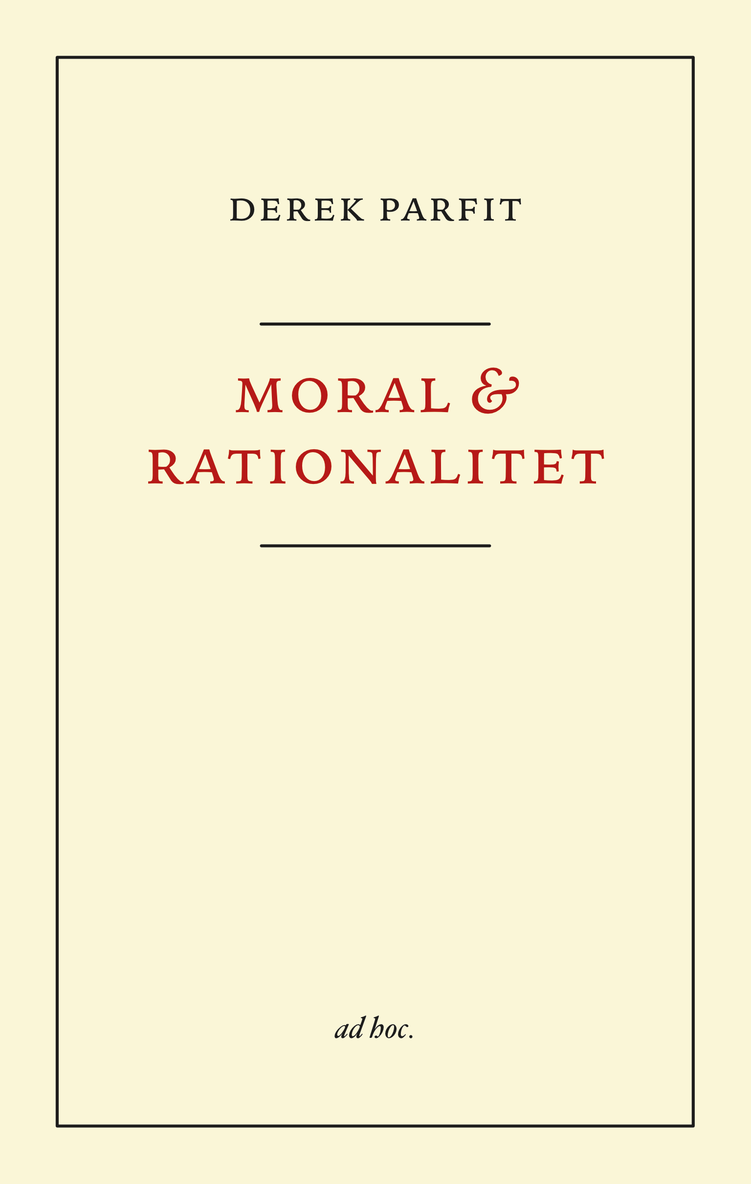
Moral och rationalitet kan läsas som ett koncentrat av centrala delar av det som skulle bli Derek Parfits mästerverk, boken Reasons and Persons (1984). Han formulerar här de sociala dilemman och problem vi måste förstå bättre, liksom skisserna till de lösningar han skulle återkomma till i sin sista bok, On What Matters (2011–2017). Det är en kompakt text. På nästan varje sida finns uppslag för en egen bok. Det gör den till en bra ingång till Parfits normativa resonemang. Samtidigt blir läsaren från första sidan indragen i ett resonemang som ifrågasätter en mängd grundläggande föreställningar om moral och rationalitet. Derek Parfit (1942–2017) var en av vår tids mest originella filosofer och var verksam vid All Souls College i Oxford i nära 50 år. Parfit undervisade även vid Harvard, Rutgers och universitetet i New York och var ledamot i British Academy. 2014 fick han Rolf Schockpriset, som ibland kallas filosofernas nobelpris. På svenska finns sedan tidigare Parfits Jämlikhet eller prioritet?, utgiven på Ad hoc förlag.