Diane E. King – författare
1 321 kr
Skickas inom 10-15 vardagar
450 kr
Skickas inom 10-15 vardagar
404 kr
Skickas inom 5-8 vardagar
1 371 kr
Skickas inom 5-8 vardagar
2 215 kr
Skickas inom 10-15 vardagar
605 kr
Skickas inom 10-15 vardagar
682 kr
Läs direkt efter köp
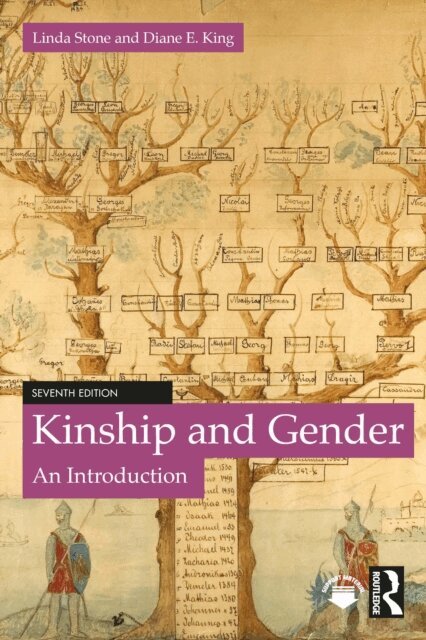
This fully revised seventh edition of Kinship and Gender: An Introduction explores kinship in today’s globalized, increasingly mobile world, and how family structures continue to influence the varied roles that men and women play in different cultures.
Written to engage students, each chapter provides key terms and useful generalizations gleaned through research on the interplay of kinship and gender in both traditional societies and contemporary communities. Detailed case studies and cross-cultural examples help students understand how such generalizations are experienced in real life. The authors also consider the ramifications of current social problems and recent developments in reproductive technology as they demonstrate the relevance of kinship and gender to students’ lives. The new edition contains a revised introduction highlighting the disaggregation of marriage and reproduction; new sections on third gender, nonbinary, and trans identities; new case studies on spiritual kinship; as well as explorations of genetic and ancestral kinship paradigms, new reproductive technologies, and a more robust global perspective throughout. Pedagogical features include suggestions for classroom media, a glossary, an appendix, and downloadable PowerPoint slides.
Kinship and Gender: An Introduction provides a broad, yet nuanced introduction to the field, and is essential reading for students taking their first steps into anthropology, gender studies, and sociology.
682 kr
Läs direkt efter köp
This fully revised seventh edition of Kinship and Gender: An Introduction explores kinship in today’s globalized, increasingly mobile world, and how family structures continue to influence the varied roles that men and women play in different cultures.
Written to engage students, each chapter provides key terms and useful generalizations gleaned through research on the interplay of kinship and gender in both traditional societies and contemporary communities. Detailed case studies and cross-cultural examples help students understand how such generalizations are experienced in real life. The authors also consider the ramifications of current social problems and recent developments in reproductive technology as they demonstrate the relevance of kinship and gender to students’ lives. The new edition contains a revised introduction highlighting the disaggregation of marriage and reproduction; new sections on third gender, nonbinary, and trans identities; new case studies on spiritual kinship; as well as explorations of genetic and ancestral kinship paradigms, new reproductive technologies, and a more robust global perspective throughout. Pedagogical features include suggestions for classroom media, a glossary, an appendix, and downloadable PowerPoint slides.
Kinship and Gender: An Introduction provides a broad, yet nuanced introduction to the field, and is essential reading for students taking their first steps into anthropology, gender studies, and sociology.
487 kr
Läs direkt efter köp
This book features chapters that examine the various ways of belonging in the Middle East. Belonging can mean fitting in, feeling at home, feeling a part; this kind of belonging is profoundly social. Belongings can be possessions, objects closely associated with one’s deepest notions of identity. Both kinds of belongings pertain to people and the kindreds, ethnic groups, and nations (and/or states) they call their own. Belongings of both kinds are, more often than not, emplaced and territorialized.
All of the chapters treat Middle Eastern collectivities as sites of anguished cultural projects. All use metaphor: national territory as woman, national resolve as cactus, and so on. None is reductionistic; belonging is rendered in its complexity, with its agonies as well as its joys. All could be identified with a growing genre of work on belonging. At the heart of each are the bonds that comprise belonging. Each one conveys both belonging’s messiness and its joys, and touches as much as it argues and elaborates.
This book was published as a special issue of Identities: Global Studies in Culture and Power.
487 kr
Läs direkt efter köp
This book features chapters that examine the various ways of belonging in the Middle East. Belonging can mean fitting in, feeling at home, feeling a part; this kind of belonging is profoundly social. Belongings can be possessions, objects closely associated with one’s deepest notions of identity. Both kinds of belongings pertain to people and the kindreds, ethnic groups, and nations (and/or states) they call their own. Belongings of both kinds are, more often than not, emplaced and territorialized.
All of the chapters treat Middle Eastern collectivities as sites of anguished cultural projects. All use metaphor: national territory as woman, national resolve as cactus, and so on. None is reductionistic; belonging is rendered in its complexity, with its agonies as well as its joys. All could be identified with a growing genre of work on belonging. At the heart of each are the bonds that comprise belonging. Each one conveys both belonging’s messiness and its joys, and touches as much as it argues and elaborates.
This book was published as a special issue of Identities: Global Studies in Culture and Power.
495 kr
Tillfälligt slut
1 459 kr
Tillfälligt slut