Didier Buthiau – författare
Visar alla böcker från författaren . Handla med fri frakt och snabb leverans.
4 produkter
4 produkter
Häftad, Engelska, 2002
1 666 kr
Skickas inom 10-15 vardagar
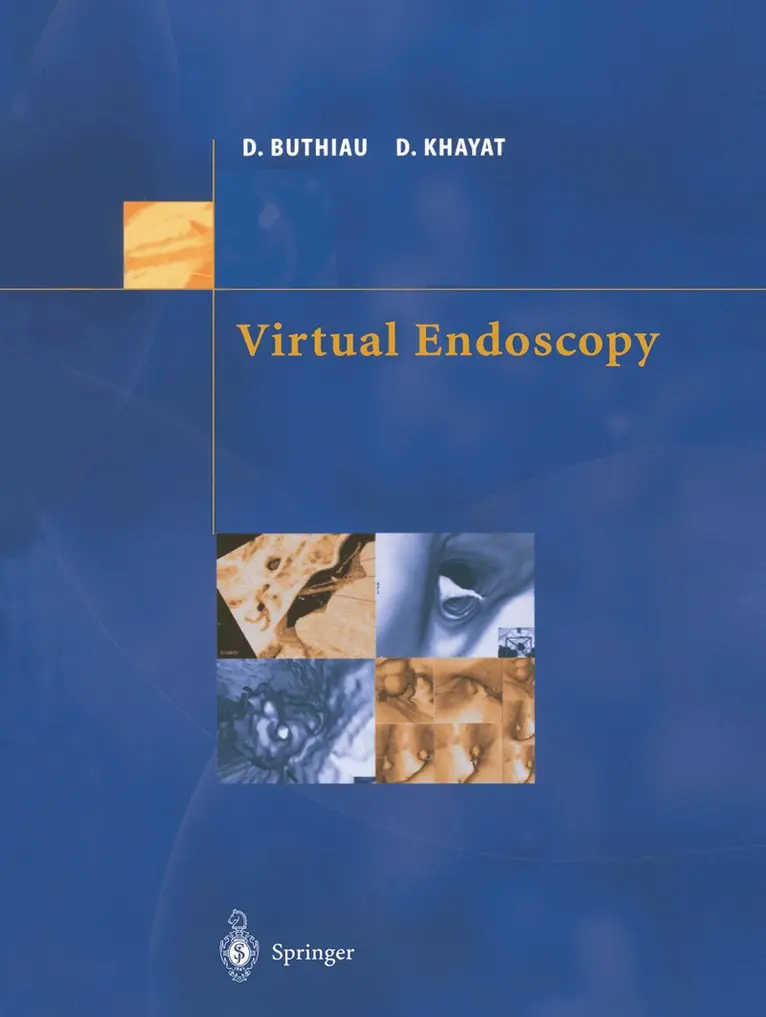
Virtual endoscopy progressively enters the real world The development of virtual reality is one of the most striking features of our Western societies. Beside chil dren games and movies, its scope has expanded to medical imaging through 3D CT scan surface or volume re constructions. Whatever the site clinicians are able to perform real endoscopy (RE), radiologists can now also provide virtual endoscopy (VE) images. VE enters our medical practice. The next question is to weigh the pros and cons. VE has the unique advantage to offer high-quality images obtained through a noninvasive and well-tolera ted procedure performed in outpatients. Compared to RE, it carries no risk of bleeding, perforation or trans mission of viruses. Importantly, VE can pass high-grade stenoses affecting large bowel, urinary tract or tra cheobronchial tree, and visualize areas hard to visit by optic fibers such as intracranial regions. 3D VE images can be commented with patients, and this might reduce potential misunderstanding and its medico-legal consequences. Last but not least, VE is the sole alternative offered both to those who refuse RE, and to severely ill elderly patients. Then, should we consider VE as the Deus ex machina of modem medical imaging - with CT scan as rna china - ? Clearly, the answer is no, given VE knows severals limits and pitfalls. One of the most important me rits of this book is to discuss honestly these aspects. First, VE will never allow to perform biopsies or resections.
E-bok
PDF, Engelska, 20132 110 kr
Läs direkt efter köp
Virtual endoscopy progressively enters the real world The development of virtual reality is one of the most striking features of our Western societies. Beside chil dren games and movies, its scope has expanded to medical imaging through 3D CT scan surface or volume re constructions. Whatever the site clinicians are able to perform real endoscopy (RE), radiologists can now also provide virtual endoscopy (VE) images. VE enters our medical practice. The next question is to weigh the pros and cons. VE has the unique advantage to offer high-quality images obtained through a noninvasive and well-tolera ted procedure performed in outpatients. Compared to RE, it carries no risk of bleeding, perforation or trans mission of viruses. Importantly, VE can pass high-grade stenoses affecting large bowel, urinary tract or tra cheobronchial tree, and visualize areas hard to visit by optic fibers such as intracranial regions. 3D VE images can be commented with patients, and this might reduce potential misunderstanding and its medico-legal consequences. Last but not least, VE is the sole alternative offered both to those who refuse RE, and to severely ill elderly patients. Then, should we consider VE as the Deus ex machina of modem medical imaging - with CT scan as rna china - ? Clearly, the answer is no, given VE knows severals limits and pitfalls. One of the most important me rits of this book is to discuss honestly these aspects. First, VE will never allow to perform biopsies or resections.
E-bok
PDF, Engelska, 20121 408 kr
Läs direkt efter köp
Imaging techniques are often called upon in oncology in virtue of their essential role in tumor diagnosis, extension work up to various organs and detection of relapse. They are also indispensable in research and in clinical practice, allowing an objective assessment of tumoral regression in patients undergoing treatment. It is currently impossible to establish the management plan of a cancer patient or to obtain follow-up of such a patient under treatment without clinical and imaging confrontation.
Häftad, Engelska, 2012
1 113 kr
Skickas inom 10-15 vardagar
Imaging techniques are often called upon in oncology in virtue of their essential role in tumor diagnosis, extension work up to various organs and detection of relapse. They are also indispensable in research and in clinical practice, allowing an objective assessment of tumoral regression in patients undergoing treatment. It is currently impossible to establish the management plan of a cancer patient or to obtain follow-up of such a patient under treatment without clinical and imaging confrontation.