Dirk Boutkan – författare
Visar alla böcker från författaren Dirk Boutkan. Handla med fri frakt och snabb leverans.
2 produkter
2 produkter
Del 1 - Leiden Indo-European Etymological Dictionary Series
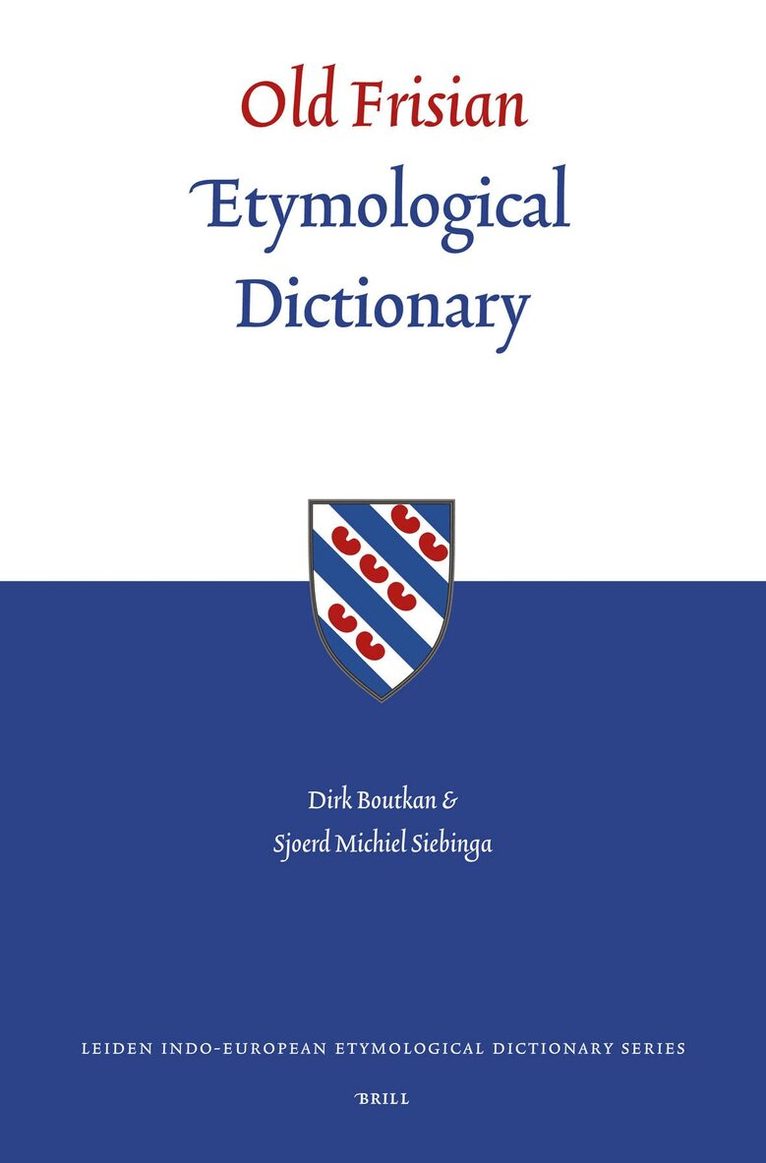
Old Frisian Etymological Dictionary
Inbunden, Engelska, 2005
3 939 kr
Skickas inom 5-8 vardagar
The Old Frisian Etymological Dictionary is an indispensable research tool for the study of Old Frisian, Germanic languages, and Proto-Indo- European.With this first etymological dictionary of Old Frisian based on the lexicon of Riustring 1 manuscript, Old Frisian becomes accessible to a wide circle of scholars of Germanic and Indo-European. The latest insights of Comparative Indo-European Linguistics have been systematically incorporated. The entries are provided with a meticulous analysis of Old Frisian dialectal forms, with Proto-Frisian reconstructions, and with a wealth of Germanic and Indo- European cognates. Due to the lack of lexicographical tools, Old Frisian cognates are rarely included in current etymological dictionaries of Germanic and Indo-European, despite the fact that Old Frisian can often provide important clues for the reconstruction. At the same time, it is difficult for the students of Old Frisian to acquire knowledge of the linguistic prehistory of this language. The Old Frisian Etymological Dictionary is an indispensable research tool for the study of Old Frisian, Germanic languages, and Proto-Indo-European.
E-bok
PDF, Engelska, 20242 946 kr
Läs direkt efter köp
The overall interpretation of Old Germanic phonology and morphology has much to gain from the recent and revolutionary views that were developed in its 'mother' discipline, Indo-European linguistics. For the first time, the Germanic Auslaut problem, i.e. the interpretation of the historical development of final syllables between Proto-Indo-European and Germanic, is analyzed against the background of the modern reconstruction of Proto-Indo-European. This especially entails new interpretations of various detail problems in the field of nominal and verbal morphology. Moreover, the traditional assumption of contrasting intonations yielding different inflexional endings (e.g. circumflex *-om > Goth ??o??, OHG -o in the _-stem genitive plural, but acute *-_m > Goth -a, OHG -a in the _-stem accusative singular) must be replaced by a theory that is in accordance with our present-day knowledge of Proto-Indo-European as a language that most probably did not display such contrasts. It is above all the interpretation of long vowels and diphthongs in Old Germanic final syllables that has given rise to a long discussion. After the standard theory, which entered most handbooks of Old Germanic linguistics, was established, it was proven to be unlikely by new investigations. Especially Lane, in his epoch-making article (JEGP 62, 1963: 155 ff), renewed the discussion and drew interesting conclusions. Studies by Antonsen, Beck, Kortlandt, Voyles and others (sometimes dealing with other subjects than Germanic Auslaut proper) also provide materials for a new theory. With respect to this 'long vowel problem', older theories (including the standard view) and modern ideas are discussed before a new interpretation is proposed. The evidence is discussed in the form of a historical overview of the nominal and verbal morphology of the Old Germanic dialects. This part of the book can therefore also be used as a reference guide in the field of historical morphology. This approach is adopted from a recent key-study in the field of Auslaut, viz. Jones' dissertation (1979, Chapell Hill). The growing interest in the relative chronology of Lautgesetze, - which was, for example, the theme of the Leiden Fachtagung der Indogermanischen Gesellschaft of 1986 -, is met with where a chronological order of the Auslautgesetze of the separate dialects is proposed. This part of the book may serve as a stimulus for the necessary discussion of the subject.