Dirk P. Kroese – författare
1 187 kr
Skickas inom 10-15 vardagar
1 734 kr
Skickas inom 10-15 vardagar
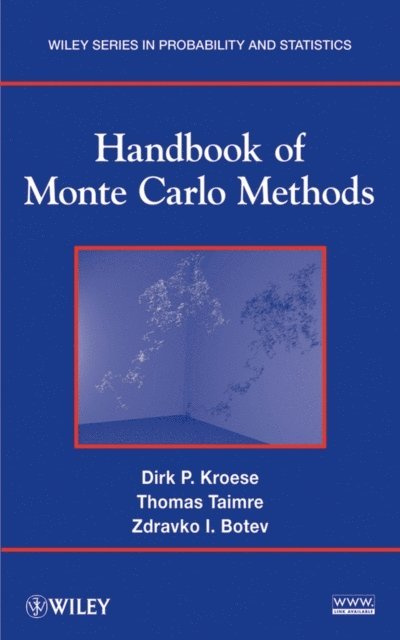
Handbook of Monte Carlo Methods
1 941 kr
Skickas inom 5-8 vardagar
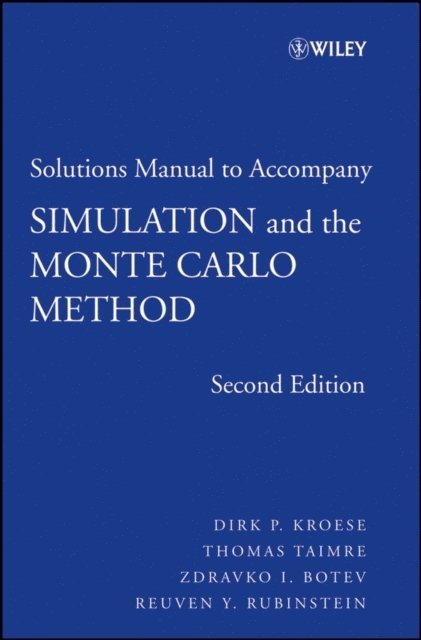
Student Solutions Manual to accompany Simulation and the Monte Carlo Method
429 kr
Skickas inom 5-8 vardagar
490 kr
Läs direkt efter köp
Simulation and the Monte Carlo Method, Second Edition reflects the latest developments in the field and presents a fully updated and comprehensive account of the major topics that have emerged in Monte Carlo simulation since the publication of the classic First Edition over twenty-five years ago. While maintaining its accessible and intuitive approach, this revised edition features a wealth of up-to-date information that facilitates a deeper understanding of problem solving across a wide array of subject areas, such as engineering, statistics, computer science, mathematics, and the physical and life sciences.
The book begins with a modernized introduction that addresses the basic concepts of probability, Markov processes, and convex optimization. Subsequent chapters discuss the dramatic changes that have occurred in the field of the Monte Carlo method, with coverage of many modern topics including:
Markov Chain Monte Carlo
Variance reduction techniques such as the transform likelihood ratio method and the screening method
The score function method for sensitivity analysis
The stochastic approximation method and the stochastic counter-part method for Monte Carlo optimization
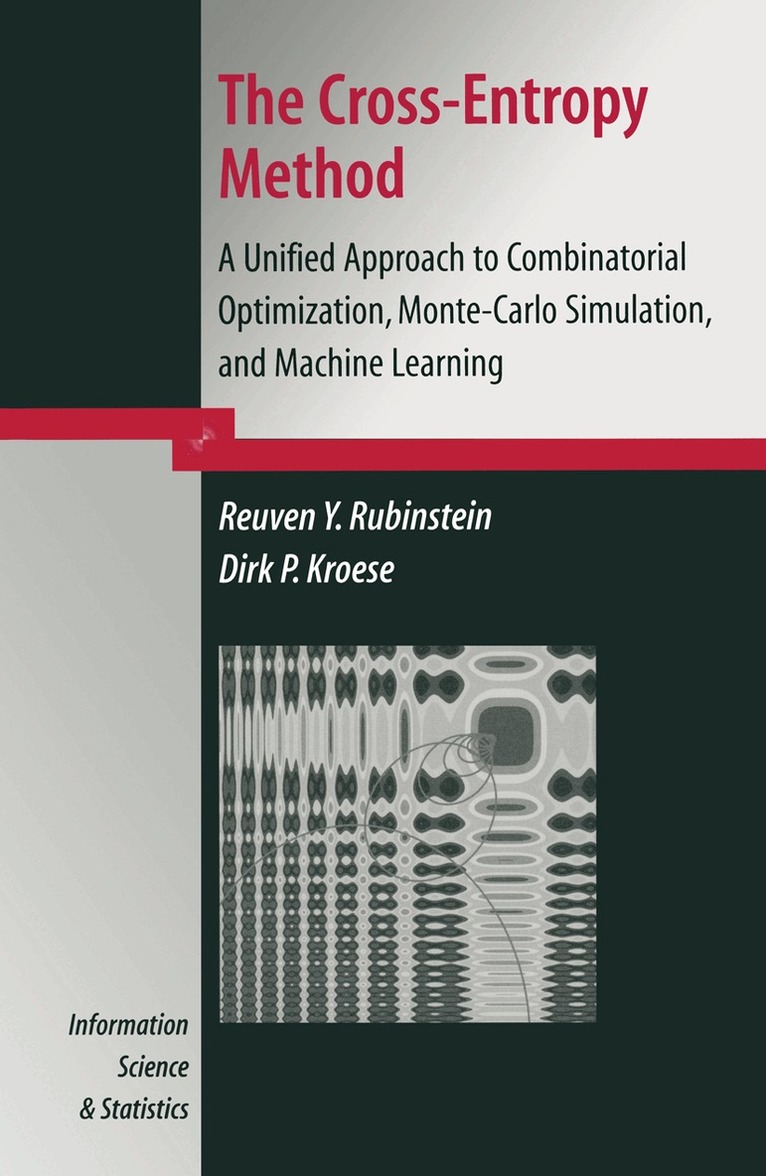
The cross-entropy method to rare events estimation and combinatorial optimization
Application of Monte Carlo techniques for counting problems, with an emphasis on the parametric minimum cross-entropy method
An extensive range of exercises is provided at the end of each chapter, with more difficult sections and exercises marked accordingly for advanced readers. A generous sampling of applied examples is positioned throughout the book, emphasizing various areas of application, and a detailed appendix presents an introduction to exponential families, a discussion of the computational complexity of stochastic programming problems, and sample MATLAB® programs.
Requiring only a basic, introductory knowledge of probability and statistics, Simulation and the Monte Carlo Method, Second Edition is an excellent text for upper-undergraduate and beginning graduate courses in simulation and Monte Carlo techniques. The book also serves as a valuable reference for professionals who would like to achieve a more formal understanding of the Monte Carlo method.
1 765 kr
Läs direkt efter köp
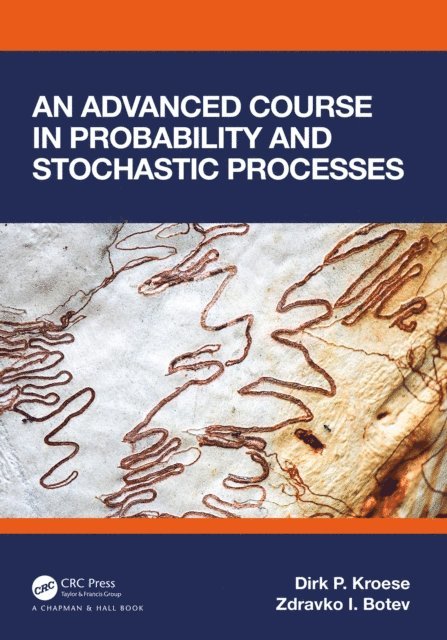
An Advanced Course in Probability and Stochastic Processes provides a modern and rigorous treatment of probability theory and stochastic processes at an upper undergraduate and graduate level. Starting with the foundations of measure theory, this book introduces the key concepts of probability theory in an accessible way, providing full proofs and extensive examples and illustrations. Fundamental stochastic processes such as Gaussian processes, Poisson random measures, Lévy processes, Markov processes, and Itô processes are presented and explored in considerable depth, showcasing their many interconnections. Special attention is paid to martingales and the Wiener process and their central role in the treatment of stochastic integrals and stochastic calculus. This book includes many exercises, designed to test and challenge the reader and expand their skillset. An Advanced Course in Probability and Stochastic Processes is meant for students and researchers who have a solid mathematical background and who have had prior exposure to elementary probability and stochastic processes.
Key Features:
Focus on mathematical understanding Rigorous and self-contained Accessible and comprehensive High-quality illustrations Includes essential simulation algorithms Extensive list of exercises and worked-out examples Elegant and consistent notation1 763 kr
Skickas inom 10-15 vardagar
1 395 kr
Läs direkt efter köp
1 395 kr
Läs direkt efter köp
1 401 kr
Skickas inom 10-15 vardagar
1 672 kr
Läs direkt efter köp
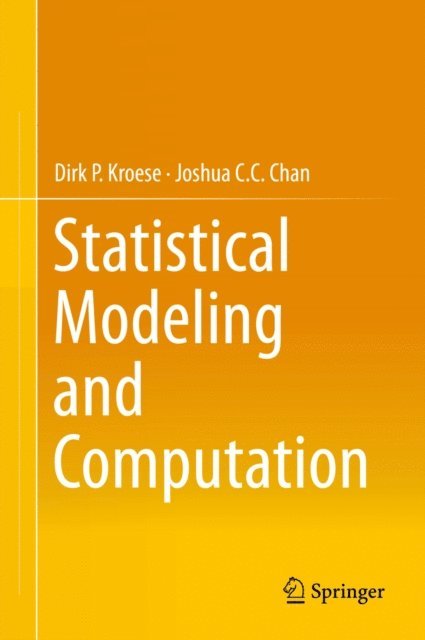
This book, Statistical Modeling and Computation, provides a unique introduction to modern statistics from both classical and Bayesian perspectives. It also offers an integrated treatment of mathematical statistics and modern statistical computation, emphasizing statistical modeling, computational techniques, and applications.
The 2nd edition changes the programming language used in the text from MATLAB to Julia. For all examples with computing components, the authors provide data sets and their own Julia codes. The new edition features numerous full color graphics to illustrate the concepts discussed in the text, and adds three entirely new chapters on a variety of popular topics, including:
Regularization and the Lasso regressionBayesian shrinkage methodsNonparametric statistical testsSplines and the Gaussian process regressionJoshua C. C. Chan is Professor of Economics, and holds the endowed Olson Chair at Purdue University. He is an elected fellow at the International Association for Applied Econometrics and served as Chair for the Economics, Finance and Business Section of the International Society for Bayesian Analysis from 2020-2022. His research focuses on building new high-dimensional time-series models and developing efficient estimation methods for these models. He has published over 50 papers in peer-reviewed journals, including some top-field journals such as Journal of Econometrics, Journal of the American Statistical Association and Journal of Business and Economic Statistics.
Dirk Kroese is Professor of Mathematics and Statistics at the University of Queensland. He is known for his significant contributions to the fields of applied probability, mathematical statistics, machine learning, and Monte Carlo methods. He has published over 140 articles and 7 books. He is a pioneer of the well-known Cross-Entropy (CE) method, which is being used around the world to help solve difficult estimation and optimization problems in science, engineering, and finance. In addition to his scholarly contributions, Dirk Kroese is recognized for his role as an educator and mentor, having supervised and inspired numerous students and researchers.
1 080 kr
Skickas inom 10-15 vardagar
2 198 kr
Läs direkt efter köp
More and more of today’s numerical problems found in engineering and finance are solved through Monte Carlo methods. The heightened popularity of these methods and their continuing development makes it important for researchers to have a comprehensive understanding of the Monte Carlo approach. Handbook of Monte Carlo Methods provides the theory, algorithms, and applications that helps provide a thorough understanding of the emerging dynamics of this rapidly-growing field.
The authors begin with a discussion of fundamentals such as how to generate random numbers on a computer. Subsequent chapters discuss key Monte Carlo topics and methods, including:
Random variable and stochastic process generation Markov chain Monte Carlo, featuring key algorithms such as the Metropolis-Hastings method, the Gibbs sampler, and hit-and-run Discrete-event simulation Techniques for the statistical analysis of simulation data including the delta method, steady-state estimation, and kernel density estimation Variance reduction, including importance sampling, latin hypercube sampling, and conditional Monte Carlo Estimation of derivatives and sensitivity analysis Advanced topics including cross-entropy, rare events, kernel density estimation, quasi Monte Carlo, particle systems, and randomized optimizationThe presented theoretical concepts are illustrated with worked examples that use MATLAB®, a related Web site houses the MATLAB® code, allowing readers to work hands-on with the material and also features the author''s own lecture notes on Monte Carlo methods. Detailed appendices provide background material on probability theory, stochastic processes, and mathematical statistics as well as the key optimization concepts and techniques that are relevant to Monte Carlo simulation.
Handbook of Monte Carlo Methods is an excellent reference for applied statisticians and practitioners working in the fields of engineering and finance who use or would like to learn how to use Monte Carlo in their research. It is also a suitable supplement for courses on Monte Carlo methods and computational statistics at the upper-undergraduate and graduate levels.
2 278 kr
Läs direkt efter köp
More and more of today’s numerical problems found in engineering and finance are solved through Monte Carlo methods. The heightened popularity of these methods and their continuing development makes it important for researchers to have a comprehensive understanding of the Monte Carlo approach. Handbook of Monte Carlo Methods provides the theory, algorithms, and applications that helps provide a thorough understanding of the emerging dynamics of this rapidly-growing field.
The authors begin with a discussion of fundamentals such as how to generate random numbers on a computer. Subsequent chapters discuss key Monte Carlo topics and methods, including:
Random variable and stochastic process generation Markov chain Monte Carlo, featuring key algorithms such as the Metropolis-Hastings method, the Gibbs sampler, and hit-and-run Discrete-event simulation Techniques for the statistical analysis of simulation data including the delta method, steady-state estimation, and kernel density estimation Variance reduction, including importance sampling, latin hypercube sampling, and conditional Monte Carlo Estimation of derivatives and sensitivity analysis Advanced topics including cross-entropy, rare events, kernel density estimation, quasi Monte Carlo, particle systems, and randomized optimizationThe presented theoretical concepts are illustrated with worked examples that use MATLAB®, a related Web site houses the MATLAB® code, allowing readers to work hands-on with the material and also features the author''s own lecture notes on Monte Carlo methods. Detailed appendices provide background material on probability theory, stochastic processes, and mathematical statistics as well as the key optimization concepts and techniques that are relevant to Monte Carlo simulation.
Handbook of Monte Carlo Methods is an excellent reference for applied statisticians and practitioners working in the fields of engineering and finance who use or would like to learn how to use Monte Carlo in their research. It is also a suitable supplement for courses on Monte Carlo methods and computational statistics at the upper-undergraduate and graduate levels.
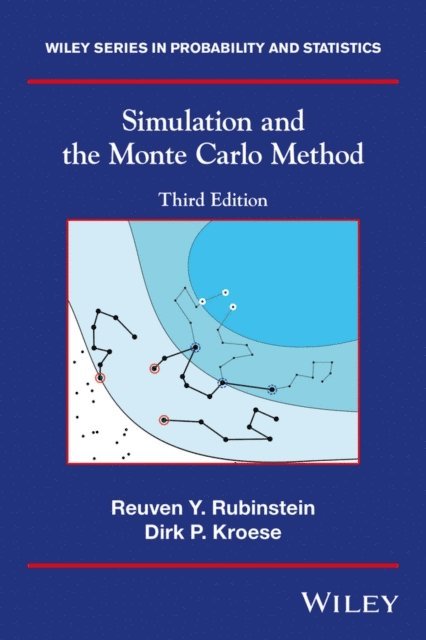
Simulation and the Monte Carlo Method
1 505 kr
Skickas inom 5-8 vardagar
1 740 kr
Läs direkt efter köp
This accessible new edition explores the major topics in Monte Carlo simulation that have arisen over the past 30 years and presents a sound foundation for problem solving
Simulation and the Monte Carlo Method, Third Edition reflects the latest developments in the field and presents a fully updated and comprehensive account of the state-of-the-art theory, methods and applications that have emerged in Monte Carlo simulation since the publication of the classic First Edition over more than a quarter of a century ago. While maintaining its accessible and intuitive approach, this revised edition features a wealth of up-to-date information that facilitates a deeper understanding of problem solving across a wide array of subject areas, such as engineering, statistics, computer science, mathematics, and the physical and life sciences. The book begins with a modernized introduction that addresses the basic concepts of probability, Markov processes, and convex optimization. Subsequent chapters discuss the dramatic changes that have occurred in the field of the Monte Carlo method, with coverage of many modern topics including: Markov Chain Monte Carlo, variance reduction techniques such as importance (re-)sampling, and the transform likelihood ratio method, the score function method for sensitivity analysis, the stochastic approximation method and the stochastic counter-part method for Monte Carlo optimization, the cross-entropy method for rare events estimation and combinatorial optimization, and application of Monte Carlo techniques for counting problems. An extensive range of exercises is provided at the end of each chapter, as well as a generous sampling of applied examples.
The Third Edition features a new chapter on the highly versatile splitting method, with applications to rare-event estimation, counting, sampling, and optimization. A second new chapter introduces the stochastic enumeration method, which is a new fast sequential Monte Carlo method for tree search. In addition, the Third Edition features new material on:
• Random number generation, including multiple-recursive generators and the Mersenne Twister
• Simulation of Gaussian processes, Brownian motion, and diffusion processes
• Multilevel Monte Carlo method
• New enhancements of the cross-entropy (CE) method, including the “improved” CE method, which uses sampling from the zero-variance distribution to find the optimal importance sampling parameters
• Over 100 algorithms in modern pseudo code with flow control
• Over 25 new exercises
Simulation and the Monte Carlo Method, Third Edition is an excellent text for upper-undergraduate and beginning graduate courses in stochastic simulation and Monte Carlo techniques. The book also serves as a valuable reference for professionals who would like to achieve a more formal understanding of the Monte Carlo method.
Reuven Y. Rubinstein, DSc, was Professor Emeritus in the Faculty of Industrial Engineering and Management at Technion-Israel Institute of Technology. He served as a consultant at numerous large-scale organizations, such as IBM, Motorola, and NEC. The author of over 100 articles and six books, Dr. Rubinstein was also the inventor of the popular score-function method in simulation analysis and generic cross-entropy methods for combinatorial optimization and counting.
Dirk P. Kroese, PhD, is a Professor of Mathematics and Statistics in the School of Mathematics and Physics of The University of Queensland, Australia. He has published over 100 articles and four books in a wide range of areas in applied probability and statistics, including Monte Carlo methods, cross-entropy, randomized algorithms, tele-traffic c theory, reliability, computational statistics, applied probability, and stochastic modeling.
1 679 kr
Läs direkt efter köp
This accessible new edition explores the major topics in Monte Carlo simulation that have arisen over the past 30 years and presents a sound foundation for problem solving
Simulation and the Monte Carlo Method, Third Edition reflects the latest developments in the field and presents a fully updated and comprehensive account of the state-of-the-art theory, methods and applications that have emerged in Monte Carlo simulation since the publication of the classic First Edition over more than a quarter of a century ago. While maintaining its accessible and intuitive approach, this revised edition features a wealth of up-to-date information that facilitates a deeper understanding of problem solving across a wide array of subject areas, such as engineering, statistics, computer science, mathematics, and the physical and life sciences. The book begins with a modernized introduction that addresses the basic concepts of probability, Markov processes, and convex optimization. Subsequent chapters discuss the dramatic changes that have occurred in the field of the Monte Carlo method, with coverage of many modern topics including: Markov Chain Monte Carlo, variance reduction techniques such as importance (re-)sampling, and the transform likelihood ratio method, the score function method for sensitivity analysis, the stochastic approximation method and the stochastic counter-part method for Monte Carlo optimization, the cross-entropy method for rare events estimation and combinatorial optimization, and application of Monte Carlo techniques for counting problems. An extensive range of exercises is provided at the end of each chapter, as well as a generous sampling of applied examples.
The Third Edition features a new chapter on the highly versatile splitting method, with applications to rare-event estimation, counting, sampling, and optimization. A second new chapter introduces the stochastic enumeration method, which is a new fast sequential Monte Carlo method for tree search. In addition, the Third Edition features new material on:
• Random number generation, including multiple-recursive generators and the Mersenne Twister
• Simulation of Gaussian processes, Brownian motion, and diffusion processes
• Multilevel Monte Carlo method
• New enhancements of the cross-entropy (CE) method, including the “improved” CE method, which uses sampling from the zero-variance distribution to find the optimal importance sampling parameters
• Over 100 algorithms in modern pseudo code with flow control
• Over 25 new exercises
Simulation and the Monte Carlo Method, Third Edition is an excellent text for upper-undergraduate and beginning graduate courses in stochastic simulation and Monte Carlo techniques. The book also serves as a valuable reference for professionals who would like to achieve a more formal understanding of the Monte Carlo method.
Reuven Y. Rubinstein, DSc, was Professor Emeritus in the Faculty of Industrial Engineering and Management at Technion-Israel Institute of Technology. He served as a consultant at numerous large-scale organizations, such as IBM, Motorola, and NEC. The author of over 100 articles and six books, Dr. Rubinstein was also the inventor of the popular score-function method in simulation analysis and generic cross-entropy methods for combinatorial optimization and counting.
Dirk P. Kroese, PhD, is a Professor of Mathematics and Statistics in the School of Mathematics and Physics of The University of Queensland, Australia. He has published over 100 articles and four books in a wide range of areas in applied probability and statistics, including Monte Carlo methods, cross-entropy, randomized algorithms, tele-traffic c theory, reliability, computational statistics, applied probability, and stochastic modeling.
1 240 kr
Skickas inom 10-15 vardagar
1 519 kr
Läs direkt efter köp
This textbook on statistical modeling and statistical inference will assist advanced undergraduate and graduate students. Statistical Modeling and Computation provides a unique introduction to modern Statistics from both classical and Bayesian perspectives. It also offers an integrated treatment of Mathematical Statistics and modern statistical computation, emphasizing statistical modeling, computational techniques, and applications. Each of the three parts will cover topics essential to university courses. Part I covers the fundamentals of probability theory. In Part II, the authors introduce a wide variety of classical models that include, among others, linear regression and ANOVA models. In Part III, the authors address the statistical analysis and computation of various advanced models, such as generalized linear, state-space and Gaussian models. Particular attention is paid to fast Monte Carlo techniques for Bayesian inference on these models. Throughout the book the authors include a large number of illustrative examples and solved problems. The book also features a section with solutions, an appendix that serves as a MATLAB primer, and a mathematical supplement.
1 575 kr
Läs direkt efter köp
1 439 kr
Skickas inom 5-8 vardagar