Donald Vandergriff – författare
Visar alla böcker från författaren Donald Vandergriff. Handla med fri frakt och snabb leverans.
6 produkter
6 produkter
Inbunden, Engelska, 2008
1 041 kr
Skickas inom 10-15 vardagar
An Industrial Age model continues to shape the way the Army approaches its recruiting, personnel management, training, and education. This outdated personnel management paradigm—designed for an earlier era—has been so intimately tied to the maintenance of Army culture that a self-perpetuating cycle has formed, diminishing the Army's attempts to develop adaptive leaders and institutions.This cycle can be broken only if the Army accepts rapid evolutionary change as the norm of the new era. Recruiting the right people, then having them step into an antiquated organization, means that many of them will not stay as they find their ability to contribute and develop limited by a centralized, hierarchical organization. Recruiting and retention data bear this out.Several factors have combined to force the Army to think about the way it develops and nurtures its leaders. Yet, Vandergriff maintains, mere modifications to today's paradigm may not be enough. Today's Army has to do more than post rhetoric about adaptability on briefing slides and in literature. One cannot divorce the way the Army accesses, promotes, and selects its leaders from its leadership-development model. The Army cannot expect to maintain leaders who grasp and practice adaptability if these officers encounter an organization that is neither adaptive nor innovative. Instead, Army culture must become adaptive, and the personnel system must evolve into one that nurtures adaptability in its policies, practices, and beliefs. Only a detailed, comprehensive plan where nothing is sacred will pave the way to cultural evolution.
E-bok
PDF, Engelska, 20081 095 kr
Läs direkt efter köp
An Industrial Age model continues to shape the way the Army approaches its recruiting, personnel management, training, and education. This outdated personnel management paradigm—designed for an earlier era—has been so intimately tied to the maintenance of Army culture that a self-perpetuating cycle has formed, diminishing the Army's attempts to develop adaptive leaders and institutions.This cycle can be broken only if the Army accepts rapid evolutionary change as the norm of the new era. Recruiting the right people, then having them step into an antiquated organization, means that many of them will not stay as they find their ability to contribute and develop limited by a centralized, hierarchical organization. Recruiting and retention data bear this out.Several factors have combined to force the Army to think about the way it develops and nurtures its leaders. Yet, Vandergriff maintains, mere modifications to today's paradigm may not be enough. Today's Army has to do more than post rhetoric about adaptability on briefing slides and in literature. One cannot divorce the way the Army accesses, promotes, and selects its leaders from its leadership-development model. The Army cannot expect to maintain leaders who grasp and practice adaptability if these officers encounter an organization that is neither adaptive nor innovative. Instead, Army culture must become adaptive, and the personnel system must evolve into one that nurtures adaptability in its policies, practices, and beliefs. Only a detailed, comprehensive plan where nothing is sacred will pave the way to cultural evolution.
E-bok
Engelska, 2019664 kr
Läs direkt efter köp
In September 2010, James G. Pierce, a retired U.S. Army colonel with the Strategic Studies Institute at the U.S. Army War College in Carlisle Barracks, Pennsylvania, published a study on Army organizational culture. Pierce postulated that "the ability of a professional organization to develop future leaders in a manner that perpetuates readiness to cope with future environmental and internal uncertainty depends on organizational culture." He found that today''s U.S. Army leadership "may be inadequately prepared to lead the profession toward future success." The need to prepare for future success dovetails with the use of the concepts of mission command. This book offers up a set of recommendations, based on those mission command concepts, for adopting a superior command culture through education and training. Donald E. Vandergriff believes by implementing these recommendations across the Army, that other necessary and long-awaited reforms will take place.
Inbunden, Engelska, 2019
424 kr
Skickas inom 5-8 vardagar
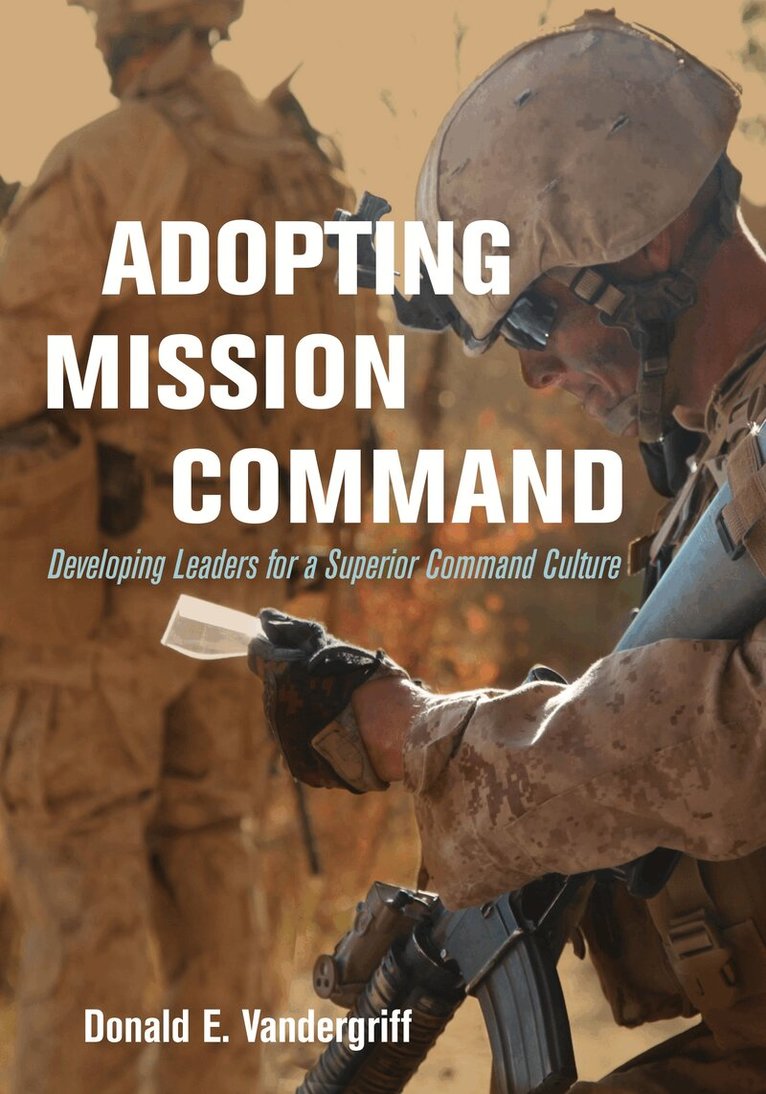
In September 2010, James G. Pierce, a retired U.S. Army colonel with the Strategic Studies Institute at the U.S. Army War College in Carlisle Barracks, Pennsylvania, published a study on Army organizational culture. Pierce postulated that "the ability of a professional organization to develop future leaders in a manner that perpetuates readiness to cope with future environmental and internal uncertainty depends on organizational culture." He found that today's U.S. Army leadership "may be inadequately prepared to lead the profession toward future success."The need to prepare for future success dovetails with the use of the concepts of mission command. This book offers up a Set of recommendations, based on those mission command concepts, for adopting a superior command culture through education and training. Donald E. Vandergriff believes by implementing these recommendations across the Army, that other necessary and long-awaited reforms will take place.
Inbunden, Engelska, 2026
374 kr
Skickas inom 5-8 vardagar
Häftad, Engelska, 2026
235 kr
Skickas inom 5-8 vardagar