Doris Aaronson – författare
Visar alla böcker från författaren Doris Aaronson. Handla med fri frakt och snabb leverans.
7 produkter
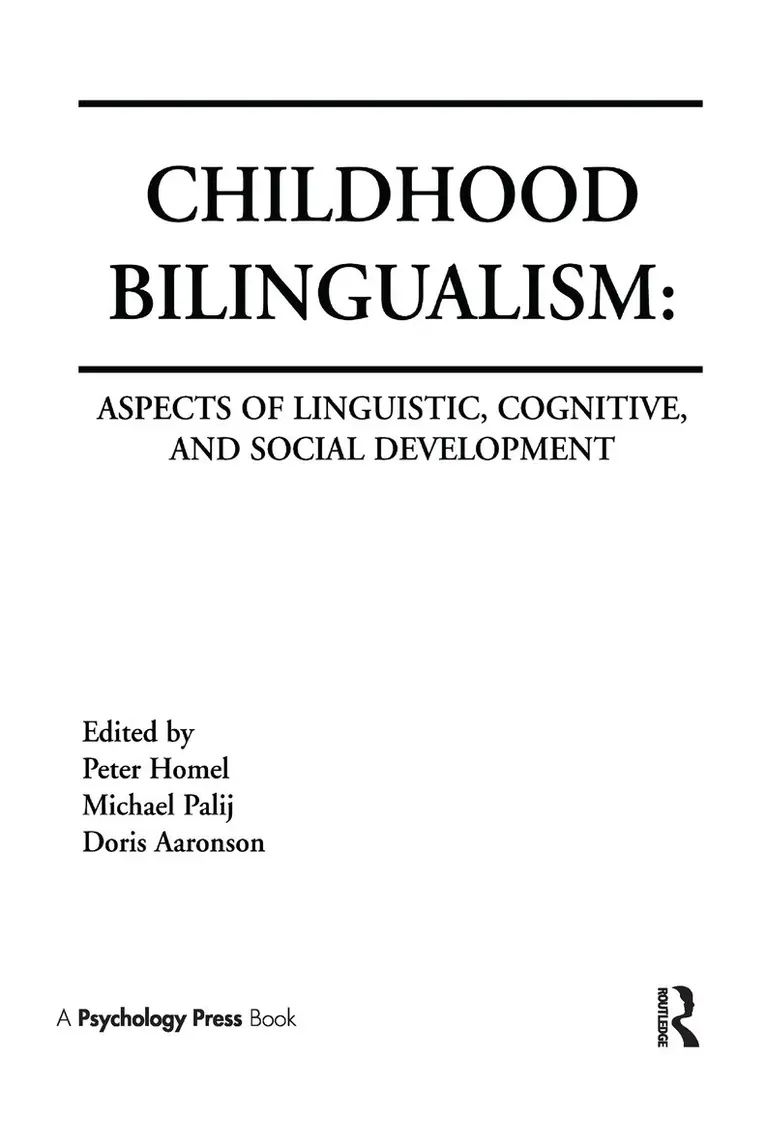
Childhood Bilingualism
Aspects of Linguistic, Cognitive, and Social Development
Av Peter Homel, Michael Palij m. fl.
Inbunden, 1987
788 kr
Lägg i varukorg
First published in 1987. This volume is based primarily on a conference on childhood bilingualism held at New York University on June 25 and 26, 1982 with an interest in exploring the nature of bilingual cognition and the effect of bilingualism on psychological development.
Psycholinguistic Research (PLE: Psycholinguistics)
Implications and Applications
Av Robert Rieber, Doris Aaronson
E-bok, 2013
840 kr
Lägg i varukorg
Originally published in 1979, this book represents an effort to bring together the two disciplines at the core of psycholinguistics, psychology and linguistics. It discusses a broad variety of theoretical approaches to psycholinguistics as well as covering a wide range of topics. At the time the …
Psycholinguistic Research (PLE: Psycholinguistics)
Implications and Applications
Av Robert Rieber, Doris Aaronson
E-bok, 2013
858 kr
Lägg i varukorg
Originally published in 1979, this book represents an effort to bring together the two disciplines at the core of psycholinguistics, psychology and linguistics. It discusses a broad variety of theoretical approaches to psycholinguistics as well as covering a wide range of topics. At the time the …
Psycholinguistic Research (PLE: Psycholinguistics)
Implications and Applications
Av Doris Aaronson, Robert Rieber
Häftad, 2015
730 kr
Lägg i varukorg
Originally published in 1979, this book represents an effort to bring together the two disciplines at the core of psycholinguistics, psychology and linguistics. It discusses a broad variety of theoretical approaches to psycholinguistics as well as covering a wide range of topics. At the time the …
Childhood Bilingualism
Aspects of Linguistic, Cognitive, and Social Development
Av Doris Aaronson, Michael Palij m. fl.
E-bok, 2014
741 kr
Lägg i varukorg
First published in 1987. This volume is based primarily on a conference on childhood bilingualism held at New York University on June 25 and 26, 1982 with an interest in exploring the nature of bilingual cognition and the effect of bilingualism on psychological development.
Childhood Bilingualism
Aspects of Linguistic, Cognitive, and Social Development
Av Doris Aaronson, Michael Palij m. fl.
E-bok, 2014
741 kr
Lägg i varukorg
First published in 1987. This volume is based primarily on a conference on childhood bilingualism held at New York University on June 25 and 26, 1982 with an interest in exploring the nature of bilingual cognition and the effect of bilingualism on psychological development.
Psycholinguistic Research (PLE: Psycholinguistics)
Implications and Applications
Av Doris Aaronson, Robert Rieber
Inbunden, 2013
2983 kr
Lägg i varukorg
Originally published in 1979, this book represents an effort to bring together the two disciplines at the core of psycholinguistics, psychology and linguistics. It discusses a broad variety of theoretical approaches to psycholinguistics as well as covering a wide range of topics. At the time the …