Douglas Arner – författare
Visar alla böcker från författaren Douglas Arner. Handla med fri frakt och snabb leverans.
7 produkter
Finance in Asia
Av Qiao Liu, Paul Lejot m. fl.
2013
7066 kr
Lägg i varukorg
Edited by three leading scholars whose expertise spans finance, economics, and law, Finance in Asia is a new collection from Routledge’s Critical Concepts in Finance series. The foundational and cutting-edge scholarship assembled in this easy-to-use, one-stop resource enables users easily to access …
Project Finance for Construction and Infrastructure
Principles and Case Studies
Av Arthur McInnes, Paul Lejot m. fl.
E-bok, 2008
1776 kr
Lägg i varukorg
This is a self-contained text on the logic and institutions of project finance, supplemented by a series of project finance case studies illustrating applications in different economic environments, across different jurisdictions and at different stages of development. It will introduce an …
Project Finance for Construction and Infrastructure
Principles and Case Studies
Av Frederik Pretorius, Douglas Arner m. fl.
Inbunden, 2007
1534 kr
Lägg i varukorg
This is a self-contained text on the logic and institutions of project finance, supplemented by a series of project finance case studies illustrating applications in different economic environments, across different jurisdictions and at different stages of development.It will introduce an …
International Economic Law
The State and Future of the Discipline
Av Colin Picker, Isabella D Bunn m. fl.
Häftad, 2008
1178 kr
Lägg i varukorg
'Bretton Woods' has become shorthand for the post-war international financial and economic framework. Mindful of the historic 1944 conference and its legacy for the discipline of international economic law, the American Society of International Law's International Economic Law Group (IELG) chose …
International Economic Law
The State and Future of the Discipline
Av Colin Picker, Isabella D Bunn m. fl.
E-bok, 2008
1291 kr
Lägg i varukorg
''Bretton Woods'' has become shorthand for the post-war international financial and economic framework. Mindful of the historic 1944 conference and its legacy for the discipline of international economic law, the American Society of International Law''s International Economic Law Group (IELG) chose …
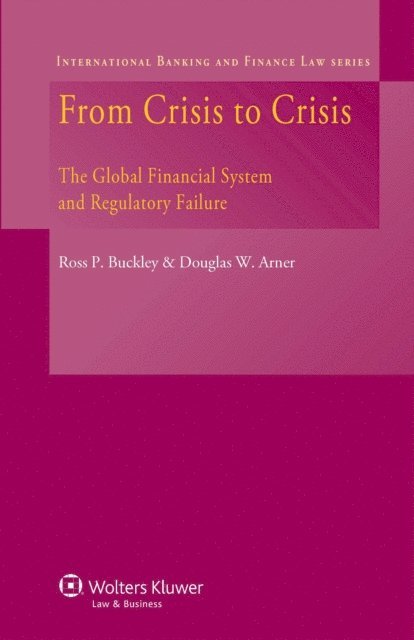
From Crisis to Crisis
The Global Financial System and Regulatory Failure
Av Douglas Arner, Ross Buckley
E-bok, 2011
1819 kr
Lägg i varukorg
The global financial system has proven increasingly unstable and crisis-prone since the early 1980s. The system has failed to serve either creditors or debtors well. This has been reinforced by the global financial crisis of 2008, where we have seen systemic weaknesses bring rich countries to the …
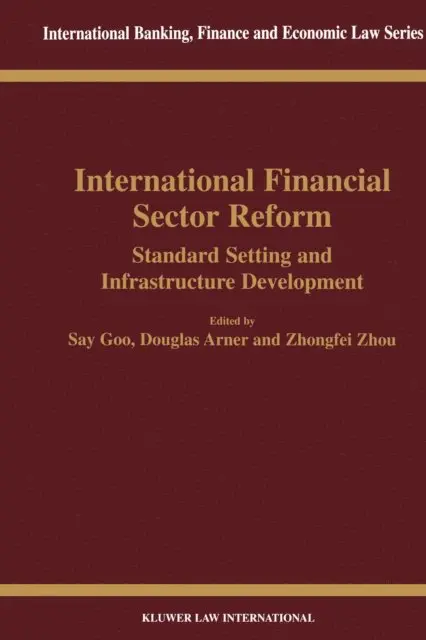
International Financial Sector Reform: Standard Setting and Infrastructure Development
Av Douglas Arner, Say Goo
E-bok, 2002
4632 kr
Lägg i varukorg
In the wake of the Asian financial crisis that erupted in 1997, an intense scrutiny of the principles and standards of the world''s financial system was inevitable. This new book, a major milestone in the progressive development of the new financial architecture arising from the debacle, represents …