D.R. Owens – författare
Visar alla böcker från författaren D.R. Owens. Handla med fri frakt och snabb leverans.
4 produkter
4 produkter
E-bok
PDF, Engelska, 2012687 kr
Läs direkt efter köp
E-bok
PDF, Engelska, 2012708 kr
Läs direkt efter köp
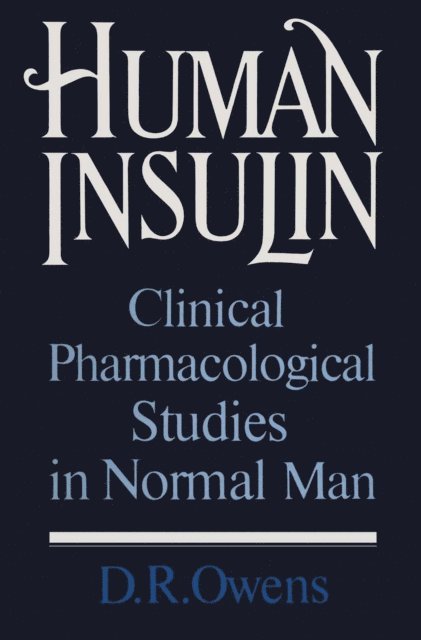
Since insulin became available for the treatment of diabetes in 1922 a number of major advances have been made, which include the modification of insulin to vary its timing of action, its purification, and latterly, the production of human insulin. Human insulin in quantities sufficiently large for therapy has been made available by two techniques developed in parallel during the late 1970s. These involve either (i) formulation in E. coli bacteria suitably encoded by DNA recombinant methods of the A- and B-chains of human insulin followed by a chain combination reaction (''biosynthetic'' human insulin) or (ii) enzymatic conversion (transpeptidation) of porcine insulin brought to react with a threonine ester by porcine trypsin in a mixture of water and organic solvents, yielding human insulin (''semi-synthetic'' human insulin). This book includes the first clinical-pharmacological studies of each of the highly purified ''semi-synthetic'' human insulin preparations: Actrapid ® HM; Monotard® HM; Protaphane® HM; Actraphane® HM; and Ultratard® HM (Novo Industri A/S, Copenhagen). The preliminary studies established their safety and efficacy relative to their porcine and bovine counterparts emphasising the relevance of species and formulation on the pharmacokinetics and biological responses to insulin. Additional investigations with human insulin demonstrated the influence of insulin concentration, site of administration, the addition of aprotinin to insulin and the mixing of ''short-'' and ''intermediate-acting'' formulations on insulin ''bioavailability''. Examination of the ''within'' and ''between'' subject day-to-day variation in absorption and the effect of subcutaneous insulin also demonstrates the dominating influence of insulin responsiveness.
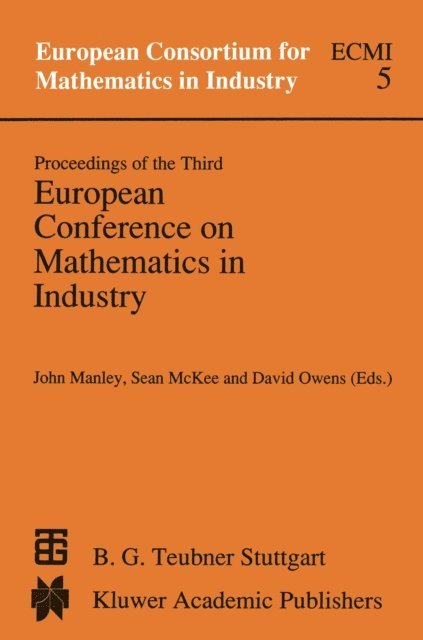
Del 5 - European Consortium for Mathematics in Industry
Proceedings of the Third European Conference on Mathematics in Industry
August 28–31, 1988 Glasgow
Häftad, Engelska, 2012
549 kr
Skickas inom 10-15 vardagar
The European Consortium for Mathematics in Industry (ECMI) was founded, largely due to the driving energy of Michiel Hazewinkel on the 14th April, 1986 in Neustadt-Mussbach in West Germany. The founder signatories were A. Bensoussan (INRIA, Paris), A. Fasano (University of Florence), M. Hazewinkel (CWI, Amsterdam), M. Heilio (Lappeenranta University, Finland), F. Hodnett (University of Limerick, Ireland), H. Martens (Norwegian Institute of Technology, Trondheim), S. McKee (University of Strathclyde, Scotland), H. NeURzert (University of Kaiserslautern, Germany), D. Sundstrom (The Swedish Institute of Applied Mathematics, Stockholm), A. Tayler (University of Oxford, England) and Hj. Wacker (University of Linz, Austria). The European Consortium for Mathematics in Industry is dedicated to: (a) promote the use of mathematical models in Industry (b) educate industrial mathematicians to meet the growing demand for such experts (c) operate on a European scale. ECMI is still a young organisation but its membership is growing fast.Although it has still to persuade more industrialists to join, ECMI certainly operates on a European scale and a flourishing postgraduate programme with student exchange has been underway for some time. It is perhaps fitting that the first open meeting of ECMI was held at the University of Strathclyde in Glasgow. Glasgow is and was the industrial capital of Scotland and was, and arguably still is, Britain's second city after London; when this volume appears it will have rightly donned the mantle of the cultural capital of Europe.

Häftad, Engelska, 2011
565 kr
Skickas inom 10-15 vardagar
Since insulin became available for the treatment of diabetes in 1922 a number of major advances have been made, which include the modification of insulin to vary its timing of action, its purification, and latterly, the production of human insulin. Human insulin in quantities sufficiently large for therapy has been made available by two techniques developed in parallel during the late 1970s. These involve either (i) formulation in E. coli bacteria suitably encoded by DNA recombinant methods of the A- and B-chains of human insulin followed by a chain combination reaction ('biosynthetic' human insulin) or (ii) enzymatic conversion (transpeptidation) of porcine insulin brought to react with a threonine ester by porcine trypsin in a mixture of water and organic solvents, yielding human insulin ('semi-synthetic' human insulin). This book includes the first clinical-pharmacological studies of each of the highly purified 'semi-synthetic' human insulin preparations: Actrapid ® HM; Monotard® HM; Protaphane® HM; Actraphane® HM; and Ultratard® HM (Novo Industri A/S, Copenhagen). The preliminary studies established their safety and efficacy relative to their porcine and bovine counterparts emphasising the relevance of species and formulation on the pharmacokinetics and biological responses to insulin. Additional investigations with human insulin demonstrated the influence of insulin concentration, site of administration, the addition of aprotinin to insulin and the mixing of 'short-' and 'intermediate-acting' formulations on insulin 'bioavailability'. Examination of the 'within' and 'between' subject day-to-day variation in absorption and the effect of subcutaneous insulin also demonstrates the dominating influence of insulin responsiveness.