D.W. Stroock – författare
Visar alla böcker från författaren D.W. Stroock. Handla med fri frakt och snabb leverans.
5 produkter
5 produkter
Häftad, Engelska, 1984
816 kr
Skickas inom 10-15 vardagar
These notes are based on a course which I gave during the academic year 1983-84 at the University of Colorado. My intention was to provide both my audience as well as myself with an introduction to the theory of 1arie deviations • The organization of sections 1) through 3) owes something to chance and a great deal to the excellent set of notes written by R. Azencott for the course which he gave in 1978 at Saint-Flour (cf. Springer Lecture Notes in Mathematics 774). To be more precise: it is chance that I was around N. Y. U. at the time'when M. Schilder wrote his thesis. and so it may be considered chance that I chose to use his result as a jumping off point; with only minor variations. everything else in these sections is taken from Azencott. In particular. section 3) is little more than a rewrite of his exoposition of the Cramer theory via the ideas of Bahadur and Zabel. Furthermore. the brief treatment which I have given to the Ventsel-Freidlin theory in section 4) is again based on Azencott's ideas. All in all. the biggest difference between his and my exposition of these topics is the language in which we have written. However. another major difference must be mentioned: his bibliography is extensive and constitutes a fine introduction to the available literature. mine shares neither of these attributes. Starting with section 5).
E-bok
PDF, Engelska, 2012993 kr
Läs direkt efter köp
These notes are based on a course which I gave during the academic year 1983-84 at the University of Colorado. My intention was to provide both my audience as well as myself with an introduction to the theory of 1arie deviations • The organization of sections 1) through 3) owes something to chance and a great deal to the excellent set of notes written by R. Azencott for the course which he gave in 1978 at Saint-Flour (cf. Springer Lecture Notes in Mathematics 774). To be more precise: it is chance that I was around N. Y. U. at the time''when M. Schilder wrote his thesis. and so it may be considered chance that I chose to use his result as a jumping off point; with only minor variations. everything else in these sections is taken from Azencott. In particular. section 3) is little more than a rewrite of his exoposition of the Cramer theory via the ideas of Bahadur and Zabel. Furthermore. the brief treatment which I have given to the Ventsel-Freidlin theory in section 4) is again based on Azencott''s ideas. All in all. the biggest difference between his and my exposition of these topics is the language in which we have written. However. another major difference must be mentioned: his bibliography is extensive and constitutes a fine introduction to the available literature. mine shares neither of these attributes. Starting with section 5).
Häftad, Engelska, 2014
709 kr
Skickas inom 10-15 vardagar
The central and distinguishing feature shared by all the contributions made by K. Ito is the extraordinary insight which they convey. Reading his papers, one should try to picture the intellectual setting in which he was working. At the time when he was a student in Tokyo during the late 1930s, probability theory had only recently entered the age of continuous-time stochastic processes: N. Wiener had accomplished his amazing construction little more than a decade earlier (Wiener, N. , "Differential space," J. Math. Phys. 2, (1923)), Levy had hardly begun the mysterious web he was to eventually weave out of Wiener's P~!hs, the generalizations started by Kolmogorov (Kol mogorov, A. N. , "Uber die analytische Methoden in der Wahrscheinlichkeitsrechnung," Math Ann. 104 (1931)) and continued by Feller (Feller, W. , "Zur Theorie der stochastischen Prozesse," Math Ann. 113, (1936)) appeared to have little if anything to do with probability theory, and the technical measure-theoretic tours de force of J. L. Doob (Doob, J. L. , "Stochastic processes depending on a continuous parameter, " TAMS 42 (1937)) still appeared impregnable to all but the most erudite. Thus, even at the established mathematical centers in Russia, Western Europe, and America, the theory of stochastic processes was still in its infancy and the student who was asked to learn the subject had better be one who was ready to test his mettle.
E-bok
PDF, Engelska, 2006427 kr
Läs direkt efter köp
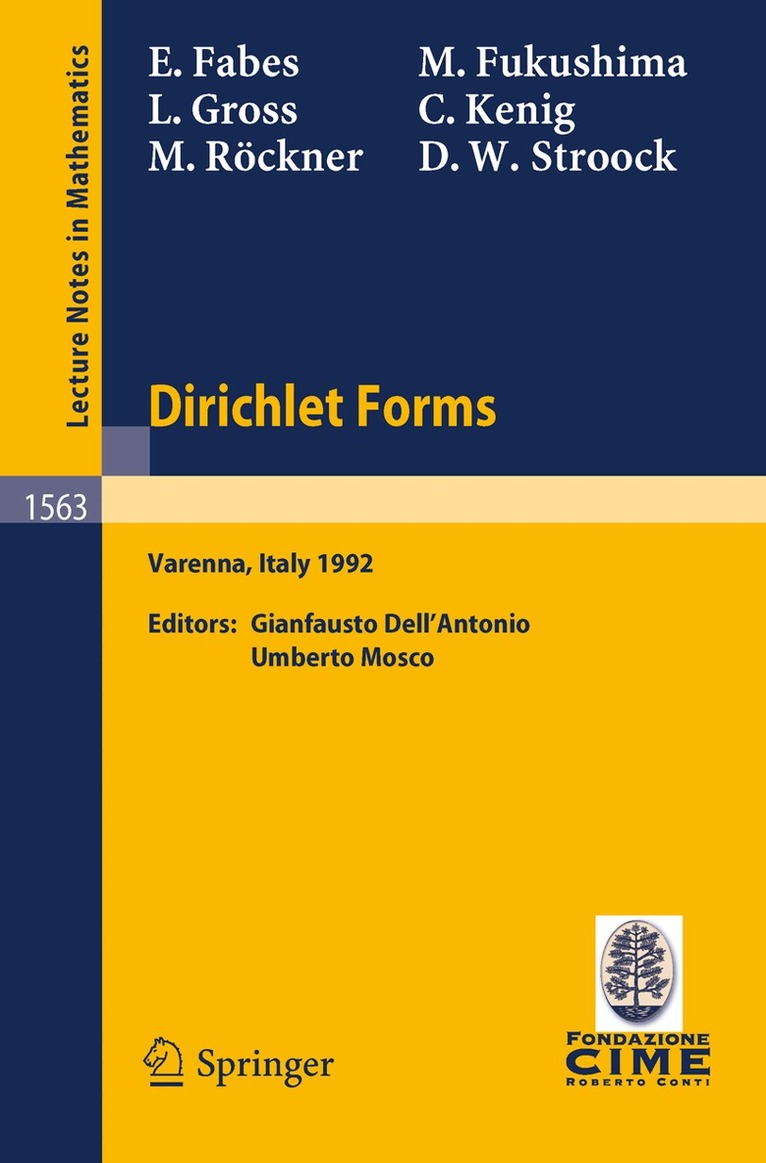
The theory of Dirichlet forms has witnessed recently somevery important developments both in theoretical foundationsand in applications (stochasticprocesses, quantum fieldtheory, composite materials,...). It was therefore felttimely to have on this subject a CIME school, in whichleading experts in the field would present both the basicfoundations of the theory and some of the recentapplications. The six courses covered the basic theory andapplications to:- Stochastic processes and potential theory (M. Fukushimaand M. Roeckner)- Regularity problems for solutions to elliptic equations ingeneral domains (E. Fabes and C. Kenig)- Hypercontractivity of semigroups, logarithmic Sobolevinequalities and relation to statistical mechanics (L. Grossand D. Stroock).The School had a constant and active participation of youngresearchers, both from Italy and abroad.
Del 1563 - Lecture Notes in Mathematics
Dirichlet Forms
Lectures given at the 1st Session of the Centro Internazionale Matematico Estivo (C.I.M.E.) held in Varenna, Italy, June 8-19, 1992
Häftad, Engelska, 1993
386 kr
Skickas inom 10-15 vardagar
The theory of Dirichlet forms has witnessed recently somevery important developments both in theoretical foundationsand in applications (stochasticprocesses, quantum fieldtheory, composite materials,...). It was therefore felttimely to have on this subject a CIME school, in whichleading experts in the field would present both the basicfoundations of the theory and some of the recentapplications. The six courses covered the basic theory andapplications to:- Stochastic processes and potential theory (M. Fukushimaand M. Roeckner)- Regularity problems for solutions to elliptic equations ingeneral domains (E. Fabes and C. Kenig)- Hypercontractivity of semigroups, logarithmic Sobolevinequalities and relation to statistical mechanics (L. Grossand D. Stroock).The School had a constant and active participation of youngresearchers, both from Italy and abroad.