
Dwight E. Neuenschwander – författare
Visar alla böcker från författaren . Handla med fri frakt och snabb leverans.
8 produkter
8 produkter
Häftad, Engelska, 2017
369 kr
Skickas
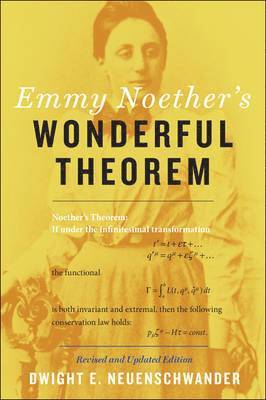
"In the judgment of the most competent living mathematicians, Fraulein Noether was the most significant creative mathematical genius thus far produced since the higher education of women began."-Albert Einstein The year was 1915, and the young mathematician Emmy Noether had just settled into Gottingen University when Albert Einstein visited to lecture on his nearly finished general theory of relativity. Two leading mathematicians of the day, David Hilbert and Felix Klein, dug into the new theory with gusto, but had difficulty reconciling it with what was known about the conservation of energy. Knowing of her expertise in invariance theory, they requested Noether's help. To solve the problem, she developed a novel theorem, applicable across all of physics, which relates conservation laws to continuous symmetries-one of the most important pieces of mathematical reasoning ever developed. Noether's "first" and "second" theorem was published in 1918. The first theorem relates symmetries under global spacetime transformations to the conservation of energy and momentum, and symmetry under global gauge transformations to charge conservation.In continuum mechanics and field theories, these conservation laws are expressed as equations of continuity. The second theorem, an extension of the first, allows transformations with local gauge invariance, and the equations of continuity acquire the covariant derivative characteristic of coupled matter-field systems. General relativity, it turns out, exhibits local gauge invariance. Noether's theorem also laid the foundation for later generations to apply local gauge invariance to theories of elementary particle interactions. In Dwight E. Neuenschwander's new edition of Emmy Noether's Wonderful Theorem, readers will encounter an updated explanation of Noether's "first" theorem. The discussion of local gauge invariance has been expanded into a detailed presentation of the motivation, proof, and applications of the "second" theorem, including Noether's resolution of concerns about general relativity. Other refinements in the new edition include an enlarged biography of Emmy Noether's life and work, parallels drawn between the present approach and Noether's original 1918 paper, and a summary of the logic behind Noether's theorem.
- Nyhet
Inbunden, Engelska, 2026
1 359 kr
Skickas inom 3-6 vardagar
An essential guide to understanding tensors through physics.Understanding tensors is essential for physics students who encounter phenomena where direction matters. A jet stream rushing overhead can trigger vertical convection that leads to thunderstorms. An unbalanced car wheel spinning around a horizontal axis produces a wobble in the vertical plane. Astronauts orbiting Earth observe an electrostatic field as a magnetic one. In all these cases, tensors offer a language that captures directional relationships with precision. In the second edition of Tensor Calculus for Physics, Dwight E. Neuenschwander provides an accessible guide that shows how tensor logic arises naturally from physical problems.Tensors' true elegance lies in how they transform: when coordinates change from one system to another, tensors follow the same rules, allowing physical laws to retain their form across perspectives. Students are often introduced to tensors piecemeal through the inertia tensor in classical mechanics or the polarization tensor in electricity and magnetism. While useful, this fragmented approach does not prepare the student for tensor features such as affine connections, dual basis vectors, and covariant derivatives they will encounter in advanced studies such as general relativity, continuum mechanics, or non-Euclidean geometry. This concise guide builds from the ground up, providing a clear, step-by-step progression that embeds tensors in contexts where their power becomes self-evident.This extensively revised second edition incorporates more illustrative examples and carefully designed homework problems to strengthen understanding. Now accompanied by a solutions manual, this edition is an ideal resource for courses in general relativity, covariant electrodynamics, continuum mechanics, fluid dynamics, materials science, and any discipline where tensors illuminate the structure of physical reality.
- Nyhet
Häftad, Engelska, 2026
861 kr
Skickas inom 3-6 vardagar
An essential guide to understanding tensors through physics.Understanding tensors is essential for physics students who encounter phenomena where direction matters. A jet stream rushing overhead can trigger vertical convection that leads to thunderstorms. An unbalanced car wheel spinning around a horizontal axis produces a wobble in the vertical plane. Astronauts orbiting Earth observe an electrostatic field as a magnetic one. In all these cases, tensors offer a language that captures directional relationships with precision. In the second edition of Tensor Calculus for Physics, Dwight E. Neuenschwander provides an accessible guide that shows how tensor logic arises naturally from physical problems.Tensors' true elegance lies in how they transform: when coordinates change from one system to another, tensors follow the same rules, allowing physical laws to retain their form across perspectives. Students are often introduced to tensors piecemeal through the inertia tensor in classical mechanics or the polarization tensor in electricity and magnetism. While useful, this fragmented approach does not prepare the student for tensor features such as affine connections, dual basis vectors, and covariant derivatives they will encounter in advanced studies such as general relativity, continuum mechanics, or non-Euclidean geometry. This concise guide builds from the ground up, providing a clear, step-by-step progression that embeds tensors in contexts where their power becomes self-evident.This extensively revised second edition incorporates more illustrative examples and carefully designed homework problems to strengthen understanding. Now accompanied by a solutions manual, this edition is an ideal resource for courses in general relativity, covariant electrodynamics, continuum mechanics, fluid dynamics, materials science, and any discipline where tensors illuminate the structure of physical reality.
Inbunden, Engelska, 2023
861 kr
Skickas inom 3-6 vardagar
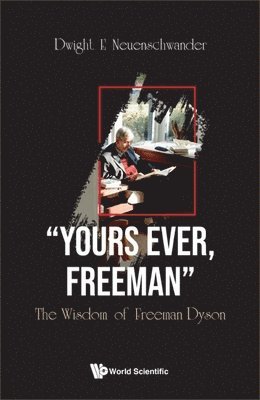
Freeman Dyson's life experiences made him a wise, kindly grandfather figure to two generations of students enrolled in an undergraduate university course "Science, Technology, & Society." Near the end of each semester, the class sent him written questions, on reading Professor Dyson's memoir Disturbing the Universe. The letter exchanges occurred regularly from April 1993 through December 2019."Yours Ever, Freeman" is devoted to this correspondence between Professor Dyson and the students. His responses went beyond answering questions, as he enlarged the scope of the questions by sharing stories from his experiences. While others have written of Professor Dyson's accomplishments and awards; the class came to know him through his discussions about life, science, and society. Topics ranged from the existential to headlines of the day, from national policies to personal values. Over three thousand students have been blessed to count Freeman Dyson as a mentor and consider him as a friend."Yours Ever, Freeman" supplements Dear Professor Dyson published earlier. While the 2016 book included in-depth reviews of the STS course contents from which the correspondence emerged, besides including the 2016-2019 correspondence, the present book maintains a tight focus on the correspondence itself, annotated as necessary for context. The book's title comes from the way Professor Dyson signed his letters.
Häftad, Engelska, 2023
569 kr
Skickas inom 5-8 vardagar
Freeman Dyson's life experiences made him a wise, kindly grandfather figure to two generations of students enrolled in an undergraduate university course "Science, Technology, & Society." Near the end of each semester, the class sent him written questions, on reading Professor Dyson's memoir Disturbing the Universe. The letter exchanges occurred regularly from April 1993 through December 2019."Yours Ever, Freeman" is devoted to this correspondence between Professor Dyson and the students. His responses went beyond answering questions, as he enlarged the scope of the questions by sharing stories from his experiences. While others have written of Professor Dyson's accomplishments and awards; the class came to know him through his discussions about life, science, and society. Topics ranged from the existential to headlines of the day, from national policies to personal values. Over three thousand students have been blessed to count Freeman Dyson as a mentor and consider him as a friend."Yours Ever, Freeman" supplements Dear Professor Dyson published earlier. While the 2016 book included in-depth reviews of the STS course contents from which the correspondence emerged, besides including the 2016-2019 correspondence, the present book maintains a tight focus on the correspondence itself, annotated as necessary for context. The book's title comes from the way Professor Dyson signed his letters.
Inbunden, Engelska, 2016
885 kr
Skickas inom 5-8 vardagar
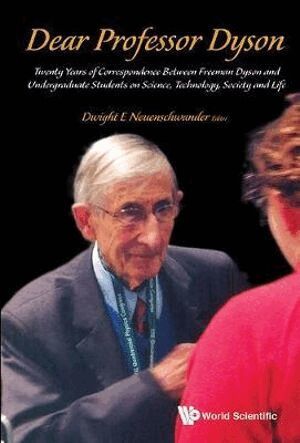
Freeman Dyson has designed nuclear reactors and bomb-powered spacecraft; he has studied the origins of life and the possibilities for the long-term future; he showed quantum mechanics to be consistent with electrodynamics and started cosmological eschatology; he has won international recognition for his work in science and for his work in reconciling science to religion; he has advised generals and congressional committees. An STS (Science, Technology, Society) curriculum or discussion group that engages topics such as nuclear policies, genetic technologies, environmental sustainability, the role of religion in a scientific society, and a hard look towards the future, would count itself privileged to include Professor Dyson as a class participant and mentor. In this book, STS topics are not discussed as objectified abstractions, but through personal stories.The reader is invited to observe Dyson's influence on a generation of young people as they wrestle with issues of science, technology, society, life in general and our place in the universe. The book is filled with personal anecdotes, student questions and responses, honest doubts and passions.
Häftad, Engelska, 2016
423 kr
Skickas
Freeman Dyson has designed nuclear reactors and bomb-powered spacecraft; he has studied the origins of life and the possibilities for the long-term future; he showed quantum mechanics to be consistent with electrodynamics and started cosmological eschatology; he has won international recognition for his work in science and for his work in reconciling science to religion; he has advised generals and congressional committees. An STS (Science, Technology, Society) curriculum or discussion group that engages topics such as nuclear policies, genetic technologies, environmental sustainability, the role of religion in a scientific society, and a hard look towards the future, would count itself privileged to include Professor Dyson as a class participant and mentor. In this book, STS topics are not discussed as objectified abstractions, but through personal stories.The reader is invited to observe Dyson's influence on a generation of young people as they wrestle with issues of science, technology, society, life in general and our place in the universe. The book is filled with personal anecdotes, student questions and responses, honest doubts and passions.
Häftad, Engelska, 2014
443 kr
Tillfälligt slut
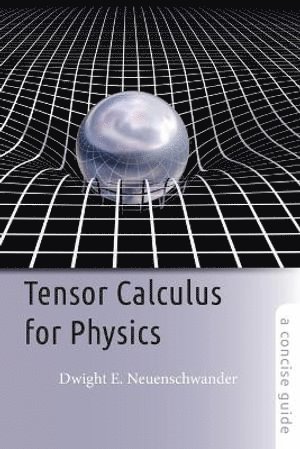
Understanding tensors is essential for any physics student dealing with phenomena where causes and effects have different directions. A horizontal electric field producing vertical polarization in dielectrics; an unbalanced car wheel wobbling in the vertical plane while spinning about a horizontal axis; an electrostatic field on Earth observed to be a magnetic field by orbiting astronauts-these are some situations where physicists employ tensors. But the true beauty of tensors lies in this fact: When coordinates are transformed from one system to another, tensors change according to the same rules as the coordinates. Tensors, therefore, allow for the convenience of coordinates while also transcending them. This makes tensors the gold standard for expressing physical relationships in physics and geometry. Undergraduate physics majors are typically introduced to tensors in special-case applications. For example, in a classical mechanics course, they meet the "inertia tensor," and in electricity and magnetism, they encounter the "polarization tensor."However, this piecemeal approach can set students up for misconceptions when they have to learn about tensors in more advanced physics and mathematics studies (e.g., while enrolled in a graduate-level general relativity course or when studying non-Euclidean geometries in a higher mathematics class). Dwight E. Neuenschwander's Tensor Calculus for Physics is a bottom-up approach that emphasizes motivations before providing definitions. Using a clear, step-by-step approach, the book strives to embed the logic of tensors in contexts that demonstrate why that logic is worth pursuing. It is an ideal companion for courses such as mathematical methods of physics, classical mechanics, electricity and magnetism, and relativity.