Edmond H. Weiss – författare
Visar alla böcker från författaren Edmond H. Weiss. Handla med fri frakt och snabb leverans.
7 produkter
7 produkter
Inbunden, Engelska, 2005
2 264 kr
Skickas inom 10-15 vardagar
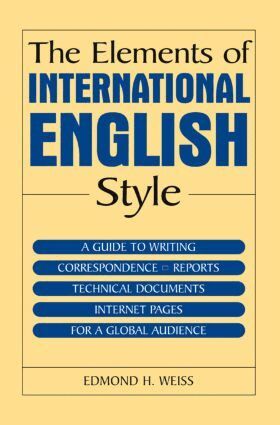
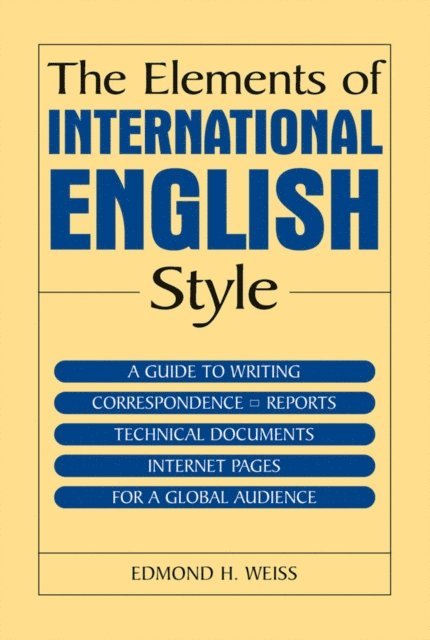
This easy-to-use handbook is an essential resource for anyone who needs to write English correspondence for an international business audience. In an engaging, accessible style it integrates the theory and controversies of intercultural communication with the practical skills of writing and editing English for those who read it as a second language. The book emphasizes principles of simplicity and clarity, proper etiquette, cultural sensitivity, appropriate layout and typography, and more to increase the chances that a text prepared by a native English speaker will be better understood by a non-native speaker. It also updates traditional advice with new insights into "e-mail culture." Equally useful for students and professionals in business communication, marketing communication, and international business, The Elements of International English Style is filled with realistic examples, problems, and projects, including: 57 specific tactics to internationalize one's English; hundreds of before-and-after comparisons showing the effects of editing for an international audience; models of international correspondence; practical discussion questions and work projects; useful resources for further study, including books, articles, and websites.
Häftad, Engelska, 2005
720 kr
Skickas inom 10-15 vardagar
This easy-to-use handbook is an essential resource for anyone who needs to write English correspondence for an international business audience. In an engaging, accessible style it integrates the theory and controversies of intercultural communication with the practical skills of writing and editing English for those who read it as a second language. The book emphasizes principles of simplicity and clarity, proper etiquette, cultural sensitivity, appropriate layout and typography, and more to increase the chances that a text prepared by a native English speaker will be better understood by a non-native speaker. It also updates traditional advice with new insights into "e-mail culture." Equally useful for students and professionals in business communication, marketing communication, and international business, The Elements of International English Style is filled with realistic examples, problems, and projects, including: 57 specific tactics to internationalize one's English; hundreds of before-and-after comparisons showing the effects of editing for an international audience; models of international correspondence; practical discussion questions and work projects; useful resources for further study, including books, articles, and websites.
Häftad, Engelska, 1990
394 kr
Skickas inom 10-15 vardagar
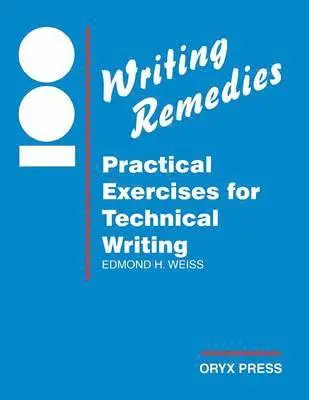
100 Writing Remedies is the only workbook/reference that shows students how to debug faulty writing and improve their communication skills. With it, your students can benefit from the same professional instruction other writers receive when attending seminars by Edmond H. Weiss. Writing must never be as volatile as speech--because the function of writing is to permit communication across time and space.
Häftad, Engelska, 1991
466 kr
Skickas inom 10-15 vardagar
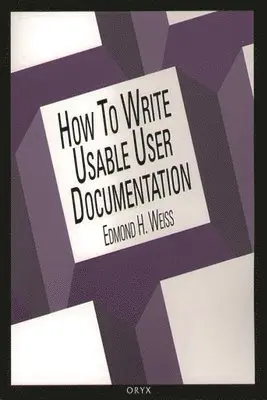
This popular handbook presents a step-by-step method for clearly explaining a product, system, or procedure. The easy-to-follow text--packed with examples and illustrations--explains the unique demands of this form of writing and shows how to set up the best user model. The book covers developing a modular outline and storyboard, generating the draft, revising, developing a formal usability test, and supporting and updating user documentation. Also included are a glossary of terms, a listing of books and periodicals for additional information, and an index.
E-bok
Engelska, 2015849 kr
Läs direkt efter köp
This easy-to-use handbook is an essential resource for anyone who needs to write English correspondence for an international business audience. In an engaging, accessible style it integrates the theory and controversies of intercultural communication with the practical skills of writing and editing English for those who read it as a second language. The book emphasizes principles of simplicity and clarity, proper etiquette, cultural sensitivity, appropriate layout and typography, and more to increase the chances that a text prepared by a native English speaker will be better understood by a non-native speaker. It also updates traditional advice with new insights into "e-mail culture." Equally useful for students and professionals in business communication, marketing communication, and international business, The Elements of International English Style is filled with realistic examples, problems, and projects, including: 57 specific tactics to internationalize one''s English; hundreds of before-and-after comparisons showing the effects of editing for an international audience; models of international correspondence; practical discussion questions and work projects; useful resources for further study, including books, articles, and websites.
E-bok
PDF, Engelska, 2015849 kr
Läs direkt efter köp
This easy-to-use handbook is an essential resource for anyone who needs to write English correspondence for an international business audience. In an engaging, accessible style it integrates the theory and controversies of intercultural communication with the practical skills of writing and editing English for those who read it as a second language. The book emphasizes principles of simplicity and clarity, proper etiquette, cultural sensitivity, appropriate layout and typography, and more to increase the chances that a text prepared by a native English speaker will be better understood by a non-native speaker. It also updates traditional advice with new insights into "e-mail culture." Equally useful for students and professionals in business communication, marketing communication, and international business, The Elements of International English Style is filled with realistic examples, problems, and projects, including: 57 specific tactics to internationalize one''s English; hundreds of before-and-after comparisons showing the effects of editing for an international audience; models of international correspondence; practical discussion questions and work projects; useful resources for further study, including books, articles, and websites.
E-bok
Engelska, 2013145 kr
Läs direkt efter köp
Making Arguments: Reason in Context offers a new approach to the teaching of argumentation and debate.Nearly all argumentation courses and textbooks tilt toward one of two extremes:* Critical thinking/informal logic, in which the "laws" of reasoning are universal and not affected by audience or context* Public speaking, in which adaptation to the audience and winning assent trumps logic and reasoningAt the first extreme are texts that stress flaws in arguments and how to discern them. Their focus tends to be on the logic (making deductive inferences and avoiding deductive mistakes or other errors of inference) and/or the recognition of fallacies (deficient or fake arguments). They also deal with the messy ambiguities of language. Generally, this approach omits the concept of an audience. And it does not explain how spotting the flaws in reasoning, or improving one's reasoning, translates into the ability to make an effective argument. Further, it is not clear how to address audiences whose grasp of logic is shaky.At the other extreme are books (especially public speaking textbooks) that err in the opposite direction. They are fixated on audience. As a result, their advice about how to argue is grounded in audience adaptation. In fact, the process of reasoning is nearly subordinated to such secondary considerations as style, delivery, and organization. And again, the connection between critical thinking/logic and audience is rarely examined.In Making Arguments, we propose to consider argument at the nexus of invention and judgment, the two endpoints from which logic and public speaking examine argumentation, respectively. By looking at the "stuff" that comes between an argument's design and its delivery, we hope to enrich the understanding and the study of argument, as both a theoretical and applied discipline.In particular, we want to answer some questions that are seldom addressed in print:* What is the starting point for augmentation? When do we even need to argue?* When should one embrace, and when should one avoid, arguing?* Why does the same argument work in one place and fail in another?* Are most audiences capable of understanding a complex argument?* With what authority can one make an argument—absent expertise in the field in which the argument takes place?* Are there substantive differences between oral and written argument?* What does it mean to "present" an argument?* Can someone control the argumentative situation/context to the benefit of his/her position?* How can argument educate and improve the arguer?* Can we learn the "truth" by arguing?This book addresses the whole advocacy process as a series of concatenated intellectual decisions affecting how arguments are created, ordered, rendered, and produced—with judgment as the over-arching concern.