Edward L. Widmer – författare
Visar alla böcker från författaren Edward L. Widmer. Handla med fri frakt och snabb leverans.
6 produkter
6 produkter
Inbunden, Engelska, 2016
422 kr
Skickas inom 5-8 vardagar
In Disunion, Edward L. Widmer, George Kalogerakis, and Clay Risen bring together the best essays of the celebrated New York Times blog to offer a unique and unforgettable history of The Civil War, from Fort Sumter to Appomattox. Celebrated upon publication for their startling originality, their uncanny ability to bring immediacy and to inspire fresh thought, the pieces were an integral part of the sesquicentennial celebrations, and indeed came to define them. Susan Schulten's "Visualizing History " offers but one example. In 1860, the United States government took its final count of the country's slave population. When the Coast Survey produced maps from the data, Americans could at last visualize slavery's prevalence; degrees of shading indicated the number of slaves in a given county. Beaufort County was one of the darkest on the map-in this blackened zone of South Carolina, slaves comprised 82.8 percent of the populace. Lincoln became obsessed with the map and used it to trace his troops' movement-Francis Bicknell Carpenter even painted it in the corner of "President Lincoln Reading the Emancipation Proclamation to His Cabinet.Schulten's pieces and scores of others explore the Civil War by means of key contemporary sources. Moving both chronologically and thematically across all four years, the volume is a comprehensive and illuminating text for scholars and general readers alike. Major academic and popular voices come together in each chapter to discuss secession, slavery, battles, and domestic and global politics. The selections feature previously unheard voices-women, freed African Americans, and Native Americans-but also Lincoln, Grant, and Lee. In one volume, Disunion explores America's bloodiest conflict and brings home its legacies.
E-bok
PDF, Engelska, 2016319 kr
Läs direkt efter köp
Between 2011 and 2015, the Opinion section of The New York Times published Disunion, a series marking the long string of anniversaries around the Civil War, the most destructive, and most defining, conflict in American history. The works were startling in their range and direction, some taking on major topics, like the Gettysburg Address and the Battle of Fredericksburg, while others tackled subjects whose seemingly incidental quality yielded unexpected riches and new angles. Some come from the country''s leading historians; others from those for whom the war figured in private ways, involving an ancestor or a letter found in a trunk. Disunion received wide acclaim for featuring some of the most original thinking about the Civil War in years. For millions of readers, Disunion came to define the Civil War sesquicentennial.Now the historian Ted Widmer, along with Clay Risen and George Kalogerakis of The New York Times, has curated a collection of these pieces, covering the entire history of the Civil War, from Lincoln''s election to Appomattox and beyond. Moving chronologically and thematically across all four years of hostilities, this comprehensive and engrossing work examines secession, slavery, battles, and domestic and global politics. Here are previously unheard voices-of women, freed African Americans, and Native Americans-alongside those of Lincoln, Grant, and Lee, portrayed in human as well as historical scale. David Blight sheds light on how Frederick Douglass welcomed South Carolina''s secession-an event he knew would catapult the abolitionist movement into the spotlight; Elizabeth R. Varon explores how both North and South clamored to assert that the nation''s “ladies,” symbolic of moral purity, had sided with them; Harold Holzer deciphers Lincoln''s official silence between his election to the presidency and his inauguration-what his supporters named “masterful inactivity”-and the effects it had on the splintering country. More than any single volume ever published, Disunion reveals the full spectrum of America''s bloodiest conflict and illuminates its living legacies.
E-bok
Engelska, 2016330 kr
Läs direkt efter köp
Between 2011 and 2015, the Opinion section of The New York Times published Disunion, a series marking the long string of anniversaries around the Civil War, the most destructive, and most defining, conflict in American history. The works were startling in their range and direction, some taking on major topics, like the Gettysburg Address and the Battle of Fredericksburg, while others tackled subjects whose seemingly incidental quality yielded unexpected riches and new angles. Some come from the country''s leading historians; others from those for whom the war figured in private ways, involving an ancestor or a letter found in a trunk. Disunion received wide acclaim for featuring some of the most original thinking about the Civil War in years. For millions of readers, Disunion came to define the Civil War sesquicentennial.Now the historian Ted Widmer, along with Clay Risen and George Kalogerakis of The New York Times, has curated a collection of these pieces, covering the entire history of the Civil War, from Lincoln''s election to Appomattox and beyond. Moving chronologically and thematically across all four years of hostilities, this comprehensive and engrossing work examines secession, slavery, battles, and domestic and global politics. Here are previously unheard voices-of women, freed African Americans, and Native Americans-alongside those of Lincoln, Grant, and Lee, portrayed in human as well as historical scale. David Blight sheds light on how Frederick Douglass welcomed South Carolina''s secession-an event he knew would catapult the abolitionist movement into the spotlight; Elizabeth R. Varon explores how both North and South clamored to assert that the nation''s “ladies,” symbolic of moral purity, had sided with them; Harold Holzer deciphers Lincoln''s official silence between his election to the presidency and his inauguration-what his supporters named “masterful inactivity”-and the effects it had on the splintering country. More than any single volume ever published, Disunion reveals the full spectrum of America''s bloodiest conflict and illuminates its living legacies.
Inbunden, Engelska, 1999
1 143 kr
Skickas inom 5-8 vardagar
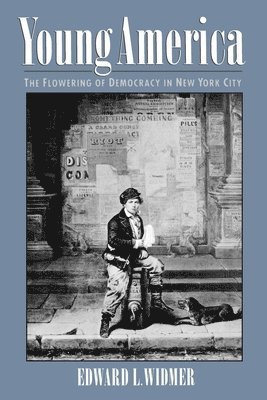
This study examines the meteoric rise and subsequent disintegration of a vigorous American literary-political movement in the 1840s. Calling itself 'Young America', the group found a mouthpiece in the Democratic Review, a literary magazine funded by the Democratic Party and edited by the brash and charismatic John O'Sullivan. The Review was not only a major voice in American politics, but also sponsored such writers as Nathaniel Hawthorne and Walt Whitman and greatly inflenced Herman Melville, before it and Young America faded from the national consciousness after the Mexican-American War.
Häftad, Engelska, 2000
945 kr
Skickas inom 5-8 vardagar
This study examines the meteoric rise and subsequent disintegration of a vigorous American literary-political movement in the 1840s. Calling itself 'Young America', the group found a mouthpiece in the Democratic Review, a literary magazine funded by the Democratic Party and edited by the brash and charismatic John O'Sullivan. The Review was not only a major voice in American politics, but also sponsored such writers as Nathaniel Hawthorne and Walt Whitman and greatly inflenced Herman Melville, before it and Young America faded from the national consciousness after the Mexican-American War.
E-bok
PDF, Engelska, 1998593 kr
Läs direkt efter köp
This fascinating study examines the meteoric career of a vigorous intellectual movement rising out of the Age of Jackson. As Americans argued over their destiny in the decades preceding the Civil War, an outspoken new generation of "ultra-democratic" writers entered the fray, staking out positions on politics, literature, art, and any other territory they could annex. They called themselves Young America--and they proclaimed a "Manifest Destiny" to push back frontiers in every category of achievement. Their swagger found a natural home in New York City, already bursting at the seams and ready to take on the world.Young America''s mouthpiece was the Democratic Review, a highly influential magazine funded by the Democratic Party and edited by the brash and charismatic John O''Sullivan. The Review offered a fresh voice in political journalism, and sponsored young writers like Hawthorne and Whitman early in their careers. Melville, too, was influenced by Young America, and provided a running commentary on its many excesses. Despite brilliant promise, the movement fell apart in the 1850s, leaving its original leaders troubled over the darker destiny they had ushered in. Their ambitious generation had failed to rewrite history as promised. Instead, their perpetual agitation helped set the stage for the Civil War.Young America: The Flowering of Democracy in New York City is without question the most complete examination of this captivating and original movement. It also provides the first published biography of its leader, John O''Sullivan, one of America''s great rhetoricians. Edward L. Widmer enriches his unique volume by offering a new theory of Manifest Destiny as part of a broader movement of intellectual expansion in nineteenth-century America.