Edwin L. Battistella – författare
Visar alla böcker från författaren Edwin L. Battistella. Handla med fri frakt och snabb leverans.
16 produkter
Dangerous Crooked Scoundrels
Insulting the President, from Washington to Trump
Inbunden, 2020
146 kr
Lägg i varukorg
Insulting the president is an American tradition. From Washington to Trump, presidents have been called "lazy," "feeble," "pusillanimous," and more. Our leaders have been derided as "ignoramuses," "idiots," "morons," and "fatheads," and have been compared to all manner of animals--worms and whales …
Dangerous Crooked Scoundrels
Insulting the President, from Washington to Trump
E-bok, 2020
114 kr
Lägg i varukorg
Insulting the president is an American tradition. From Washington to Trump, presidents have been called "lazy," "feeble," "pusillanimous," and more. Our leaders have been derided as "ignoramuses," "idiots," "morons," and "fatheads," and have been compared to all manner of animals--worms and whales …
Dangerous Crooked Scoundrels
Insulting the President, from Washington to Trump
E-bok, 2020
114 kr
Lägg i varukorg
Insulting the president is an American tradition. From Washington to Trump, presidents have been called "lazy," "feeble," "pusillanimous," and more. Our leaders have been derided as "ignoramuses," "idiots," "morons," and "fatheads," and have been compared to all manner of animals--worms and whales …
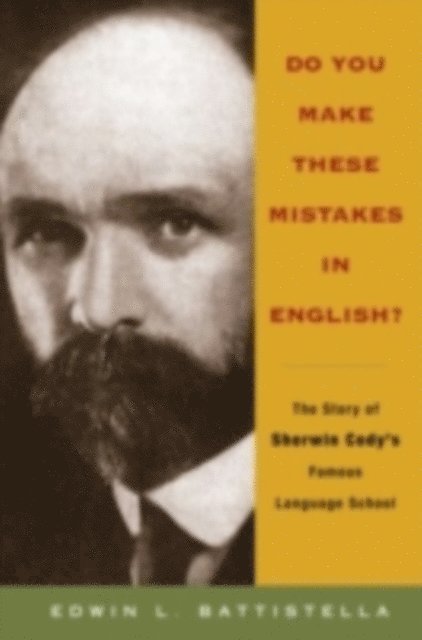
Do You Make These Mistakes in English?
The Story of Sherwin Cody's Famous Language School
E-bok, 2008
477 kr
Lägg i varukorg
In the early 1900s, the language of America was becoming colloquial English-the language of the businessman, manager, and professional. Since college and high school education were far from universal, many people turned to correspondence education-that era''s distance learning-to learn the art of …
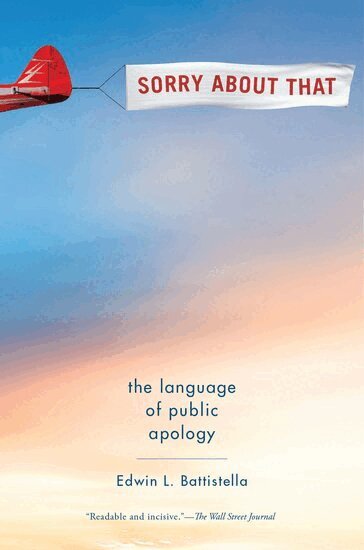
Sorry About That
The Language of Public Apology
Häftad, 2016
392 kr
Lägg i varukorg
People do bad things. They misspeak, mislead, and misbehave. They lie, cheat, steal, and kill. Often, afterward, they apologize. But what makes a successful apology? Why does Joe Biden's 2007 apology for referring to Barack Obama as "articulate and bright" succeed, whereas Mel Gibson's 2006 apology …
The Logic of Markedness
Inbunden, 1997
3083 kr
Lägg i varukorg
Theories of language espoused by linguists during much of this century have assumed that there is a hierarchy to the elements of language such that certain constructions, rules, and features are unmarked while others are marked; "play" for example, is unmarked or neutral, while "played" or "player" …
Bad Language
Are Some Words Better than Others?
Inbunden, 2005
737 kr
Lägg i varukorg
Is today's language at an all-time low? Are pronunciations like "cawfee" and "chawklit" bad English? Is slang like "my bad" or "hook up" improper? Is it incorrect to mix English and Spanish, as in "Yo quiero Taco Bell"? Can you write "Who do you trust?" rather than "Whom do you trust?" Linguist …
Bad Language
Are Some Words Better Than Others?
Häftad, 2007
519 kr
Lägg i varukorg
Is today's language at an all-time low? Edwin Battistella argues that it is wrong to think of slang, regional dialects and nonstandard grammar as simply breaking the rules of good English. Reexamining debates over relativism in language, Battistella argues that we should view language as made up of …
Logic of Markedness
E-bok, 1996
1964 kr
Lägg i varukorg
Theories of language espoused by linguists during much of this century have assumed that there is a hierarchy to the elements of language such that certain constructions, rules, and features are unmarked while others are marked ; "play" for example, is unmarked or neutral, while "played" or …
Sorry About That
The Language of Public Apology
Inbunden, 2014
510 kr
Lägg i varukorg
People do bad things. They misspeak, mislead, and misbehave. They lie, cheat, steal, and kill. Often, afterward, they apologize. In Sorry About That, linguist Edwin Battistella analyzes the public apologies of presidents, politicians, entertainers, and businessmen, situating the apology within …
Sorry About That
The Language of Public Apology
E-bok, 2014
283 kr
Lägg i varukorg
People do bad things. They misspeak, mislead, and misbehave. They lie, cheat, steal, and kill. Often, afterward, they apologize. But what makes a successful apology? Why does Joe Biden''s 2007 apology for referring to Barack Obama as "articulate and bright" succeed, whereas Mel Gibson''s 2006 …
Sorry About That
The Language of Public Apology
E-bok, 2014
283 kr
Lägg i varukorg
People do bad things. They misspeak, mislead, and misbehave. They lie, cheat, steal, and kill. Often, afterward, they apologize. But what makes a successful apology? Why does Joe Biden''s 2007 apology for referring to Barack Obama as "articulate and bright" succeed, whereas Mel Gibson''s 2006 …
Do You Make These Mistakes in English?
The Story of Sherwin Cody's Famous Language School
E-bok, 2008
477 kr
Lägg i varukorg
In the early 1900s, the language of America was becoming colloquial English-the language of the businessman, manager, and professional. Since college and high school education were far from universal, many people turned to correspondence education-that era''s distance learning-to learn the art of …
Dorothy B. Hughes
A Poet Turns to Crime
Inbunden, 2026
296 kr
Kommande
Hailed by critics and fans as “The Queen of Noir” and “a prescient feminist,” Dorothy B. Hughes (1904-1993) challenged the conventions of the crime fiction genre by exploring race, class, and social justice across her fourteen novels. Edwin Battistella’s new work weaves discussion of Hughes’s …
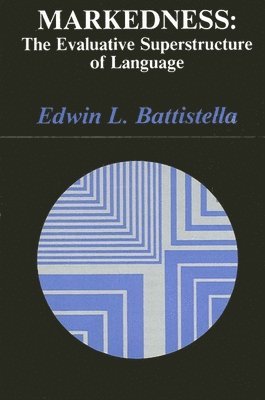
Markedness
The Evaluative Superstructure of Language
Häftad, 1990
413 kr
Tillfälligt slut
Battistella traces the development of markedness theory as a central part of structuralist theories of language. He outlines the concepts of marked and unmarked from Prague School structuralism to present day applications in linguistic theory and cultural analysis, using the reference point of …