Elisabeth Lenk – författare
Visar alla böcker från författaren Elisabeth Lenk. Handla med fri frakt och snabb leverans.
4 produkter
4 produkter
Inbunden, Engelska, 2015
1 117 kr
Skickas inom 5-8 vardagar
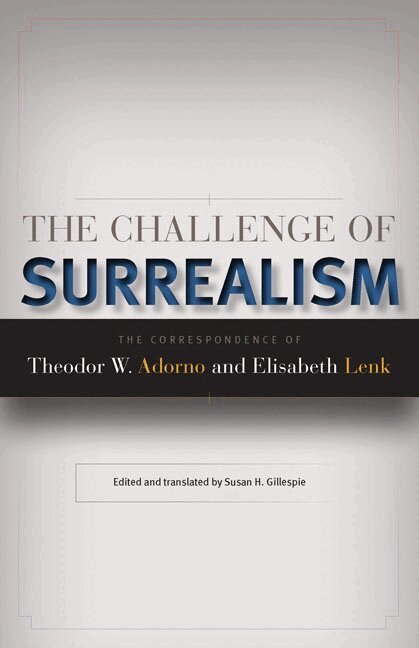
The correspondence between the philosopher Theodor W. Adorno and his politically active graduate student Elisabeth Lenk offers fresh insights into both Adorno’s view of surrealism and its relation to the student uprisings of 1960s France and Germany. Written between 1962, when Lenk moved to Paris and persuaded an initially reluctant Adorno to supervise her sociology dissertation on the surrealists, and Adorno’s death in 1969, these letters reveal a surprisingly tender side of the distinguished professor. The correspondence is accompanied by a selection of documents that bring additional depth and context to the letters and their engagement with the art and politics of the period.Filling in the background of Adorno and Lenk’s lively exchange, the volume includes new translations of classic essays by Walter Benjamin (“Surrealism: Last Snapshot of the European Intelligentsia”) and Adorno (“Surrealism Reconsidered”), along with a collection of short prose readings by Adorno and the writer-scholar Carl Dreyfus and three original essays by Lenk: her afterword to Paris Peasant by Louis Aragon, her Introduction to the German edition of Charles Fourier’s The Theory of the Four Movements and the General Destinies, and her incisive essay “Critical Theory and Surreal Practice.” An Introduction by Lenk’s student, the contemporary writer and critic Rita Bischof, points to the continuing challenge of surrealist politics.This remarkable body of correspondence appears here in English for the first time, as do Adorno and Dreyfus’s surrealist readings and the essays by Lenk. Together, they provide a rich mine of critical material for reassessing the significance of the surrealist movement and its successors.
Häftad, Engelska, 2015
284 kr
Skickas inom 11-20 vardagar
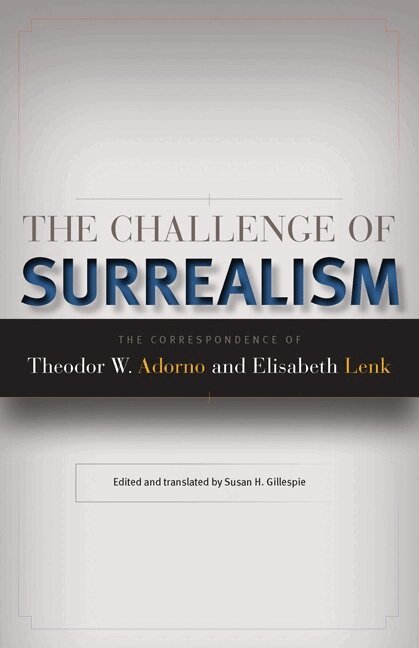
The correspondence between the philosopher Theodor W. Adorno and his politically active graduate student Elisabeth Lenk offers fresh insights into both Adorno’s view of surrealism and its relation to the student uprisings of 1960s France and Germany. Written between 1962, when Lenk moved to Paris and persuaded an initially reluctant Adorno to supervise her sociology dissertation on the surrealists, and Adorno’s death in 1969, these letters reveal a surprisingly tender side of the distinguished professor. The correspondence is accompanied by a selection of documents that bring additional depth and context to the letters and their engagement with the art and politics of the period.Filling in the background of Adorno and Lenk’s lively exchange, the volume includes new translations of classic essays by Walter Benjamin (“Surrealism: Last Snapshot of the European Intelligentsia”) and Adorno (“Surrealism Reconsidered”), along with a collection of short prose readings by Adorno and the writer-scholar Carl Dreyfus and three original essays by Lenk: her afterword to Paris Peasant by Louis Aragon, her Introduction to the German edition of Charles Fourier’s The Theory of the Four Movements and the General Destinies, and her incisive essay “Critical Theory and Surreal Practice.” An Introduction by Lenk’s student, the contemporary writer and critic Rita Bischof, points to the continuing challenge of surrealist politics.This remarkable body of correspondence appears here in English for the first time, as do Adorno and Dreyfus’s surrealist readings and the essays by Lenk. Together, they provide a rich mine of critical material for reassessing the significance of the surrealist movement and its successors.

Inbunden, Tyska, 2026
467 kr
Skickas inom 3-6 vardagar
E-bok
PDF, Tyska, 2026394 kr
Läs direkt efter köp
In den hier erstmals gesammelt vorliegenden Kritischen Schriften Elisabeth Lenks druckt sich ein Denken aus, das sich souveran und mit groer Selbstverstandlichkeit zwischen Kritischer Theorie und surrealer Praxis bewegt und das sich in allem, worauf es seine Aufmerksamkeit richtet, um die Frage dreht, wie und warum asthetisches Denken und politisches Engagement einander bedingen. Sei es die Verteidigung des kritischen Gehalts mimetischer Ausdrucksformen am Paradigma der traumartigen Schreibweisen, das Pariabewusstsein schreibender Frauen, der Bruch mit dem Tabu der Gewaltdarstellungen oder revolutionare Uberlegungen zum Verhaltnis von Literatur und Zeit - immer handelt es sich um originare Konfigurationen einer neuen Literaturasthetik, die dem tief in der deutschen Geistesgeschichte verwurzelten Misstrauen gegen alles Asthetische den Kampf erklart. Elisabeth Lenk fuhrt in ihren Essays auf eindrucksvolle Weise den Streit um die Asthetik fort, der mit Schiller und den Jenenser Romantikern begann, und halt kompromisslos daran fest, dass die Aufgabe der Versohnung nicht der Kunst zukommt.