Emilio Benfenati – författare
Visar alla böcker från författaren Emilio Benfenati. Handla med fri frakt och snabb leverans.
9 produkter
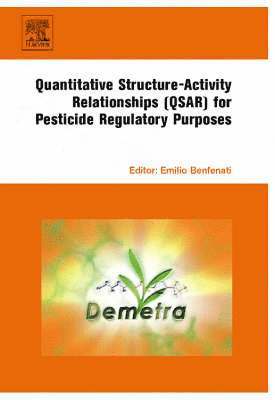
Quantitative Structure-Activity Relationships (QSAR) for Pesticide Regulatory Purposes
Inbunden, 2007
2658 kr
Lägg i varukorg
Quantitative Structure-Activity Relationship (QSAR) for Pesticide Regulatory Purposes stems from the experience of the EC funded project DEMETRA. This project combined institutes involved in the regulatory process of pesticides, industries of the sector and scientists to develop and offer original …
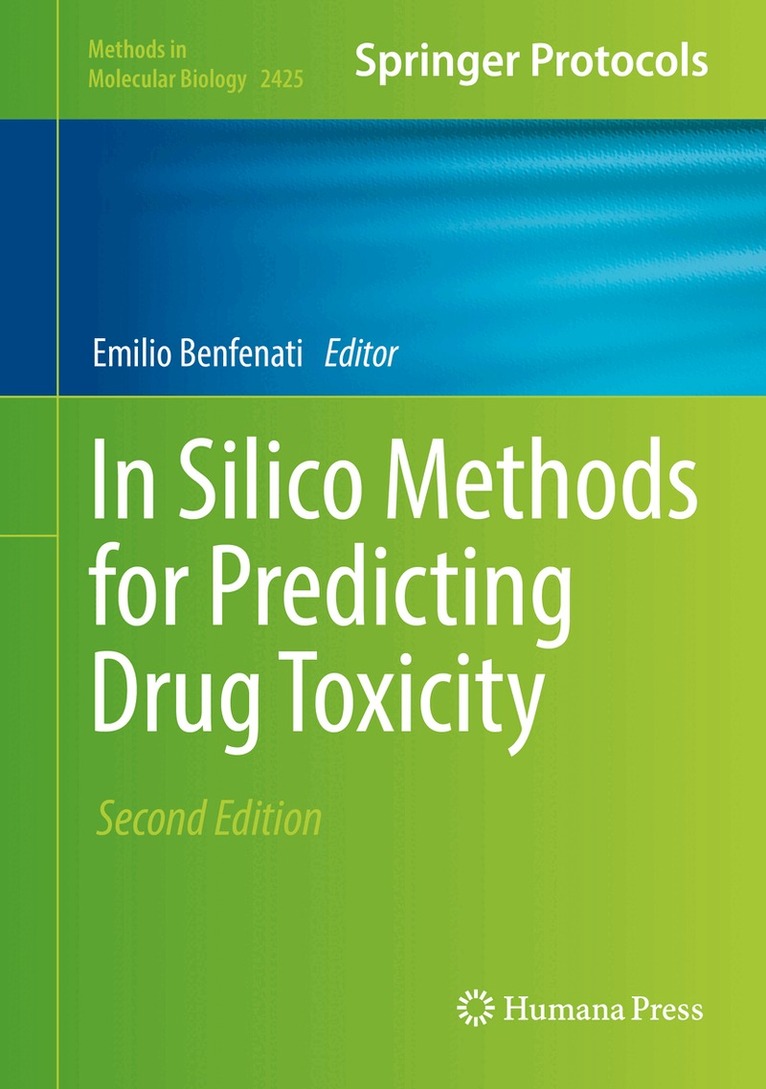
In Silico Methods for Predicting Drug Toxicity
Inbunden, 2022
2475 kr
Lägg i varukorg
This fully updated book explores all-new and revised protocols involving the use of in silico models, particularly with regard to pharmaceuticals. Divided into five sections, the volume covers the modeling of pharmaceuticals in the body, toxicity data for modeling purposes, in silico models for …
In Silico Methods for Predicting Drug Toxicity
E-bok, 2022
2341 kr
Lägg i varukorg
This fully updated book explores all-new and revised protocols involving the use of in silico models, particularly with regard to pharmaceuticals. Divided into five sections, the volume covers the modeling of pharmaceuticals in the body, toxicity data for modeling purposes, in silico models for …
In Silico Methods for Predicting Drug Toxicity
Häftad, 2022
1802 kr
Lägg i varukorg
This fully updated book explores all-new and revised protocols involving the use of in silico models, particularly with regard to pharmaceuticals. Divided into five sections, the volume covers the modeling of pharmaceuticals in the body, toxicity data for modeling purposes, in silico models for …
In Silico Methods for Predicting Drug Toxicity
Inbunden, 2016
1690 kr
Lägg i varukorg
This detailed volume explores in silico methods forpharmaceutical toxicity by combiningthe theoretical advanced research with the practical application of the tools.Beginning with a section covering sophisticated models addressing the bindingto receptors, pharmacokinetics and adsorption, …
In Silico Methods for Predicting Drug Toxicity
E-bok, 2016
1670 kr
Lägg i varukorg
This detailed volume explores in silico methods forpharmaceutical toxicity by combiningthe theoretical advanced research with the practical application of the tools.Beginning with a section covering sophisticated models addressing the bindingto receptors, pharmacokinetics and adsorption, …
In Silico Methods for Predicting Drug Toxicity
Häftad, 2018
1239 kr
Lägg i varukorg
This detailed volume explores in silico methods forpharmaceutical toxicity by combiningthe theoretical advanced research with the practical application of the tools.Beginning with a section covering sophisticated models addressing the bindingto receptors, pharmacokinetics and adsorption, …
Knowledge Exploration in Life Science Informatics
International Symposium KELSI 2004, Milan, Italy, November 25-26, 2004, Proceedings
Av Jesús A. López, Emilio Benfenati m. fl.
Häftad, 2004
568 kr
Lägg i varukorg
This volume of the Springer Lecture Notes in Computer Science series contains the contributions presented at the International Symposium on Knowledge Exploration in Life Science Informatics (KELSI 2004) held in Milan, Italy, 25-26 November 2004. The two main objectives of the symposium were: * To …
Knowledge Exploration in Life Science Informatics
International Symposium KELSI 2004, Milan, Italy, November 25-26, 2004, Proceedings
Av Werner Dubitzky, Emilio Benfenati m. fl.
E-bok, 2005
734 kr
Lägg i varukorg