Emin Özsoy - Böcker
Visar alla böcker från författaren Emin Özsoy. Handla med fri frakt och snabb leverans.
6 produkter
6 produkter
2 101 kr
Skickas inom 10-15 vardagar
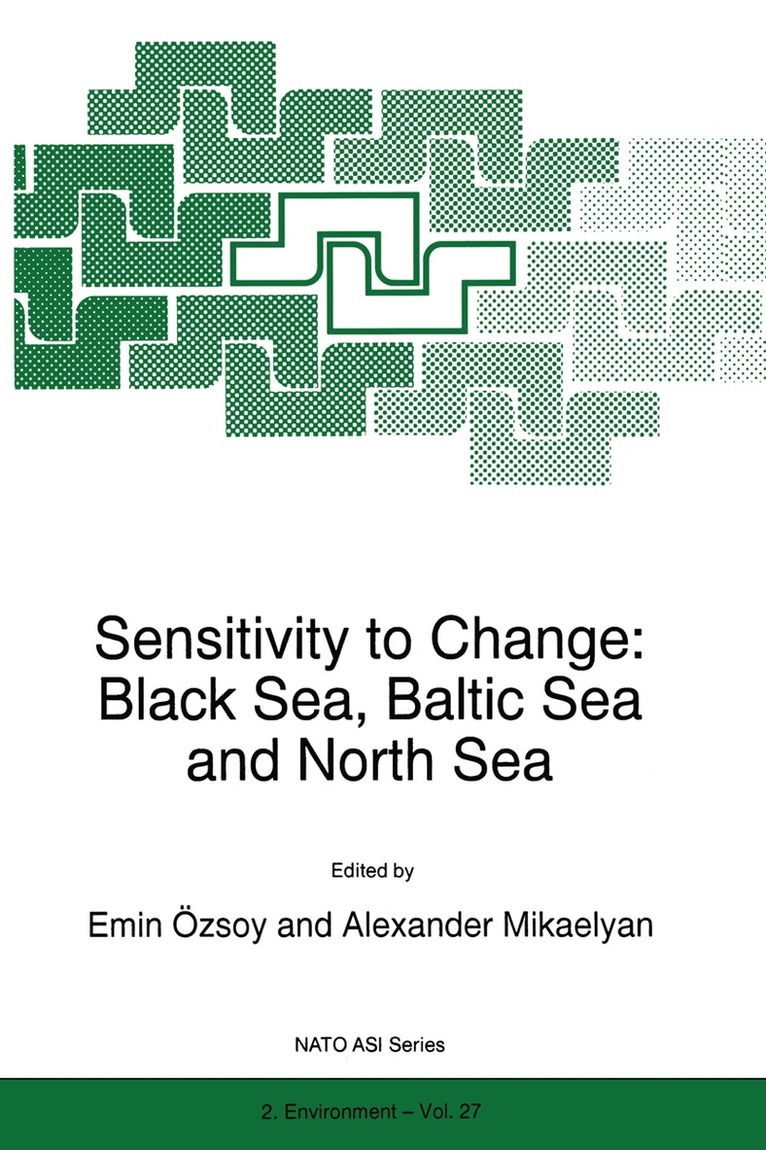
The most seriously threatened European seas are the North Sea, the Baltic and the Black Sea. This text examines the rapid degradation of these marine environments comparatively to identify similarities and differences in the driving forces and responses of the marine systems. Although it is difficult to distinguish between anthropogenic changes and those due to natural climate fluctuations, an attempt is made here to define possible effects based on a multidisciplinary mix of recent observations and modelling. The systems studied range from almost totally enclosed domains to marginal seas adjoining a large ocean body, and from shallow, dissipative and tidally dominated shelf regions to deep, relatively stagnant basins with adjoining energetic shelf regions, and from completely anoxic to oxygen-saturated chemical environments. Climate control appears as a background theme, while the most significant human effect is eutrophication, which is leading to rapid changes in these systems.
Geophysical Fluid Dynamics I
An Introduction to Atmosphere—Ocean Dynamics: Homogeneous Fluids
Inbunden, Engelska, 2020
906 kr
Skickas inom 10-15 vardagar
This textbook develops a fundamental understanding of geophysical fluid dynamics by providing a mathematical description of fluid properties, kinematics and dynamics as influenced by earth’s rotation. Its didactic value is based on elaborate treatment of basic principles, derived equations, exemplary solutions and their interpretation.Both starting graduate students and experienced scientists can closely follow the mathematical development of the basic theory applied to the flow of uniform density fluids on a rotating earth, with (1) basic physics introducing the "novel" effects of rotation for flows on planetary scales, (2) simplified dynamics of shallow water and quasi-geostrophic theories applied to a variety of steady, unsteady flows and geophysical wave motions, demonstrating the restoring effects of Coriolis acceleration, earth’s curvature (beta) and topographic steering, (3) conservation of vorticity and energy at geophysical scales, and (4) specific applications to help demonstrate the ability to create and solve new problems in this very rich field. A comprehensive review of the complex geophysical flows of the ocean and the atmosphere is closely knitted with this basic description, intended to be developed further in the second volume that addresses density stratified geophysical fluid dynamics.
Geophysical Fluid Dynamics I
An Introduction to Atmosphere—Ocean Dynamics: Homogeneous Fluids
Häftad, Engelska, 2021
536 kr
Skickas inom 10-15 vardagar
This textbook develops a fundamental understanding of geophysical fluid dynamics by providing a mathematical description of fluid properties, kinematics and dynamics as influenced by earth’s rotation. Its didactic value is based on elaborate treatment of basic principles, derived equations, exemplary solutions and their interpretation.Both starting graduate students and experienced scientists can closely follow the mathematical development of the basic theory applied to the flow of uniform density fluids on a rotating earth, with (1) basic physics introducing the "novel" effects of rotation for flows on planetary scales, (2) simplified dynamics of shallow water and quasi-geostrophic theories applied to a variety of steady, unsteady flows and geophysical wave motions, demonstrating the restoring effects of Coriolis acceleration, earth’s curvature (beta) and topographic steering, (3) conservation of vorticity and energy at geophysical scales, and (4) specific applications to help demonstrate the ability to create and solve new problems in this very rich field. A comprehensive review of the complex geophysical flows of the ocean and the atmosphere is closely knitted with this basic description, intended to be developed further in the second volume that addresses density stratified geophysical fluid dynamics.
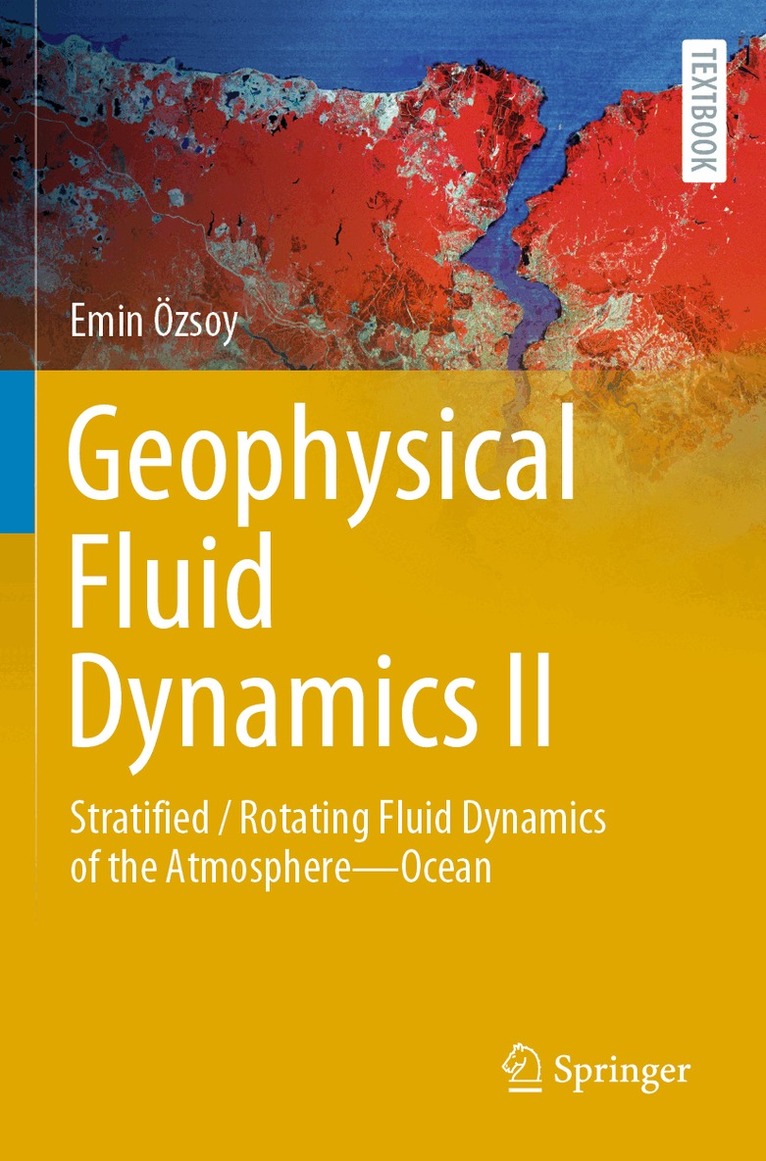
Geophysical Fluid Dynamics II
Stratified / Rotating Fluid Dynamics of the Atmosphere—Ocean
Inbunden, Engelska, 2021
712 kr
Skickas inom 5-8 vardagar
This book develops a fundamental understanding of geophysical fluid dynamics based on a mathematical description of the flows of inhomogeneous fluids. It covers these topics:1. development of the equations of motion for an inhomogeneous fluid 2. review of thermodynamics3. thermodynamic and kinetic energy equations4. equations of state for the atmosphere and the ocean, salt, and moisture effects5. concepts of potential temperature and potential density6. Boussinesq and quasi-geostrophic approximations7. conservation equations for vorticity, mechanical and thermal energy instability theories, internal waves, mixing, convection, double-diffusion, stratified turbulence, fronts, intrusions, gravity currentsGraduate students will be able to learn and apply the basic theory of geophysical fluid dynamics of inhomogeneous fluids on a rotating earth, including:1. derivation of the governing equations for a stratified fluid starting from basic principles of physics2. review of thermodynamics, equations of state, isothermal, adiabatic, isentropic changes3. scaling of the equations, Boussinesq approximation, applied to the ocean and the atmosphere4. examples of stratified flows at geophysical scales, steady and unsteady motions, inertia-gravity internal waves, quasi-geostrophic theory5. vorticity and energy conservation in stratified fluids6.boundary layer convection in stratified containers and basins
Geophysical Fluid Dynamics II
Stratified / Rotating Fluid Dynamics of the Atmosphere—Ocean
Häftad, Engelska, 2022
448 kr
Skickas inom 5-8 vardagar
This book develops a fundamental understanding of geophysical fluid dynamics based on a mathematical description of the flows of inhomogeneous fluids. It covers these topics:1. development of the equations of motion for an inhomogeneous fluid 2. review of thermodynamics3. thermodynamic and kinetic energy equations4. equations of state for the atmosphere and the ocean, salt, and moisture effects5. concepts of potential temperature and potential density6. Boussinesq and quasi-geostrophic approximations7. conservation equations for vorticity, mechanical and thermal energy instability theories, internal waves, mixing, convection, double-diffusion, stratified turbulence, fronts, intrusions, gravity currentsGraduate students will be able to learn and apply the basic theory of geophysical fluid dynamics of inhomogeneous fluids on a rotating earth, including:1. derivation of the governing equations for a stratified fluid starting from basic principles of physics2. review of thermodynamics, equations of state, isothermal, adiabatic, isentropic changes3. scaling of the equations, Boussinesq approximation, applied to the ocean and the atmosphere4. examples of stratified flows at geophysical scales, steady and unsteady motions, inertia-gravity internal waves, quasi-geostrophic theory5. vorticity and energy conservation in stratified fluids6.boundary layer convection in stratified containers and basins
2 101 kr
Skickas inom 10-15 vardagar
Recent decades have seen a degradation of the environmental quality in semi-enclosed seas, which are particularly sensitive to population pressures due to their naturally low flushing rates related to their geometry. The North Sea, Baltic Sea and the Black Sea are amongst the most seriously threatened seas in the Euro-Asian region. Each semi-enclosed sea has a distinct pattern of circulation, transport, mixing, associated with the particular geometry, topography, boundary processes, interior stratification, atmospheric forcing, ice fonnation, straits / sill controls, and the specific inputs of freshwater, nutrients and pollutants. The workshop investigated the distinctive physical and ecological characteristics of the three seas in a comparative manner, in order to identify the types of driving forces and dynamic controls operating on productivity, nutrient cycling, physical transport and mixing mechanisms. A comparative study of these controlling mechanisms would allow us to better understand ecosystem sensitivity in these different environments. The workshop presentations highlighted the complexity of the semi-enclosed seas related to the interaction amongst the physical, chemical and biological fields, and differences in time and space scales in each of the systems. Further, a strong climate signal exists in these systems, manifest in the interannual, interdecadal and longer term variability. Part of the variability appears connected with background climatic variability.