The foundation of the Sasanian Empire in Persia in AD 224 established a formidable new power on the Roman Empire's eastern frontier, and relations over the next four centuries proved turbulent. This book provides a chronological narrative of their relationship, supported by a substantial collection of translated sources illustrating structural patterns. The political goals of the two sides, their military confrontations and their diplomatic solutions are discussed, as well as the common interests between the two powers. Special attention is given to the situation of Arabia and Armenia, to economic aspects, the protection of the frontiers, the religious life in both empires and the channels of communication between East and West. Considerable attention is also paid to exploring the role played by the Sasanians in the history of the ancient Near East. The book will prove invaluable for students and non-specialists interested in late antiquity and early Byzantium.
This book accounts for the results of fieldwork in Doliche, located in Gaziantep, South East Turkey. Doliche was an important city of ancient North Syria which continued to thrive into the Middle Ages. For the first time, an international research project started to explore the site in 2015. The chapters collected in this volume discuss the main discoveries of the first seasons. It is divided in two parts. The first part considers the main excavation results, with a particular emphasis on a newly discovered early Christian basilica and its decoration. This section also contains the first comprehensive discussion of a newly discovered Roman Imperial hypogeum from the city necropolis. The chapters of the second part deal with the preliminary findings from an intra-urban intensive survey. Between 2017 and 2019, a significant portion of the city area has been investigated, and the results of the survey offer new insights in the spatial and chronological of the city. The chapters consider methodological questions, but also discuss artefact groups. In general, the results presented in this volume add to the knowledge of urbanism in Roman and Late antique North Syria.
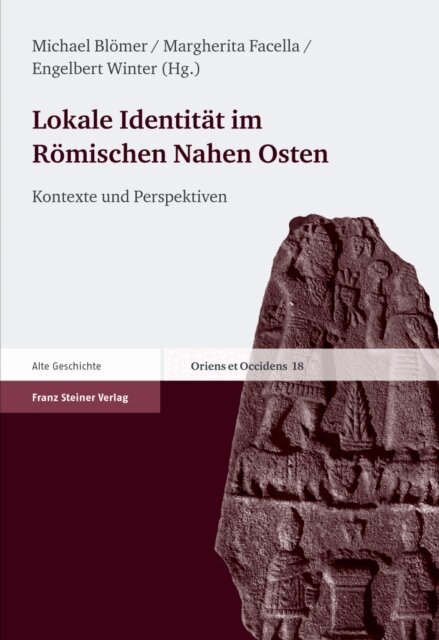
In den letzten zwei Jahrzehnten hat das Interesse am Römischen Nahen Osten stark zugenommen. Das dort zu fassende Zusammenspiel verschiedener Gruppen mit oft weit zurückreichenden Traditionen und ein über Jahrhunderte wirksamer griechisch-römischer Einfluss äußern sich in einem komplexen Neben- und Miteinander verschiedenartiger Identitäten und Identifikationsmodelle. Diese Vielfalt blieb lange Zeit verdeckt durch ein generalisierendes Bild vom römischen Orient und ist häufig nur schwer zu dekodieren.Die hier versammelten Beiträge aus der althistorischen, der numismatischen und der archäologischen Forschung beleuchten exemplarisch verschiedene Formen von Identität, indem sie den jeweils wirksamen lokalen Kontexten besondere Beachtung schenken.
Der Kult des Iuppiter Dolichenus, des lokalen Gottes der Kleinstadt Doliche in der heutigen Südosttürkei, verbreitete sich im 2. Jahrhundert n. Chr. mit großer Geschwindigkeit in weiten Teilen des Imperium Romanum. Die Debatte um "orientalische" Kulte im römischen Reich, aber auch die Ergebnisse der Ausgrabungen im Hauptheiligtum von Doliche haben Anlass geboten, verschiedene Facetten des Kultes erneut in den Blick zu nehmen. Aus historischer wie archäologischer Perspektive beleuchten die Beiträge ein breites Spektrum von Fragen, das von der Bedeutung Doliches für den Kult im Westen, den Wegen seiner Verbreitung, seinem Status im römischen Heer bis zur Rolle von Frauen im Kult reicht. Außerdem wird die differenzierte Auswertung der bekannten Dolichenus-Heiligtümer und die Darstellung der Funde aus der Donauregion sowie eine ausführliche Vorlage des neu entdeckten Dolichenus-Heiligtums von Vindolanda thematisiert.