Eric Bertin – författare
759 kr
Skickas inom 10-15 vardagar
916 kr
Läs direkt efter köp
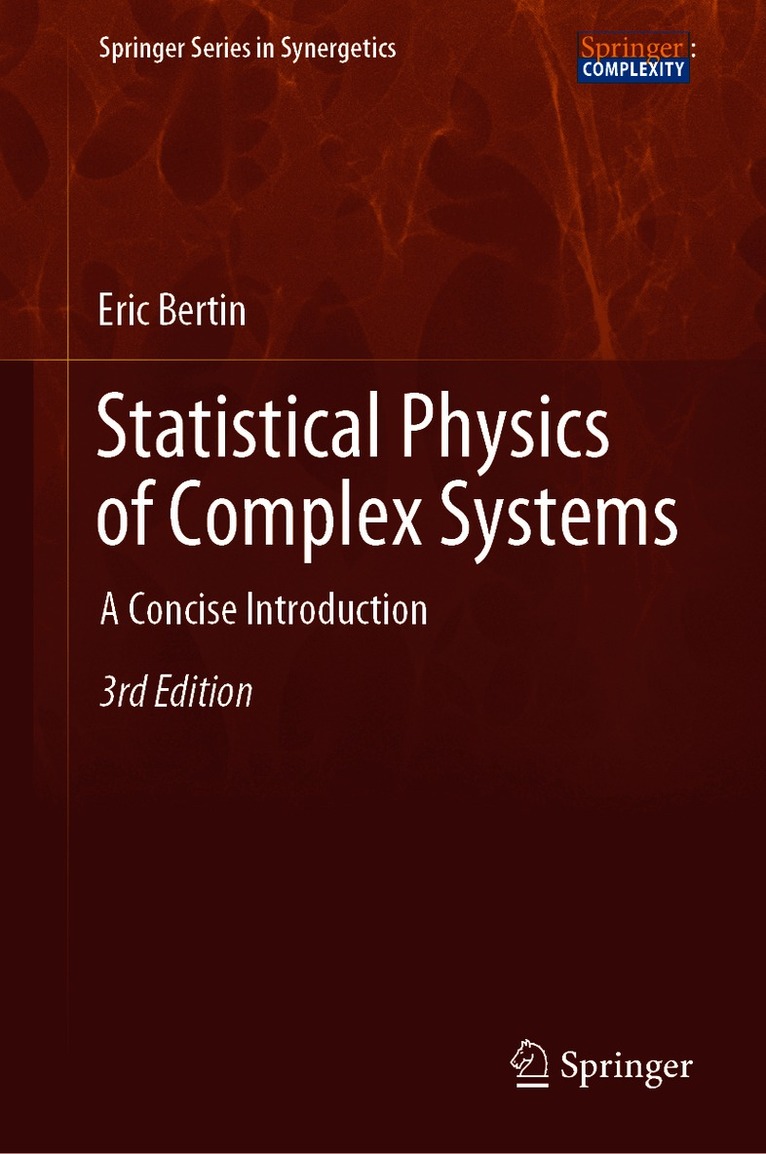
This third edition of Statistical Physics of Complex Systems has been expanded to provide more examples of applications of concepts and methods from statistical physics to the modeling of complex systems. These include avalanche dynamics in materials, models of social agents like road traffic or wealth repartition, the real space aspects of biological evolution dynamics, propagation phenomena on complex networks, formal neural networks and their connection to constraint satisfaction problems.
This course-tested textbook provides graduate students and non-specialists with a basic understanding of the concepts and methods of statistical physics and demonstrates their wide range of applications to interdisciplinary topics in the field of complex system sciences, including selected aspects of theoretical modeling in biology and the social sciences. It covers topics such as non-conserved particles, evolutionary population dynamics, networks, properties of both individual and coupled simple dynamical systems, and convergence theorems, as well as short appendices that offer helpful hints on how to perform simple stochastic simulations in practice. The original spirit of the book is to remain accessible to a broad, non-specialized readership. The format is a set of concise, modular, and self-contained topical chapters, avoiding technicalities and jargon as much as possible, and complemented by a wealth of worked-out examples, so as to make this work useful as a self-study text or as textbook for short courses.
687 kr
Läs direkt efter köp
This course-tested primer provides graduate students and non-specialists with a basic understanding of the concepts and methods of statistical physics and demonstrates their wide range of applications to interdisciplinary topics in the field of complex system sciences, including selected aspects of theoretical modeling in biology and the social sciences.
Generally speaking, the goals of statistical physics may be summarized as follows: on the one hand to study systems composed of a large number of interacting units, and on the other to predict the macroscopic, collective behavior of the system considered from the perspective of the microscopic laws governing the dynamics of the individual entities. These two goals are essentially also shared by what is now called ''complex systems science,'' and as such, systems studied in the framework of statistical physics may be considered to be among the simplest examples of complex systems – while also offering a rather well developed mathematical treatment.
The second edition has been significantly revised and expanded, featuring in particular three new chapters addressing non-conserved particles, evolutionary population dynamics, networks, properties of both individual and coupled simple dynamical systems, and convergence theorems, as well as short appendices that offer helpful hints on how to perform simple stochastic simulations in practice.
Yet, the original spirit of the book – to remain accessible to a broad, non-specialized readership – has been kept throughout: the format is a set of concise, modular and self-contained topical chapters, avoiding technicalities and jargon as much as possible, and complemented by a wealth of worked-out examples, so as to make this work useful as a self-study text or as textbook for short courses.
From the reviews of the first edition:
“… a good introduction to basic concepts of statistical physics and complex systems for students and researchers with an interest in complex systems in other fields … .” Georg Hebermehl, Zentralblatt MATH, Vol. 1237, 2012
“… this short text remains very refreshing for the mathematician.” Dimitri Petritis, Mathematical Reviews, Issue 2012k
687 kr
Läs direkt efter köp
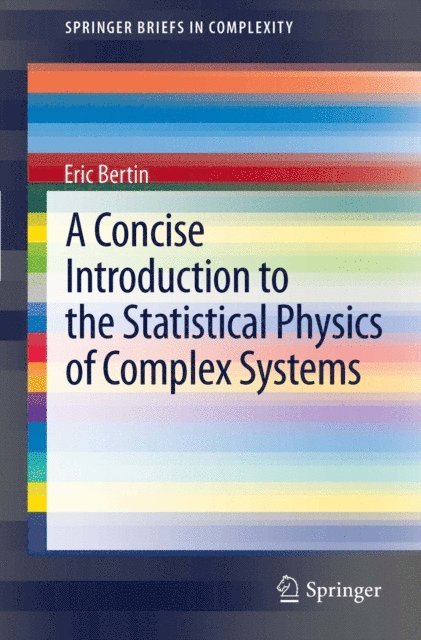
This concise primer (based on lectures given at summer schools on complex systems and on a masters degree course in complex systems modeling) will provide graduate students and newcomers to the field with the basic knowledge of the concepts and methods of statistical physics and its potential for application to interdisciplinary topics.
Indeed, in recent years, statistical physics has begun to attract the interest of a broad community of researchers in the field of complex system sciences, ranging from biology to the social sciences, economics and computer science. More generally, a growing number of graduate students and researchers feel the need to learn some basic concepts and questions originating in other disciplines without necessarily having to master all of the corresponding technicalities and jargon. Generally speaking, the goals of statistical physics may be summarized as follows: on the one hand to study systems composed of a large number of interacting ‘entities’, and on the other to predict the macroscopic (or collective) behavior of the system considered from the microscopic laws ruling the dynamics of the individual ‘entities’. These two goals are, to some extent, also shared by what is nowadays called ‘complex systems science’ and for these reasons, systems studied in the framework of statistical physics may be considered as among the simplest examples of complex systems—allowing in addition a rather well developed mathematical treatment.