Eric W. Robinson - Böcker
Visar alla böcker från författaren Eric W. Robinson. Handla med fri frakt och snabb leverans.
5 produkter
5 produkter
456 kr
Skickas inom 7-10 vardagar
This book invites readers to join in a fresh and extensive investigation of one of Ancient Greece's greatest inventions: democratic government. Provides an accessible, up-to-date survey of vital issues in Greek democracy.Covers democracy’s origins, growth and essential nature.Raises questions of continuing interest.Combines ancient texts in translation and recent scholarly articles.Invites the reader into a process of historical investigation.Contains maps, a glossary and an index.
441 kr
Skickas inom 7-10 vardagar
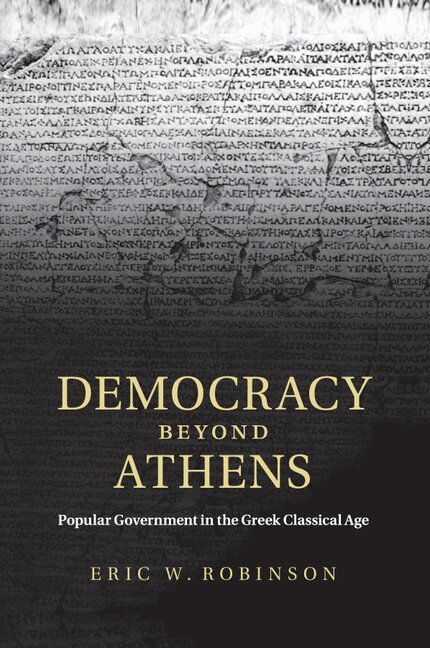
What was ancient democracy like? Why did it spread in ancient Greece? An astonishing number of volumes have been devoted to the well-attested Athenian case, while non-Athenian democracy - for which evidence is harder to come by - has received only fleeting attention. Nevertheless, there exists a scattered body of ancient material regarding democracy beyond Athens, from ancient literary authors and epigraphic documents to archaeological evidence, out of which one can build an understanding of the phenomenon. This book presents a detailed study of ancient Greek democracy in the Classical period (480-323 BC), focusing on examples outside Athens. It has three main goals: to identify where and when democratic governments established themselves in ancient Greek city-states; to explain why democracy spread to many parts of Greece in this period; and to further our understanding of the nature of ancient democracy by studying its practices beyond Athens.
767 kr
Skickas inom 7-10 vardagar
What was ancient democracy like? Why did it spread in ancient Greece? An astonishing number of volumes have been devoted to the well-attested Athenian case, while non-Athenian democracy - for which evidence is harder to come by - has received only fleeting attention. Nevertheless, there exists a scattered body of ancient material regarding democracy beyond Athens, from ancient literary authors and epigraphic documents to archaeological evidence, out of which one can build an understanding of the phenomenon. This book presents a detailed study of ancient Greek democracy in the Classical period (480-323 BC), focusing on examples outside Athens. It has three main goals: to identify where and when democratic governments established themselves in ancient Greek city-states; to explain why democracy spread to many parts of Greece in this period; and to further our understanding of the nature of ancient democracy by studying its practices beyond Athens.
1 772 kr
Skickas inom 7-10 vardagar
This book invites readers to join in a fresh and extensive investigation of one of Ancient Greece's greatest inventions: democratic government. Provides an accessible, up-to-date survey of vital issues in Greek democracy.Covers democracy’s origins, growth and essential nature.Raises questions of continuing interest.Combines ancient texts in translation and recent scholarly articles.Invites the reader into a process of historical investigation.Contains maps, a glossary and an index.
2 266 kr
Kommande
Spartan Legend explores the nature and significance of ancient Sparta's supreme military reputation. Commentators ancient and modern have long remarked upon the Spartans' legendary valor in battle, but the character of the reputation as it developed in Greece over many decades, and its powerful consequences, are not widely understood. On multiple occasions Sparta's mystique so cowed their foes that they ran from battle just as it was joined, giving the Spartans an easy victory. Eric W. Robinson provides evidence that largely justifies Sparta's reputation. Moreover, he uncovers how the fear of Spartan war-fighting meant that Sparta could make and maintain large alliances over time, swelling the number of men fighting by their side, with real consequences on the battlefield. They could also frequently dictate when and where their wars would be fought. For these reasons the military reputation of the Spartans substantially lengthened the era of Sparta's hegemony in Greece. Ultimately, Spartan Legend reveals the enduring nature of the Spartan legend, which continues to the present day, readily visible in popular culture.