Eric Yarbrough – författare
700 kr
Skickas inom 5-8 vardagar
762 kr
Läs direkt efter köp
Societal awareness of transgender and gender-nonconforming (TGNC) individuals is greater now than at any point in history, owing to the education of policy makers by advocacy organizations, the education of clinicians by research and scientific organizations, and the education of the general public by movies, television, and other media. However, most professional training programs for mental health professionals provide little to no education regarding gender diversity.
Transgender Mental Health squarely addresses this deficit. This guide forgoes clinical jargon in favor of accessible, straightforward language designed to educate clinicians on how to address the basic needs of the TGNC community, thus increasing access to mental health care for TGNC individuals, which has been sorely lacking to this point.
Rich in cases drawn from real clinical experience, the guide is organized into four sections. The first section includes a discussion of the gender spectrum and offers a history of the TGNC experience. This section also covers advocacy, particularly letter writing for gender marker changes and gender-affirming surgeries. The second section is dedicated to mental health factors in TGNC care and examines sex and sexuality, support systems, and transitioning and detransitioning. The third of the guide''s sections addresses general physical health with TGNC individuals, including masculinizing and feminizing hormones, with an eye toward preparing practitioners to address the social, psychological, and physical needs of their patients. The final section discusses all major gender-affirming surgical procedures, as well as nonsurgical interventions.
Each chapter includes summarizing key points and review questions at the end that not only test the reader''s comprehension of the material but also provide additional information on the complicated political, social, and cultural barriers that many TGNC individuals experience as they attempt to secure adequate care.
Relevant for a range of mental health professionals, including psychiatrists, psychiatric nurse practitioners, psychologists, social workers, family therapists, and school counselors, Transgender Mental Health is a simple yet thorough primer on the complex topic of gender diversity.
634 kr
Skickas inom 5-8 vardagar
805 kr
Läs direkt efter köp
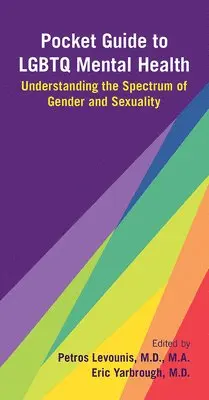
The Pocket Guide to LGBTQ Mental Health is a down-to-earth, informative, and affirming manual for mental health clinicians working with patients of diverse gender and sexual identities. In recent years, people have begun to grapple with these issues in a healthier, more public way, and mental health practitioners must be prepared to meet their patients with the knowledge, understanding, and grasp of the context in which patients live their lives. The editors have brought their specialized knowledge to the project and, along with contributors who are experts in the field of LGBTQ mental health, have created a book of uncommon empathy. The volume''s structure is simple, consistent, and effective, with 10 chapters covering lesbian, gay, bisexual, transgender, queer, questioning, intersex, asexual, pansexual, and allied individuals. Some chapters overlap because some people identify with more than one of these identities. The writers have drawn on both the scientific literature and their own clinical experience to create a volume that is informative, practical, and easy to read.
The book possesses an abundance of useful features: All diagnostic and treatment discussions are based on the latest information found in DSM-5. Each chapter includes straightforward, real-world, and evidence-based answers to "Questions Well-Meaning People Ask" -- essentially, "What would patients, their friends, their parents, their physicians like to know about being X, Y, or Z?" A special section in each chapter addresses themes that may emerge during therapy, preparing the clinician to identify and respond sensitively and knowledgeably to issues that may become salient as counseling progresses. Each chapter concludes with "Five Take-Home Points," a handy summary of the most important information, allowing the reader to identify essential material and consolidate learning. An extensive collection of resources is included, helping the reader to locate more information on reliable websites and from other authoritative sources.
Written in a conversational style that will appeal to patients and families, as well as clinicians, the Pocket Guide to LGBTQ Mental Health explores the psychological and cultural context for each gender or sexual identity in a comprehensive, realistic, and affirming way.