
Erik Denters – författare
Visar alla böcker från författaren Erik Denters. Handla med fri frakt och snabb leverans.
2 produkter
2 produkter
E-bok
PDF, Engelska, 20235 505 kr
Läs direkt efter köp
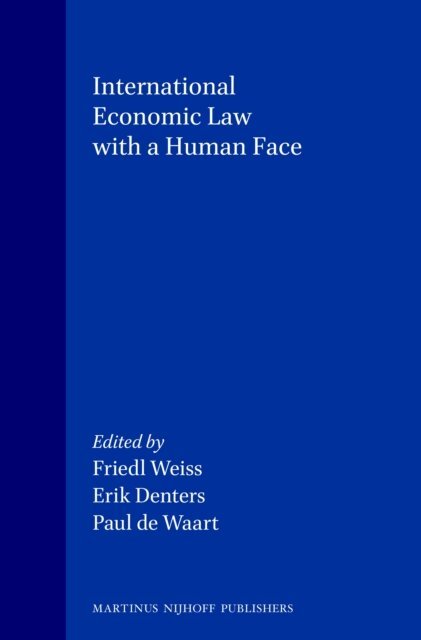
International Economic Law with a Human Face addresses a vital question in contemporary international economies: the design, structure and content of the legal and institutional framework within an increasingly globalized civil society and market economy. It is based on the belief that liberalized global markets cannot be expected to provide the public goods required to secure the acquis communautaire for human rights worldwide, let alone to extend those rights to peoples hitherto deprived of their benefits. Scholars from Europe, America, Asia and Australia examine a variety of aspects of relevant state practice in a fresh and stimulating manner. They combine `international social critique' of state practice with ideas for `social engineering', offering critical legal analysis and ideas about policy options for setting standards to induce legal change and development. International Economic Law with a Human Face is a `user-friendly' book. Twenty-seven chapters are sub-titled and arranged under three main headings: Towards a new human and economic order (chapters 1-8); Trade, environmental protection and resource management (chapters 9-18); and Investment and finance (chapters 19-27). It also contains a detailed Table of Contents and an Index.
E-bok
PDF, Engelska, 20235 223 kr
Läs direkt efter köp
The chapters in this volume are based on the papers that were presented at a seminar in March 1994 organized under the auspices of the newly established ILA Committee on Legal Aspects of Sustainable Development. The seminar focused on the legal principles and international practice of sustainable development and good governance as one of its constitutive elements. The book is divided into four parts: Evolution of Concepts, Participatory Development, Development Cooperation and Human Rights, and Sensible Economic and Social Policies. They reflect the holistic concept of sustainable development advanced by the International Union for the Conservation of Nature sustainable development. This concept implies that maintaining a quality of life for many generations is socially desirable, economically viable and ecologically sustainable. The volume highlights the principle of sustainable development as a major topic in international law embodied in the international instruments agreed upon at the UN Conference on Environment and Development in Rio de Janeiro (1992). The introductory chapter discusses the interlinking of development and good governance, including human rights, democracy, and sensible economic and social policies as presented in the 1994 UN Agenda for development. The management of the economy, society and environment towards sustainability will be one of the most momentous discussions of our times. According to one author sustainable development is incompatible with continuous growth of the economy, while good governance appears to be incompatible with the achievement, within a reasonable time scale, of a non-growth society. Other provocative opinions make this volume a highly challenging source for any scholar interested in the subject.