Erna Moller – författare
Visar alla böcker från författaren Erna Moller. Handla med fri frakt och snabb leverans.
5 produkter
5 produkter
E-bok
PDF, Engelska, 2013708 kr
Läs direkt efter köp
The 55th Nobel Symposium entitled "Genetics of the Immune Response" took place in Saltsjobaden, Sweden, June 15 - 17, 1982. The topic was selected for several reasons, such as the rapid progress in the genetic analysis of immunoglobulin and MHC genes and the elucidation of the mechanism of switch to different immunoglobulin classes and subclasses. The genetic advances formed a basis for discussions of problems relating to regulation of T cell subsets, mechanisms of activation and regulation of B cell differentiation and an analysis of the network hypothesis. The format of the symposium was arranged so as to include two sessions in the morning and two in the afternoon. Each session was introduced by one speaker, followed by free discussion. The intro ductory lectures are included in the proceedings. The participants summarized their contributions to the discussion in written form. In addi tion to the closed sessions, there was one open session at the Karolinska Institute with lectures by Drs. L. Hood, C. Milstein, D. Baltimore, J. Klein and B. Benacerraf, which are not included in these procee din gs. The symposium was sponsored by the Nobel Foundation and its Nobel Symposium Committee through grants from the Tercentenary Fund of the Bank of Sweden and the Knut & Alice Wallenberg Foundation. The Swedish Medical Research Council, the Swedish Cancer Society and the Swedish Ministry of Education and Cultural Affairs also made contri butions.
Del 55 - Nobel Foundation Symposia
Genetics of the Immune Response
Häftad, Engelska, 2012
565 kr
Skickas inom 10-15 vardagar
The 55th Nobel Symposium entitled "Genetics of the Immune Response" took place in Saltsjobaden, Sweden, June 15 - 17, 1982. The topic was selected for several reasons, such as the rapid progress in the genetic analysis of immunoglobulin and MHC genes and the elucidation of the mechanism of switch to different immunoglobulin classes and subclasses. The genetic advances formed a basis for discussions of problems relating to regulation of T cell subsets, mechanisms of activation and regulation of B cell differentiation and an analysis of the network hypothesis. The format of the symposium was arranged so as to include two sessions in the morning and two in the afternoon. Each session was introduced by one speaker, followed by free discussion. The intro ductory lectures are included in the proceedings. The participants summarized their contributions to the discussion in written form. In addi tion to the closed sessions, there was one open session at the Karolinska Institute with lectures by Drs. L. Hood, C. Milstein, D. Baltimore, J. Klein and B. Benacerraf, which are not included in these procee din gs. The symposium was sponsored by the Nobel Foundation and its Nobel Symposium Committee through grants from the Tercentenary Fund of the Bank of Sweden and the Knut & Alice Wallenberg Foundation. The Swedish Medical Research Council, the Swedish Cancer Society and the Swedish Ministry of Education and Cultural Affairs also made contri butions.
E-bok
PDF, Engelska, 20121 408 kr
Läs direkt efter köp
This volume deals with the structure and function of molecules that have, during the last decade, turned out to have a central role in immune responses. Trans plantation antigens were discovered and characterized by Gorer about 50 years ago, and the biological basis for the unequalled complexity of their variability between individuals within a species, in spite of extreme conservation between species, was the subject of intense research and discussion for many years. During the days of belief in "immune surveillance" against spontaneously developing tumors, it was suggested that histoincompatibility between members of one species would prevent cancer from being a contagious disease and thus a threat to the species. Immunologists involved in human transplantation had to learn and care about the complexity, especially after 1967, when it was found that HLA antigens were the products of the human MHC. Rejection of HLA-identical sib kidney grafts was so rare, even in those days, that cases of rejection were described in scientific papers.
Häftad, Engelska, 2011
1 123 kr
Skickas inom 10-15 vardagar
This volume deals with the structure and function of molecules that have, during the last decade, turned out to have a central role in immune responses. Trans plantation antigens were discovered and characterized by Gorer about 50 years ago, and the biological basis for the unequalled complexity of their variability between individuals within a species, in spite of extreme conservation between species, was the subject of intense research and discussion for many years. During the days of belief in "immune surveillance" against spontaneously developing tumors, it was suggested that histoincompatibility between members of one species would prevent cancer from being a contagious disease and thus a threat to the species. Immunologists involved in human transplantation had to learn and care about the complexity, especially after 1967, when it was found that HLA antigens were the products of the human MHC. Rejection of HLA-identical sib kidney grafts was so rare, even in those days, that cases of rejection were described in scientific papers.
E-bok
PDF, Engelska, 20121 408 kr
Läs direkt efter köp
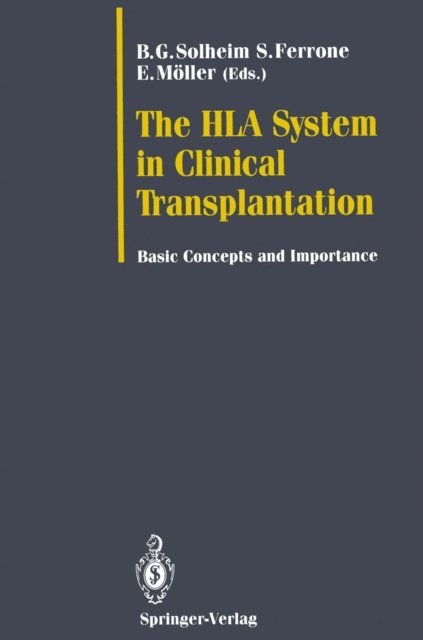
With this book we· want to address young graduate students, clini cians involved in transplantation, and technicians in transplantation immunology laboratories. The volume should give a comprehensive but basic, up to date introduction to the structure, function, and clinical importance of the HLA system. We believe that there is a need for such a survey, and think that the present level of our knowledge is an optimal occasion for publication. A significant number of ques tions have now been resolved, and our knowledge has reached a level of sophistication that provides the basis for additional questions and answers. Although the emphasis of this book is on the role of HLA anti gens in clinical transplantation, their involvement in other clinical contexts is also discussed. The main focus is on the human MHC an tigenic system, but MHC systems in other species are described as they contribute to our understanding of the structural and functional characteristics of HLA antigens. Some important issues related to laboratory techniques are also covered. The contributors have a close affiliation to the field of transplan tation immunology. A majority have even been playing important roles in unraveling the HLA system and its functions. We believe this has contributed significantly to the quality and clinical and practical relevance of the book. As editors, we drew up the principal guidelines and took care that the chapters can be read as separate entities, although this invariably results in some overlapping.