Etienne Veto – författare
Visar alla böcker från författaren Etienne Veto. Handla med fri frakt och snabb leverans.
4 produkter
4 produkter
Häftad, Engelska, 2025
377 kr
Skickas inom 5-8 vardagar
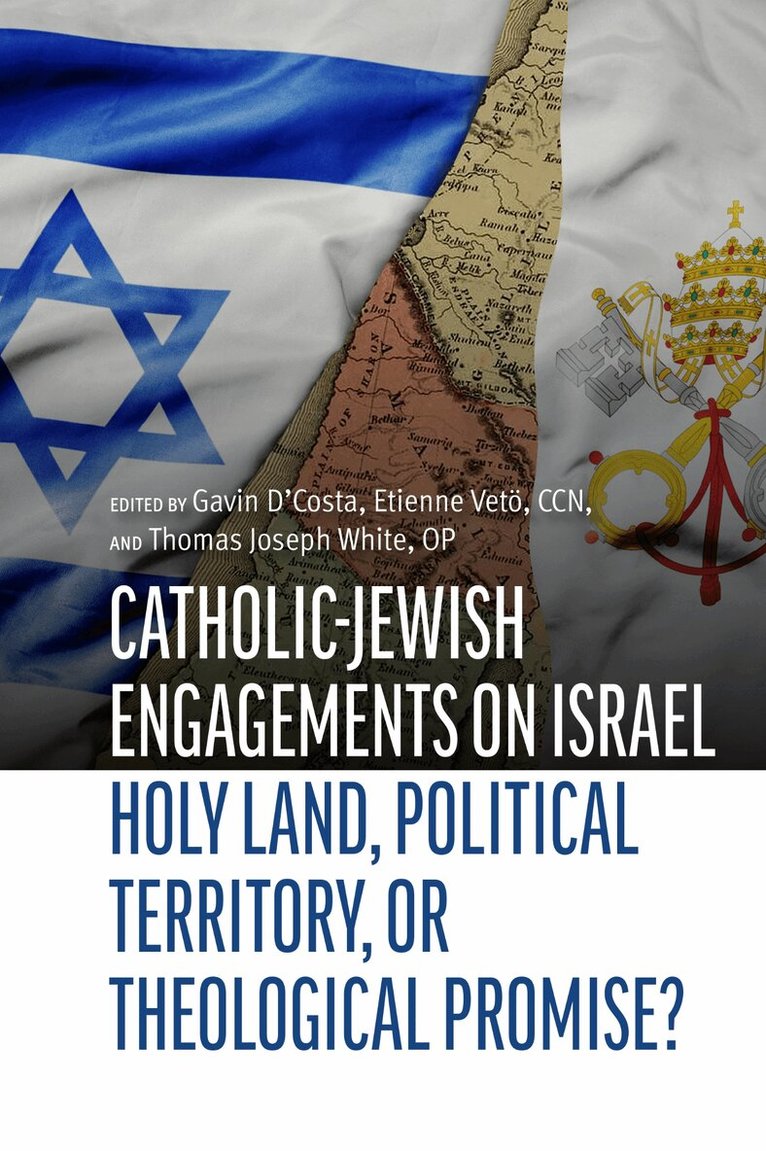
This is the first volume of its kind, bringing together a group of international Jewish and Catholic scholars in creative conversation addressing the question of the status of the land called Israel. Is Israel best viewed as political territory, the 'Holy Land', or part of the biblical promise? If committing to one of these options, what are the theological and political consequences?The book is divided into sections that take the reader through several related questions that bear upon this topic. There is a preface with an overview of how far Catholic Jewish conversations have gone since Nostra Aetate, and how these conversations have now begun to address the land. Then there is an attempt to advance positive theological cases by Catholics and Jews affirming the people in the land as theologically significant, not without difficulties regarding the state itself. The next section deals with the bible/Tanakh as the basis of such claims and addresses the different reading strategies by each community. One of the central questions is then addressed: what of the Palestinian people, do the biblical promise to the Jewish people spell disaster for the Palestinians? Can revelation mean dispossession? The following essays address a stumbling block for both groups: do Jewish and Christian theologies underwrite a nation state? Isn't this option perilously close to God underwriting nationalism? The book ends with subtle critiques of the entire venture undertaken in this volume.Essential reading for Catholic Jewish relations and one that addresses one of the most pressing contemporary questions for both religions.
Häftad, Engelska, 2019
240 kr
Skickas inom 5-8 vardagar
Inbunden, Engelska, 2019
421 kr
Skickas inom 5-8 vardagar
E-bok
Engelska, 2019387 kr
Läs direkt efter köp
The Holy Spirit is in a way the most mysterious of the three "e;names"e; of God. For many it is the "e;unknown God"e; (Acts 17:23). How can a "e;Spirit"e; be love? How can it be a person? What role can a "e;Spirit"e; have in the trinitarian relations?In The Breath of God, Veto argues that a more exact comprehension of the third divine person can be reached by considering the way it acts in the economy of salvation and how it reveals itself in its scriptural names: Ruah and Pneuma, breath or wind. Just as, in the eternal life of God, the Father and the Son are precisely what their names designate, likewise, the Holy Spirit is the Breath of God. The procession of the Spirit is the "e;breathing out"e; of the Father into the Son, the communication of one intimacy into another, and the "e;breathing"e; back of the Son into the Father. This leads to reshaping many aspects of trinitarian theology, in particular divine personhood. It is also fruitful for the believer's life of prayer because it offers a better understanding of the distinct relationship one can have to Father, Son, and Spirit.