Eva Lomnicka – författare
Visar alla böcker från författaren Eva Lomnicka. Handla med fri frakt och snabb leverans.
6 produkter
6 produkter
E-bok
PDF, Engelska, 20185 009 kr
Läs direkt efter köp
Personal property security is an important subject in commercial practice as it is the key to much of the law of banking and sale. This book examines traditional methods of securing debts (such as mortgages, charges and pledges) on property other than land, describing how these are created, how they must be registered (or otherwise ''perfected'') if they are to be valid, the rights and duties of the parties and how the security is enforced if the debt is not paid. The third edition has been updated to cover a wealth of cases which have been decided since the last edition. These include new cases on: control of financial collateral, and relief against forfeiture under a financial collateral arrangement; retention of title (including the effect of "extended" clauses); estoppel and the HPI register; availability of set-off against assignee; a number of cases on enforcement of security; equitable liens; solicitor''s liens and databases; on priority or purchase money security interests; and the Irish Supreme Court decision on floating charge and crystallisation. The effect of key legislative changes have also been analysed and these include the 2013 amendments to the Companies Act 2006 Part 25, and issues post-ratification relating to the Cape Town Convention.The only full-length treatment covering both traditional security over personal property and also devices that fulfil a similar economic function, such as retention of title and sales of receivables, The Law of Security and Title-Based Financing is a frequently-cited and indispensable reference work both for practitioners and academics.
E-bok
Engelska, 20185 009 kr
Läs direkt efter köp
Personal property security is an important subject in commercial practice as it is the key to much of the law of banking and sale. This book examines traditional methods of securing debts (such as mortgages, charges and pledges) on property other than land, describing how these are created, how they must be registered (or otherwise ''perfected'') if they are to be valid, the rights and duties of the parties and how the security is enforced if the debt is not paid. The third edition has been updated to cover a wealth of cases which have been decided since the last edition. These include new cases on: control of financial collateral, and relief against forfeiture under a financial collateral arrangement; retention of title (including the effect of "extended" clauses); estoppel and the HPI register; availability of set-off against assignee; a number of cases on enforcement of security; equitable liens; solicitor''s liens and databases; on priority or purchase money security interests; and the Irish Supreme Court decision on floating charge and crystallisation. The effect of key legislative changes have also been analysed and these include the 2013 amendments to the Companies Act 2006 Part 25, and issues post-ratification relating to the Cape Town Convention.The only full-length treatment covering both traditional security over personal property and also devices that fulfil a similar economic function, such as retention of title and sales of receivables, The Law of Security and Title-Based Financing is a frequently-cited and indispensable reference work both for practitioners and academics.
Inbunden, Engelska, 2024
4 817 kr
Skickas inom 5-8 vardagar
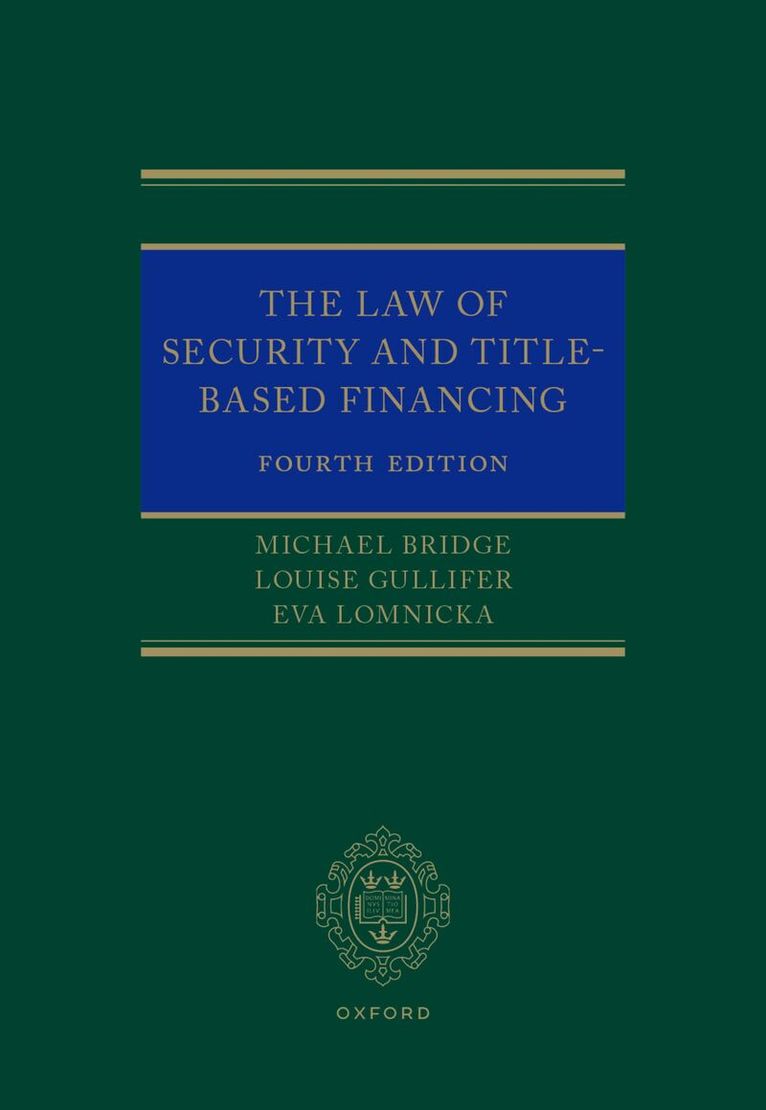
Personal property security is an important subject in commercial practice as it is the key to much of the law of banking and sale. This book examines traditional methods of securing debts (such as mortgages, charges and pledges as well as so-called 'quasi-security') on property other than land, describing how these are created, how they must be registered (or otherwise 'perfected') if they are to be valid, the rights and duties of the parties and how the security is enforced if the debt is not paid.This fourth edition has been updated to incorporate recent political and legal developments, including Brexit. The 'Edinburgh Reforms', which have followed the United Kingdom's exit from the European Union, promise a thorough overhaul of the consumer credit regime. The Retained EU Law (Revocation and Reform) Act 2023 potentially affects the interpretation of EU assimilated law, including the Financial Collateral Arrangements (No2) Regulations (FCARs).This edition further assesses the implications of the Business Contract Terms (Assignment of Receivables) Regulations 2018, taking pledges over electronic documents of title in the light of the Electronic Trade Documents Act 2023, the outlawing of 'ipso facto' clauses by the Corporate Insolvency and Governance Act 2020, and the reduced scope of the EU Insolvency Regulation. The treatment of insolvency matters within the framework of the Cape Town Convention is also considered, as are recent cases on pledges of bills of lading when the carrier no longer has possession of the goods, the distinction between fixed and floating charges, equitable liens and the right of appropriation of financial collateral. There is a full discussion of the taking of security over digital assets and the relevance of the FCARs. The only full-length treatment covering both traditional security over personal property and also devices that fulfil a similar economic function, such as retention of title and sales of receivables, The Law of Security and Title-Based Financing is a frequently-cited and indispensable reference work both for practitioners and academics.
E-bok
PDF, Engelska, 20244 282 kr
Läs direkt efter köp
Personal property security is an important subject in commercial practice as it is the key to much of the law of banking and sale. This book examines traditional methods of securing debts (such as mortgages, charges and pledges as well as so-called ''quasi-security'') on property other than land, describing how these are created, how they must be registered (or otherwise ''perfected'') if they are to be valid, the rights and duties of the parties and how the security is enforced if the debt is not paid.This fourth edition has been updated to incorporate recent political and legal developments, including Brexit. The ''Edinburgh Reforms'', which have followed the United Kingdom''s exit from the European Union, promise a thorough overhaul of the consumer credit regime. The Retained EU Law (Revocation and Reform) Act 2023 potentially affects the interpretation of EU assimilated law, including the Financial Collateral Arrangements (No2) Regulations (FCARs).This edition further assesses the implications of the Business Contract Terms (Assignment of Receivables) Regulations 2018, taking pledges over electronic documents of title in the light of the Electronic Trade Documents Act 2023, the outlawing of ''ipso facto'' clauses by the Corporate Insolvency and Governance Act 2020, and the reduced scope of the EU Insolvency Regulation. The treatment of insolvency matters within the framework of the Cape Town Convention is also considered, as are recent cases on pledges of bills of lading when the carrier no longer has possession of the goods, the distinction between fixed and floating charges, equitable liens and the right of appropriation of financial collateral. There is a full discussion of the taking of security over digital assets and the relevance of the FCARs. The only full-length treatment covering both traditional security over personal property and also devices that fulfil a similar economic function, such as retention of title and sales of receivables, The Law of Security and Title-Based Financing is a frequently-cited and indispensable reference work both for practitioners and academics.
E-bok
Engelska, 20244 282 kr
Läs direkt efter köp
Personal property security is an important subject in commercial practice as it is the key to much of the law of banking and sale. This book examines traditional methods of securing debts (such as mortgages, charges and pledges as well as so-called ''quasi-security'') on property other than land, describing how these are created, how they must be registered (or otherwise ''perfected'') if they are to be valid, the rights and duties of the parties and how the security is enforced if the debt is not paid.This fourth edition has been updated to incorporate recent political and legal developments, including Brexit. The ''Edinburgh Reforms'', which have followed the United Kingdom''s exit from the European Union, promise a thorough overhaul of the consumer credit regime. The Retained EU Law (Revocation and Reform) Act 2023 potentially affects the interpretation of EU assimilated law, including the Financial Collateral Arrangements (No2) Regulations (FCARs).This edition further assesses the implications of the Business Contract Terms (Assignment of Receivables) Regulations 2018, taking pledges over electronic documents of title in the light of the Electronic Trade Documents Act 2023, the outlawing of ''ipso facto'' clauses by the Corporate Insolvency and Governance Act 2020, and the reduced scope of the EU Insolvency Regulation. The treatment of insolvency matters within the framework of the Cape Town Convention is also considered, as are recent cases on pledges of bills of lading when the carrier no longer has possession of the goods, the distinction between fixed and floating charges, equitable liens and the right of appropriation of financial collateral. There is a full discussion of the taking of security over digital assets and the relevance of the FCARs. The only full-length treatment covering both traditional security over personal property and also devices that fulfil a similar economic function, such as retention of title and sales of receivables, The Law of Security and Title-Based Financing is a frequently-cited and indispensable reference work both for practitioners and academics.
Inbunden, Engelska
1 839 kr
Tillfälligt slut