Fabio Spizzichino – författare
Visar alla böcker från författaren Fabio Spizzichino. Handla med fri frakt och snabb leverans.
5 produkter
5 produkter
Häftad, Engelska, 2019
960 kr
Skickas inom 10-15 vardagar
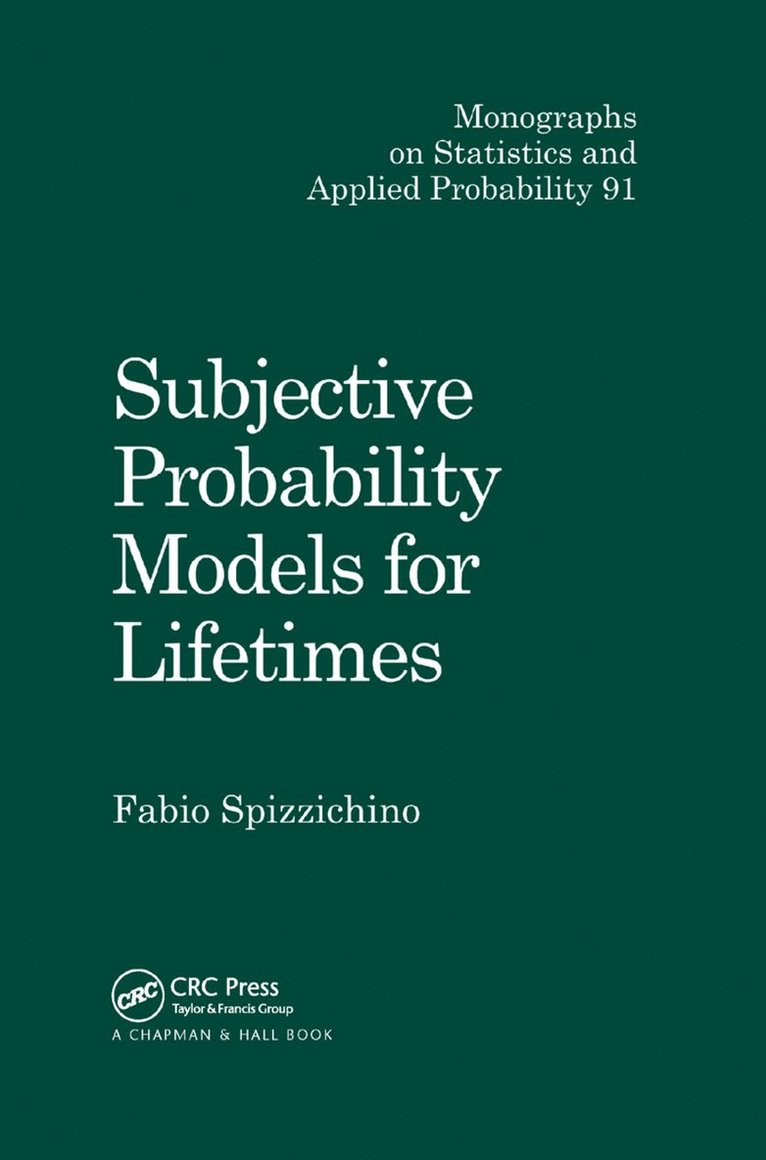
Bayesian methods in reliability cannot be fully utilized and understood without full comprehension of the essential differences that exist between frequentist probability and subjective probability. Switching from the frequentist to the subjective approach requires that some fundamental concepts be rethought and suitably redefined.Subjective Probability Models for Lifetimes details those differences and clarifies aspects of subjective probability that have a direct influence on modeling and drawing inference from failure and survival data. In particular, within a framework of Bayesian theory, the author considers the effects of different levels of information in the analysis of the phenomena of positive and negative aging.The author coherently reviews and compares the various definitions and results concerning stochastic ordering, statistical dependence, reliability, and decision theory. He offers a detailed but accessible mathematical treatment of different aspects of probability distributions for exchangeable vectors of lifetimes that imparts a clear understanding of what the "probabilistic description of aging" really is, and why it is important to analyzing survival and failure data.
E-bok
Engelska, 20011 103 kr
Läs direkt efter köp
Bayesian methods in reliability cannot be fully utilized and understood without full comprehension of the essential differences that exist between frequentist probability and subjective probability. Switching from the frequentist to the subjective approach requires that some fundamental concepts be rethought and suitably redefined.Subjecti
E-bok
PDF, Engelska, 20011 103 kr
Läs direkt efter köp
Bayesian methods in reliability cannot be fully utilized and understood without full comprehension of the essential differences that exist between frequentist probability and subjective probability. Switching from the frequentist to the subjective approach requires that some fundamental concepts be rethought and suitably redefined.Subjecti
Inbunden, Engelska, 2001
2 389 kr
Skickas inom 10-15 vardagar
Bayesian methods in reliability cannot be fully utilized and understood without full comprehension of the essential differences that exist between frequentist probability and subjective probability. Switching from the frequentist to the subjective approach requires that some fundamental concepts be rethought and suitably redefined.Subjective Probability Models for Lifetimes details those differences and clarifies aspects of subjective probability that have a direct influence on modeling and drawing inference from failure and survival data. In particular, within a framework of Bayesian theory, the author considers the effects of different levels of information in the analysis of the phenomena of positive and negative aging.The author coherently reviews and compares the various definitions and results concerning stochastic ordering, statistical dependence, reliability, and decision theory. He offers a detailed but accessible mathematical treatment of different aspects of probability distributions for exchangeable vectors of lifetimes that imparts a clear understanding of what the "probabilistic description of aging" really is, and why it is important to analyzing survival and failure data.
Inbunden, Engelska, 1993
2 713 kr
Tillfälligt slut
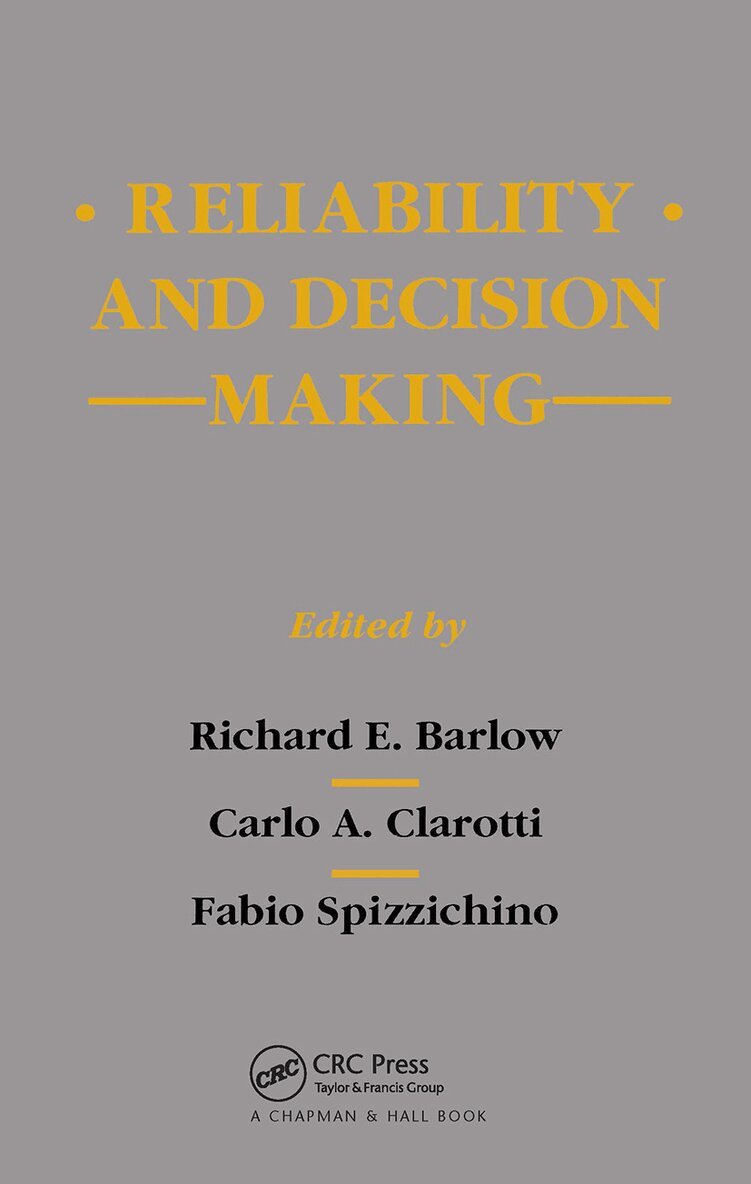
The very scope of reliability analyses is to take decisions relative to engineering systems. This commands for radical changes in the probabilistic/statistical techniques used in reliability practice. Since the decisions to be taken have an engineering/economical relevance (one can incur a loss if the system fails before mission time), the superimposed cost structure does play a central role in any reliability problem. Only the Bayesian predictive approach allows to combine harmonically together, costs and probabilities. Using a predictive approach means to assess one's own probability distribution on the observable random quantities of interest (for example, on the failure time of a system). The probability assessment is possibly made on the basis of some statistical evidence. In this view, parameters of probability distributions are just a computational aid to derive the probability of interest. From the Bayesian predictive standpoint, any reliability problem (even a system reliability problem) becomes a decision problem in face of uncertainty. Uncertainty can be mitigated by some forthcoming statistical evidence; the latter has, in general, a dynamic character. It is often the case that one can exercise some control on the forthcoming information. First decisions to be taken when coping with a reliability problem is then: what course of actions will make the control on the forthcoming information optimal (in some suitable sense)? The need of answering this question and the dynamic character of the statistical evidence require the use of the theory of point process, of the theory of stochastic control and of the theory of stochastic filtering. The volume aims to enlighten the reasons which motivated the changes in the mathematical technology of reliability theory, and to give the readers an insight into the disciplines which recently started playing an important role in the reliability field. This volume should be of interest to both reliability theoreticians and practitioners.