Fabiola Sfodera – författare
Visar alla böcker från författaren Fabiola Sfodera. Handla med fri frakt och snabb leverans.
3 produkter
3 produkter
Inbunden, Engelska, 2025
2 024 kr
Kommande
This book explores destination experience design, synthesizing knowledge from various disciplines to offer insights and practical guidance for academic researchers and destination practitioners. It frames the concept of the flourishing destination as a new paradigm in destination studies and covers foundational concepts, stakeholder perspectives, modern trends, practical tools, and future directions to design, plan, and implement engaging, hospitable, and well-being-oriented experiences for visitors. Brief examples of existing practices and future scenarios ensure a balanced representation of destinations from different regions and development stages. The primary readers include academic researchers, DMOs, destination experience providers, urban planners, event organizers, and tourism professionals. By addressing both theoretical and practical aspects, the book aims to inspire and equip stakeholders to create exceptional visitor experiences and drive innovation in destination experience design and management.
Häftad, Engelska, 2005
1 116 kr
Skickas inom 10-15 vardagar
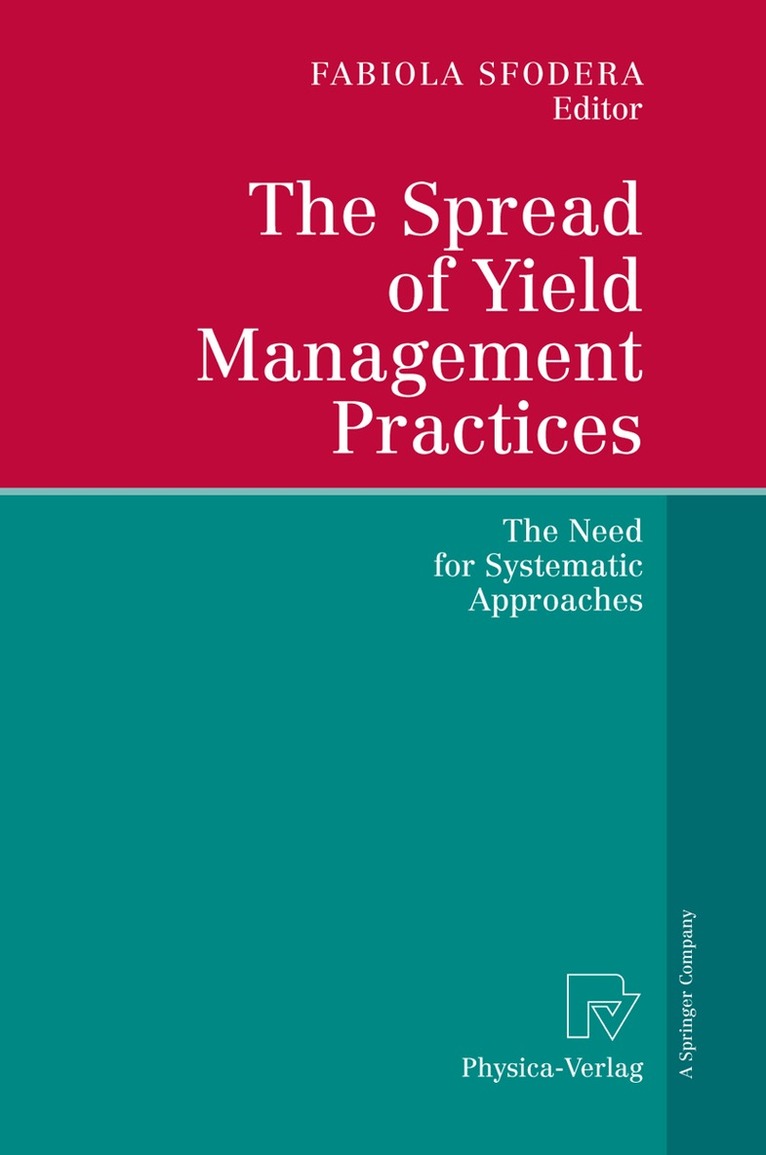
Yield management has always been considered a teclinique for large companies, whether these be airlines, railroad, car rental or hotel companies. Its application to the small and medium sized businesses that characterise the tourism industry in many countries, Italy in the first place, has never been totally excluded, but its implementation and subsequent actuation has always been considered too expensive for this type of business. In recent years all this has been changing. Technology and research have opened up new possibilities for its application at costs, and following methods, that are acceptable even to those who cannot access sophisticated statistics or mathematics instruments. The evolution and the rapid changes in the reference scenarios both of the demand and the offer, have done the rest. It has become clear that to compete in a market as vast as the tourism one, one must apply the principles and techniques of marketing to produce and deliver a service that can satisfy the needs of the client better than the competition. In the same way, however, a deeper knowledge of the processes of the clientele's choice, acquisition and consumption permits the formulation of increasingly accurate forecasts of their behaviour and an understanding of the significance and importance that each client segment attaches to the purchase and consumption of a particular service. In this way the application of the yield management technique has assumed a new and more important position as well as a greater and constant spread.
E-bok
PDF, Engelska, 20061 459 kr
Läs direkt efter köp
Yield management has always been considered a teclinique for large companies, whether these be airlines, railroad, car rental or hotel companies. Its application to the small and medium sized businesses that characterise the tourism industry in many countries, Italy in the first place, has never been totally excluded, but its implementation and subsequent actuation has always been considered too expensive for this type of business. In recent years all this has been changing. Technology and research have opened up new possibilities for its application at costs, and following methods, that are acceptable even to those who cannot access sophisticated statistics or mathematics instruments. The evolution and the rapid changes in the reference scenarios both of the demand and the offer, have done the rest. It has become clear that to compete in a market as vast as the tourism one, one must apply the principles and techniques of marketing to produce and deliver a service that can satisfy the needs of the client better than the competition. In the same way, however, a deeper knowledge of the processes of the clientele''s choice, acquisition and consumption permits the formulation of increasingly accurate forecasts of their behaviour and an understanding of the significance and importance that each client segment attaches to the purchase and consumption of a particular service. In this way the application of the yield management technique has assumed a new and more important position as well as a greater and constant spread.