Fabrizio Slavazzi – författare
Visar alla böcker från författaren Fabrizio Slavazzi. Handla med fri frakt och snabb leverans.
6 produkter
6 produkter
Inbunden, Tyska, 2020
1 682 kr
Skickas inom 5-8 vardagar
When the University of Halle-Wittenberg founded the Interdisciplinary Centre for European Enlightenment Studies in 1993, it was following the destiny of its history as a centre of the early Enlightenment in Germany which affected the whole of Europe. Research foci of the Centre are at the moment aesthetics, discourses of history, cultures of learning and erudition, university history and not least the wide field of early Enlightenment as a field of experimentation and the foundation of cultural models for the Modern Age. The results of this research have been published since Autumn 1995 in the Centres’ research publications series entitled University of Halle Series on the European Enlightenment. In addition, there have been relevant works produced outside the Centre. Two to four volumes are published annually (monographs, collected volumes, commentaries on sources).
E-bok
PDF, Tyska, 20201 807 kr
Läs direkt efter köp
Schon zu Lebzeiten hat der deutsche Archäologe und Kunsthistoriker Johann Joachim Winckelmann (1717-1768) europaweit Resonanz gefunden. Seine Geschichte der Kunst des Altertums (1764) wurde vor 1800 zweimal ins Italienische und gleich dreimal ins Französische übersetzt. Winckelmann war damit ein europäischer Klassiker, noch bevor er am Anfang des 19. Jahrhunderts von Weimar aus zu einem deutschen Klassiker gemacht wurde. Ziel des vorliegenden Bandes ist es, die bislang wenig erforschte Wirkungsgeschichte seines Werkes in Italien vor dem Hintergrund seiner europäischen Rezeption zu untersuchen. Am Beispiel Winckelmanns wird damit der Versuch unternommen, ein nationales Rezeptionsphänomen mit einer europäischen Perspektive zu kombinieren. Deutlich wird dabei, dass die italienische Winckelmann-Rezeption vor allem deshalb komplex ist, weil sie immer in Kenntnis von und mit Blick auf die Winckelmann-Rezeption in anderen europäischen Ländern – insbesondere in Deutschland und Frankreich – stattfindet: Rezeptionsgeschichte kann hier nur als eine Geschichte von Verflechtungen geschrieben werden.
E-bok
Tyska, 20201 807 kr
Läs direkt efter köp
Schon zu Lebzeiten hat der deutsche Archäologe und Kunsthistoriker Johann Joachim Winckelmann (1717-1768) europaweit Resonanz gefunden. Seine Geschichte der Kunst des Altertums (1764) wurde vor 1800 zweimal ins Italienische und gleich dreimal ins Französische übersetzt. Winckelmann war damit ein europäischer Klassiker, noch bevor er am Anfang des 19. Jahrhunderts von Weimar aus zu einem deutschen Klassiker gemacht wurde. Ziel des vorliegenden Bandes ist es, die bislang wenig erforschte Wirkungsgeschichte seines Werkes in Italien vor dem Hintergrund seiner europäischen Rezeption zu untersuchen. Am Beispiel Winckelmanns wird damit der Versuch unternommen, ein nationales Rezeptionsphänomen mit einer europäischen Perspektive zu kombinieren. Deutlich wird dabei, dass die italienische Winckelmann-Rezeption vor allem deshalb komplex ist, weil sie immer in Kenntnis von und mit Blick auf die Winckelmann-Rezeption in anderen europäischen Ländern – insbesondere in Deutschland und Frankreich – stattfindet: Rezeptionsgeschichte kann hier nur als eine Geschichte von Verflechtungen geschrieben werden.
Inbunden, Engelska, 2023
2 002 kr
Skickas inom 3-6 vardagar
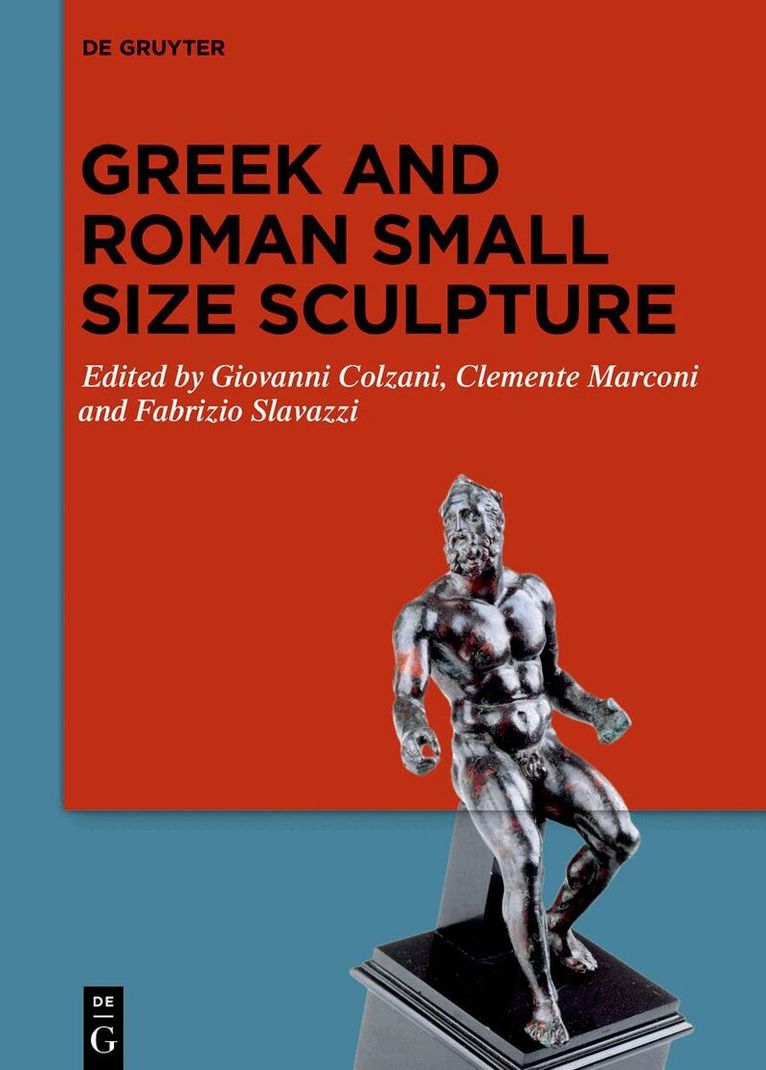
Considerations about size and scale have always played a central role within Greek and Roman visual culture, deeply affecting sculptural production. Both Greeks and Romans, in particular, had a clear notion of “colossality” and were able to fully exploit its implications with sculpture in many different areas of social, cultural and religious life. Instead, despite their ubiquitous presence, an equal and contrary categorization for small size statues does not seem to have existed in Greek and Roman culture, leading one to wonder what were the ancient ways of conceptualizing sculptural representations in a format markedly smaller than “life-size.” Even in the context of modern scholarship on Classical Art, few notions appear to be as elusive as that of “small sculpture”, often treated with a certain degree of diffidence well summarized in the formula Klein, aber Kunst? In fact, a large and heterogeneous variety of objects corresponds to this definition: all kinds of small sculpture, from statuettes to miniatures, in a variety of materials including stone, bronze, and terracotta, associated with a great array of functions and contexts, and with extremely different levels of manufacture and patronage. It would be a major misunderstanding to think of these small sculptures in general as nothing more than a cheap and simplified alternative to larger scale statues. Compared with those, their peculiar format allowed for a wider range of choices, in terms, for example, of use of either cheap or extremely valuable materials (not only marble and bronze, but also gold and silver, ivory, hard stones, among others), methods of production (combining seriality and variation), modes of fruition (such as involving a degree of intimacy with the beholder, rather than staging an illusion of “presence”). Furthermore, their pervasive presence in both private and public spaces at many levels of Greek and Roman society presents us with a privileged point of view on the visual literacy of a large and varied public. Although very different in many respects, small-sized sculptures entertained often a rather ambivalent relationship with their larger counterparts, drawing from them at the same time schemes, forms and iconographies. By offering a fresh, new analysis of archaeological evidence and literary sources, through a variety of disciplinary approaches, this volume helps to illuminate this rather complex dynamic and aims to contribute to a better understanding of the status of Greek and Roman small size sculpture within the general development of ancient art.
E-bok
PDF, Engelska, 20231 500 kr
Läs direkt efter köp
Considerations about size and scale have always played a central role within Greek and Roman visual culture, deeply affecting sculptural production. Both Greeks and Romans, in particular, had a clear notion of “colossality” and were able to fully exploit its implications with sculpture in many different areas of social, cultural and religious life. Instead, despite their ubiquitous presence, an equal and contrary categorization for small size statues does not seem to have existed in Greek and Roman culture, leading one to wonder what were the ancient ways of conceptualizing sculptural representations in a format markedly smaller than “life-size.” Even in the context of modern scholarship on Classical Art, few notions appear to be as elusive as that of “small sculpture”, often treated with a certain degree of diffidence well summarized in the formula Klein, aber Kunst? In fact, a large and heterogeneous variety of objects corresponds to this definition: all kinds of small sculpture, from statuettes to miniatures, in a variety of materials including stone, bronze, and terracotta, associated with a great array of functions and contexts, and with extremely different levels of manufacture and patronage. It would be a major misunderstanding to think of these small sculptures in general as nothing more than a cheap and simplified alternative to larger scale statues. Compared with those, their peculiar format allowed for a wider range of choices, in terms, for example, of use of either cheap or extremely valuable materials (not only marble and bronze, but also gold and silver, ivory, hard stones, among others), methods of production (combining seriality and variation), modes of fruition (such as involving a degree of intimacy with the beholder, rather than staging an illusion of “presence”). Furthermore, their pervasive presence in both private and public spaces at many levels of Greek and Roman society presents us with a privileged point of view on the visual literacy of a large and varied public. Although very different in many respects, small-sized sculptures entertained often a rather ambivalent relationship with their larger counterparts, drawing from them at the same time schemes, forms and iconographies. By offering a fresh, new analysis of archaeological evidence and literary sources, through a variety of disciplinary approaches, this volume helps to illuminate this rather complex dynamic and aims to contribute to a better understanding of the status of Greek and Roman small size sculpture within the general development of ancient art.
E-bok
Engelska, 20231 554 kr
Läs direkt efter köp
Considerations about size and scale have always played a central role within Greek and Roman visual culture, deeply affecting sculptural production. Both Greeks and Romans, in particular, had a clear notion of “colossality” and were able to fully exploit its implications with sculpture in many different areas of social, cultural and religious life. Instead, despite their ubiquitous presence, an equal and contrary categorization for small size statues does not seem to have existed in Greek and Roman culture, leading one to wonder what were the ancient ways of conceptualizing sculptural representations in a format markedly smaller than “life-size.” Even in the context of modern scholarship on Classical Art, few notions appear to be as elusive as that of “small sculpture”, often treated with a certain degree of diffidence well summarized in the formula Klein, aber Kunst? In fact, a large and heterogeneous variety of objects corresponds to this definition: all kinds of small sculpture, from statuettes to miniatures, in a variety of materials including stone, bronze, and terracotta, associated with a great array of functions and contexts, and with extremely different levels of manufacture and patronage. It would be a major misunderstanding to think of these small sculptures in general as nothing more than a cheap and simplified alternative to larger scale statues. Compared with those, their peculiar format allowed for a wider range of choices, in terms, for example, of use of either cheap or extremely valuable materials (not only marble and bronze, but also gold and silver, ivory, hard stones, among others), methods of production (combining seriality and variation), modes of fruition (such as involving a degree of intimacy with the beholder, rather than staging an illusion of “presence”). Furthermore, their pervasive presence in both private and public spaces at many levels of Greek and Roman society presents us with a privileged point of view on the visual literacy of a large and varied public. Although very different in many respects, small-sized sculptures entertained often a rather ambivalent relationship with their larger counterparts, drawing from them at the same time schemes, forms and iconographies. By offering a fresh, new analysis of archaeological evidence and literary sources, through a variety of disciplinary approaches, this volume helps to illuminate this rather complex dynamic and aims to contribute to a better understanding of the status of Greek and Roman small size sculpture within the general development of ancient art.