Fatihcan M. Atay - Böcker
Visar alla böcker från författaren Fatihcan M. Atay. Handla med fri frakt och snabb leverans.
5 produkter
5 produkter
Del 281 - Operator Theory: Advances and Applications
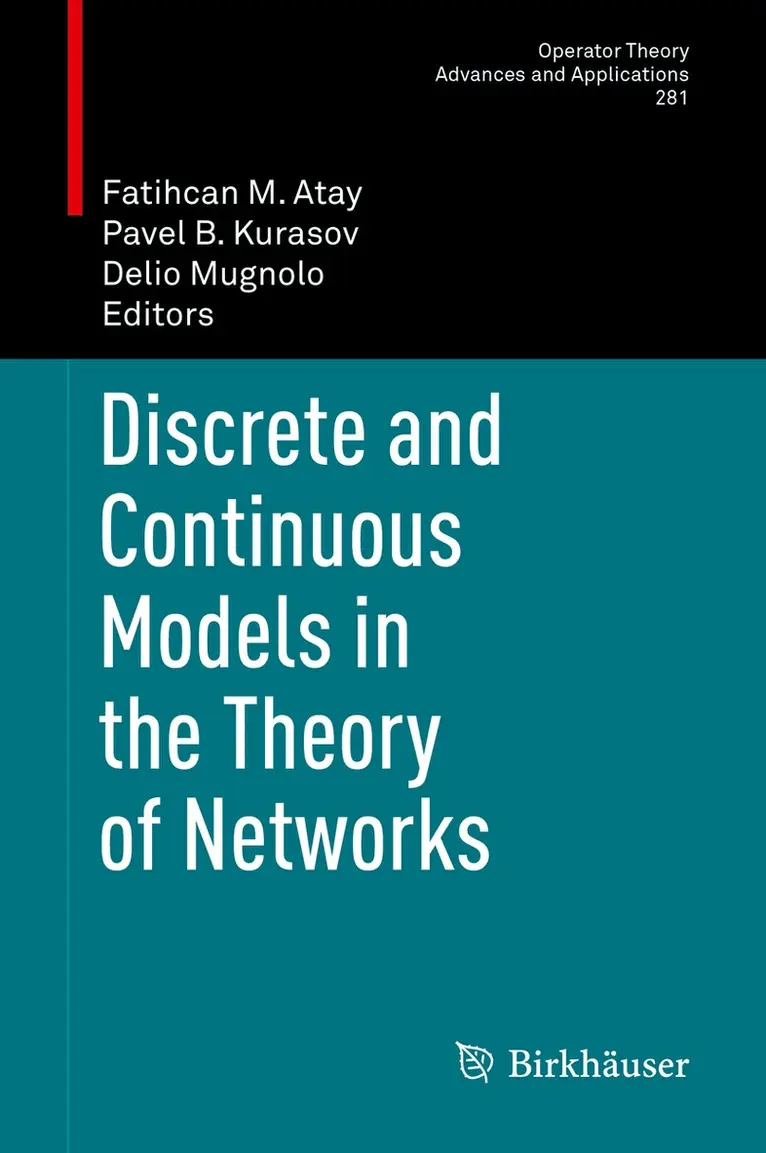
Discrete and Continuous Models in the Theory of Networks
Inbunden, Engelska, 2020
774 kr
Skickas inom 5-8 vardagar
This book contains contributions from the participants of the research group hosted by the ZiF - Center for Interdisciplinary Research at the University of Bielefeld during the period 2013-2017 as well as from the conclusive conference organized at Bielefeld in December 2017.
Del 281 - Operator Theory: Advances and Applications
Discrete and Continuous Models in the Theory of Networks
Häftad, Engelska, 2021
774 kr
Skickas inom 5-8 vardagar
This book contains contributions from the participants of the research group hosted by the ZiF - Center for Interdisciplinary Research at the University of Bielefeld during the period 2013-2017 as well as from the conclusive conference organized at Bielefeld in December 2017.
588 kr
Skickas inom 10-15 vardagar
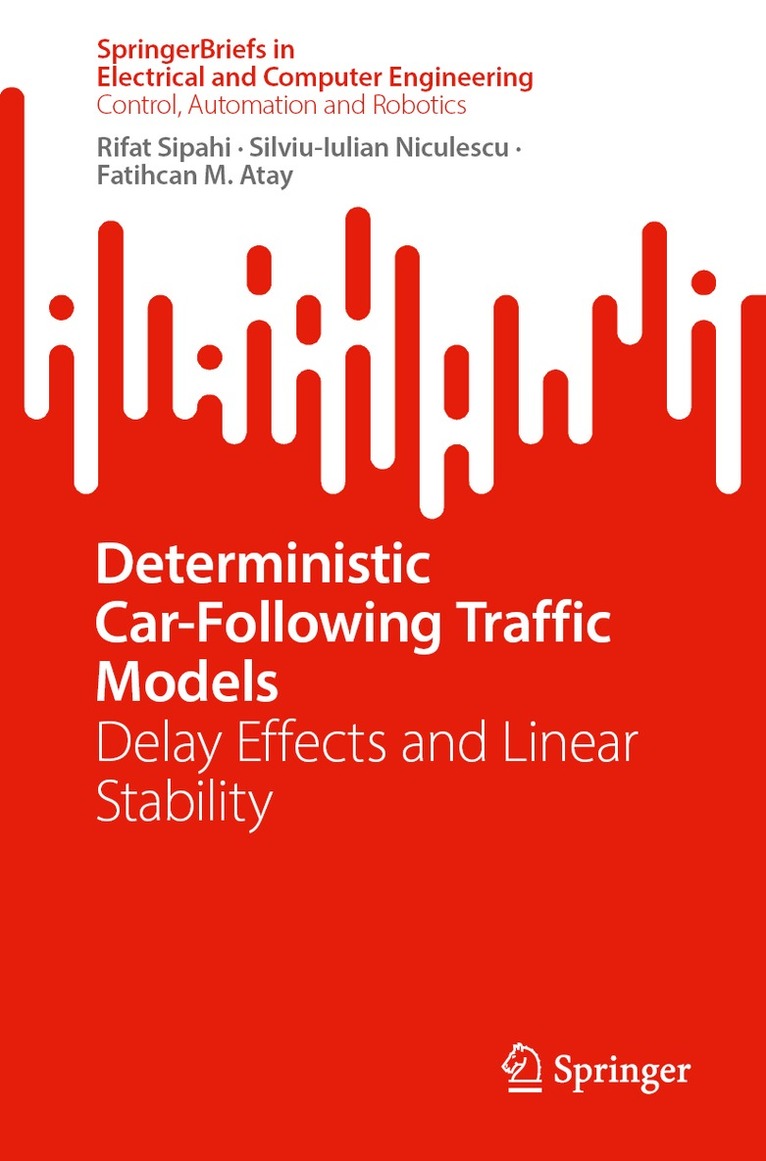
This book is a study of the effects of delays, stemming from a range of sources, on the behaviour of traffic flow. It provides the reader with theoretical approaches and computational tools, including existing tools from the field of control systems, for analysing the stability and slinky features of dynamical systems affected by time delays. Through examples and case-studies it shows how to implement these tools on a variety of traffic-flow models.The models considered are microscopic flow models (dealing with the behaviour of individual vehicles rather than the study of group effects) formulated as continuous-time deterministic delay-differential equations. Physiological lag (human reaction), mechanical time-lag and the delay time of vehicular motion are only a few examples of the multitude of delays that are applied to a traffic model. Such delays may also be discrete (constant), distributed or time-varying; the text concentrates on the constant and distributed delays associated with the representation of linear stability and slinky features to allow a compact and analytically tractable demonstration of the intricacy of delay effects. Readers with an academic research background in applied maths, vehicle dynamics and traffic modelling and graduate students working in those fields will find this brief to be an interesting source of results and openings for further work. It is also useful for engineers working on traffic-management systems and the guidance and control of autonomous vehicles.
536 kr
Skickas inom 10-15 vardagar
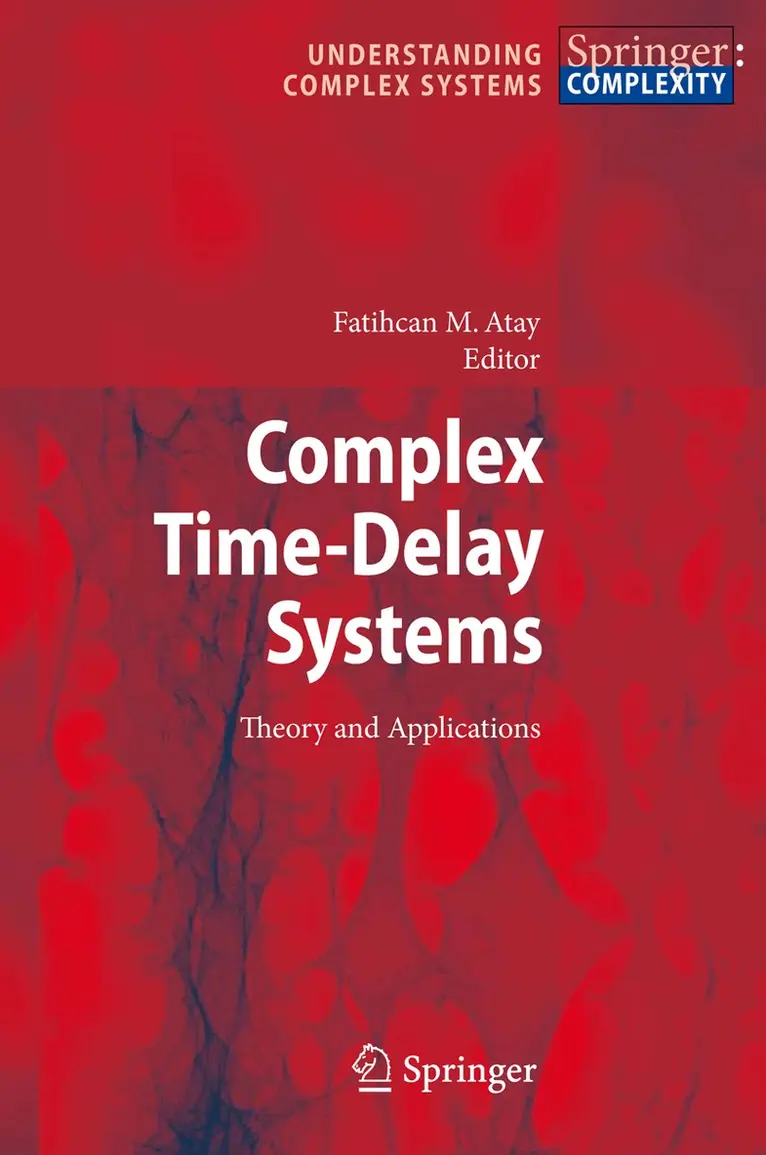
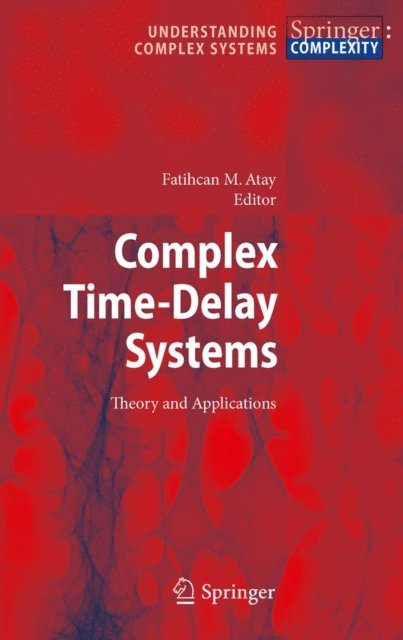
One of the major contemporary challenges in both physical and social sciences is modeling, analyzing, and understanding the self-organization, evolution, behavior, and eventual decay of complex dynamical systems ranging from cell assemblies to the human brain to animal societies. The multi-faceted problems in this domain require a wide range of methods from various scienti?c disciplines. There is no question that the inclusion of time delays in complex system models considerably enriches the challenges presented by the problems. Although this inclusion often becomes inevitable as real-world applications demand more and more realistic m- els, the role of time delays in the context of complex systems so far has not attracted the interest it deserves. The present volume is an attempt toward ?lling this gap. There exist various useful tools for the study of complex time-delay systems. At the forefront is the mathematical theory of delay equations, a relatively mature ?eld in many aspects, which provides some powerful techniques for analytical inquiries, along with some other tools from statistical physics, graph theory, computer science, dynamical systems theory, probability theory, simulation and optimization software, and so on. Nevertheless, the use of these methods requires a certain synergy to address complex systems problems, especially in the presence of time delays.
536 kr
Skickas inom 10-15 vardagar
One of the major contemporary challenges in both physical and social sciences is modeling, analyzing, and understanding the self-organization, evolution, behavior, and eventual decay of complex dynamical systems ranging from cell assemblies to the human brain to animal societies. The multi-faceted problems in this domain require a wide range of methods from various scienti?c disciplines. There is no question that the inclusion of time delays in complex system models considerably enriches the challenges presented by the problems. Although this inclusion often becomes inevitable as real-world applications demand more and more realistic m- els, the role of time delays in the context of complex systems so far has not attracted the interest it deserves. The present volume is an attempt toward ?lling this gap. There exist various useful tools for the study of complex time-delay systems. At the forefront is the mathematical theory of delay equations, a relatively mature ?eld in many aspects, which provides some powerful techniques for analytical inquiries, along with some other tools from statistical physics, graph theory, computer science, dynamical systems theory, probability theory, simulation and optimization software, and so on. Nevertheless, the use of these methods requires a certain synergy to address complex systems problems, especially in the presence of time delays.