Felicity Kaganas - Böcker
Visar alla böcker från författaren Felicity Kaganas. Handla med fri frakt och snabb leverans.
4 produkter
4 produkter
1 921 kr
Skickas inom 10-15 vardagar
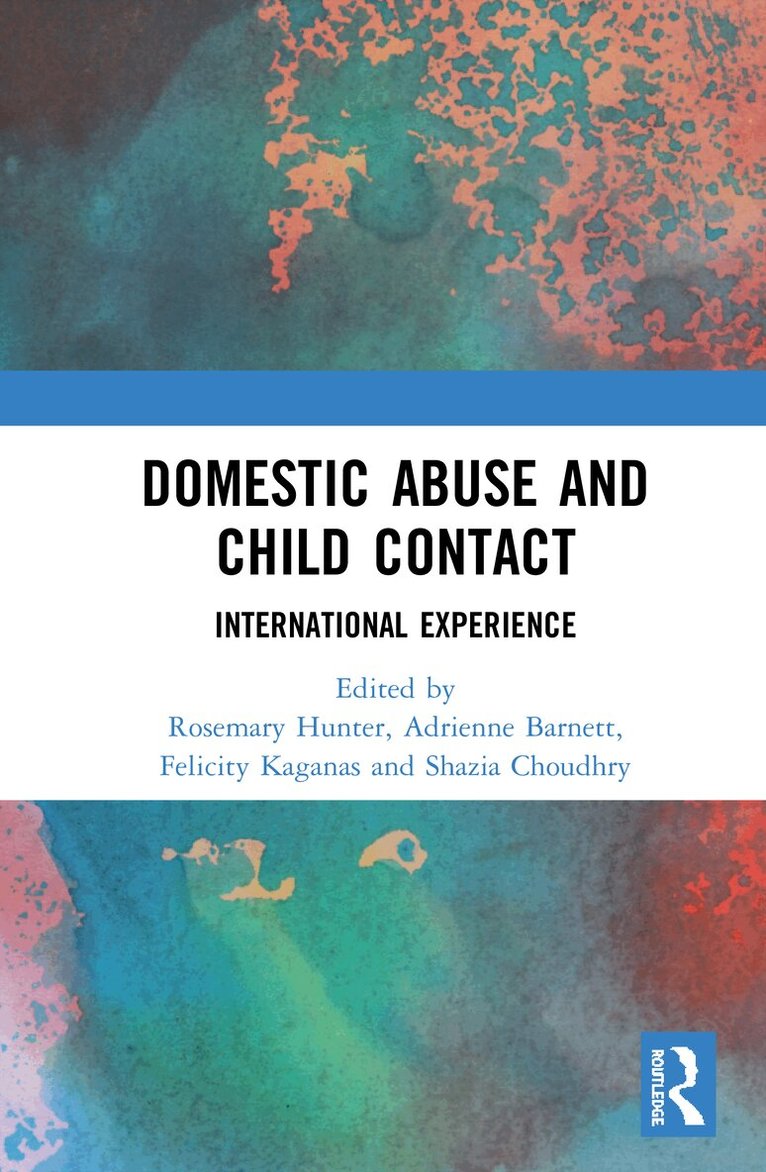
This book presents papers from an International Symposium on Contact Disputes and Allegations of Domestic Violence: Identifying Best Practices, held in London in May 2017.The editors invited a group of international experts to explain the approaches taken in their jurisdictions to allegations of domestic violence in child contact cases, with a view to identifying international best practices in such cases. The book includes contributions from England and Wales, Scotland, Ireland, Canada, Sweden and Spain, as well as information presented at the symposium from New Zealand and Australia. The chapters include attention to particular issues such as specialist domestic violence courts, judicial training and hearing children’s voices. Collectively, the chapters identify a set of common problems experienced across all of the jurisdictions, including an overwhelming emphasis on the value of children’s ongoing contact with non-resident parents and the consequent minimisation of domestic violence and the muting of the voices of children who do not wish to have contact with abusive parents. Best practices in taking domestic violence seriously and providing adequate protection from further abuse for children and non-abusive parents were less in evidence. However, the concluding chapter draws together details of several initiatives and approaches which offer promising ways forward.The chapters in this book were originally published as a special issue of the Journal of Social Welfare and Family Law.
568 kr
Skickas inom 10-15 vardagar
This book presents papers from an International Symposium on Contact Disputes and Allegations of Domestic Violence: Identifying Best Practices, held in London in May 2017.The editors invited a group of international experts to explain the approaches taken in their jurisdictions to allegations of domestic violence in child contact cases, with a view to identifying international best practices in such cases. The book includes contributions from England and Wales, Scotland, Ireland, Canada, Sweden and Spain, as well as information presented at the symposium from New Zealand and Australia. The chapters include attention to particular issues such as specialist domestic violence courts, judicial training and hearing children’s voices. Collectively, the chapters identify a set of common problems experienced across all of the jurisdictions, including an overwhelming emphasis on the value of children’s ongoing contact with non-resident parents and the consequent minimisation of domestic violence and the muting of the voices of children who do not wish to have contact with abusive parents. Best practices in taking domestic violence seriously and providing adequate protection from further abuse for children and non-abusive parents were less in evidence. However, the concluding chapter draws together details of several initiatives and approaches which offer promising ways forward.The chapters in this book were originally published as a special issue of the Journal of Social Welfare and Family Law.
1 113 kr
Skickas inom 10-15 vardagar
The third edition of this work on family law, comprising text, cases and materials, provides not only an explication of legal principle but also explores, primarily from a feminist perspective, some of the assumptions about, and constructions of, gender, sexual orientation, class and culture that underlie the law. It examines the ideology of the family and, in particular, the role of the law in contributing to and reproducing that ideology. Structured around the themes of equality, welfare, and family privacy, the book aims to offer the benefits of a textbook while also giving students a wide-ranging set of materials for classroom discussion. As well as providing a firm grounding in family law, the text sets the law in its social and historical context and encourages a critical approach by students to the subject. It provides an ideal introduction to family law for undergraduates, but will be equally helpful for postgraduate students of family law for whom it provides a challenging selection of materials set within a theoretical framework rich in ideas and arguments.Review of the second edition:'Diduck and Kaganas examine legal developments to shed light on society, principally by investigating the ways in which family law constructs and regulates family life and responsibilities. Theirs is an important and ambitious book that aims ultimately at a feminist restatement of family law. ....[T]he [book] is written and referenced in such depth that it is a useful resource for legal as well as social science researchers at all levels, whether looking for theoretical inspiration or drawing up a literature review.The range of diverse sources that Diduck and Kaganas draw on is impressive: they seem to have included every bit of material that helps feminists make sense of family law. There is a well-pitched selection of further reading of such material at the end of each chapter. What's more, they undersell themselves by describing their book as "Text, Cases and Materials", because they have woven by far the largest proportion of the cases and materials into the text.'Helen Reece, Times Higher Education, May 2007.Reviews of first edition:'A stimulating work which attempts to situate family law in its social, historical and political context. Its appeal should not be confined to family law students, as its commitment to a critical and analytical approach offers insights and ideas with broader significance.'Mary Childs, Child and Family Law Quarterly, September 2002'The arguments are provocative, the analysis is stimulating and the materials amassed strongly support the authors' aim to question the "axiomatic status of what is traditionally designated as the family".'Fiona E Raitt, Infant and Child Development, September 2002'It is not often that one can say of a textbook in Law that it "makes interesting reading" with quite the enthusiasm that can be expressed for this text. This new publication offers something that few textbooks seem to offer - a book you CAN open up virtually anywhere and find an interesting piece on almost any aspect of the broad family law spectrum.'Penny Booth, The Law Teacher, September 2002'All the major themes in feminist and constructionist perspectives in family law are presented together with a wealth of readings and extensive references. As a teaching manual, it is excellent - a coherent feminist perspective across the entire range of family law'Marty Slaughter, Feminist Legal Studies, July 2003
503 kr
Skickas inom 10-15 vardagar
The Children Act 1989, together with the Guidance and Regulations, makes constant reference to co-operation and consultation. These are seen as embodying different aspects of the principle of partnership. However, as many of the contributions to this book clearly show, the notion of partnership in the daily practice of child welfare and protection is elusive.As well as describing the various situations and settings in which the concept of partnership appears, this book takes an analytical and critical view. It analyses how the partnership principle is reflected in the law. It critically examines partnership between agencies, between child welfare professionals and children, and, finally, between child welfare professionals and parents. It brings together contributors from a number of different disciplines and partnership is analysed from a variety of theoretical and professional perspectives, including law, social work, psychoanalytic theory and social theory.