Ferenc Nagy – författare
Visar alla böcker från författaren Ferenc Nagy. Handla med fri frakt och snabb leverans.
5 produkter
5 produkter
Inbunden, Engelska, 2006
2 174 kr
Skickas inom 10-15 vardagar
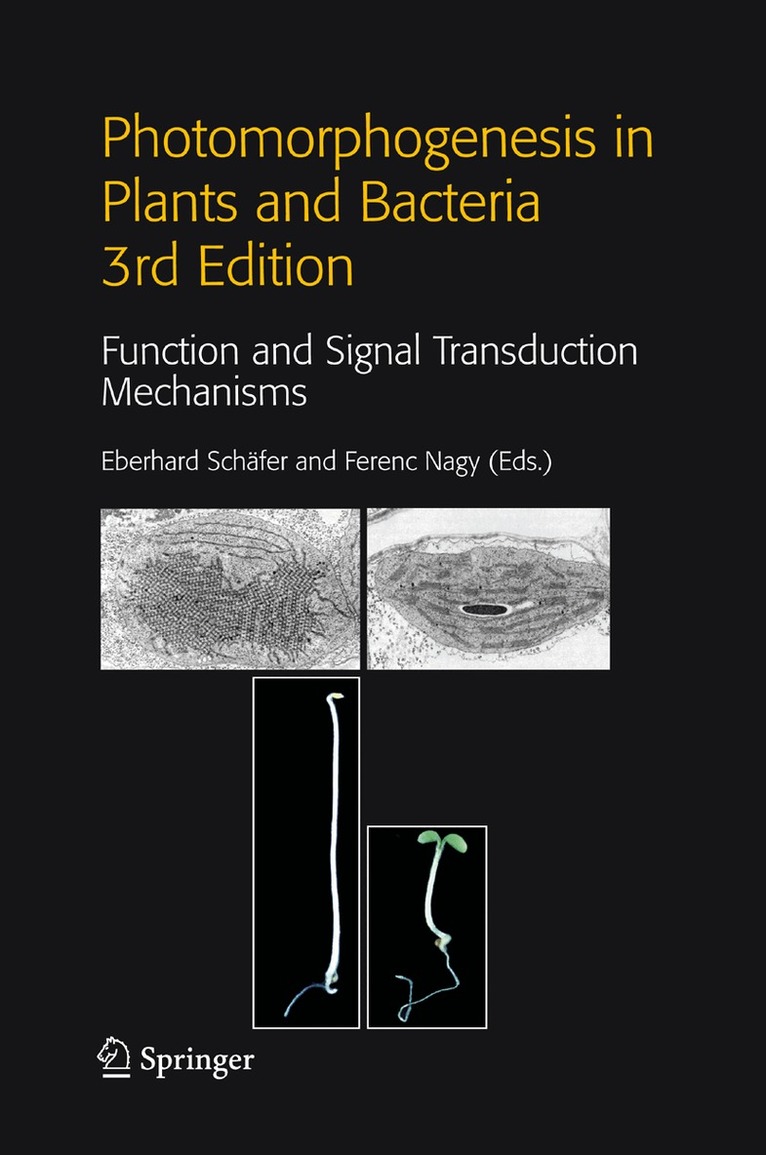
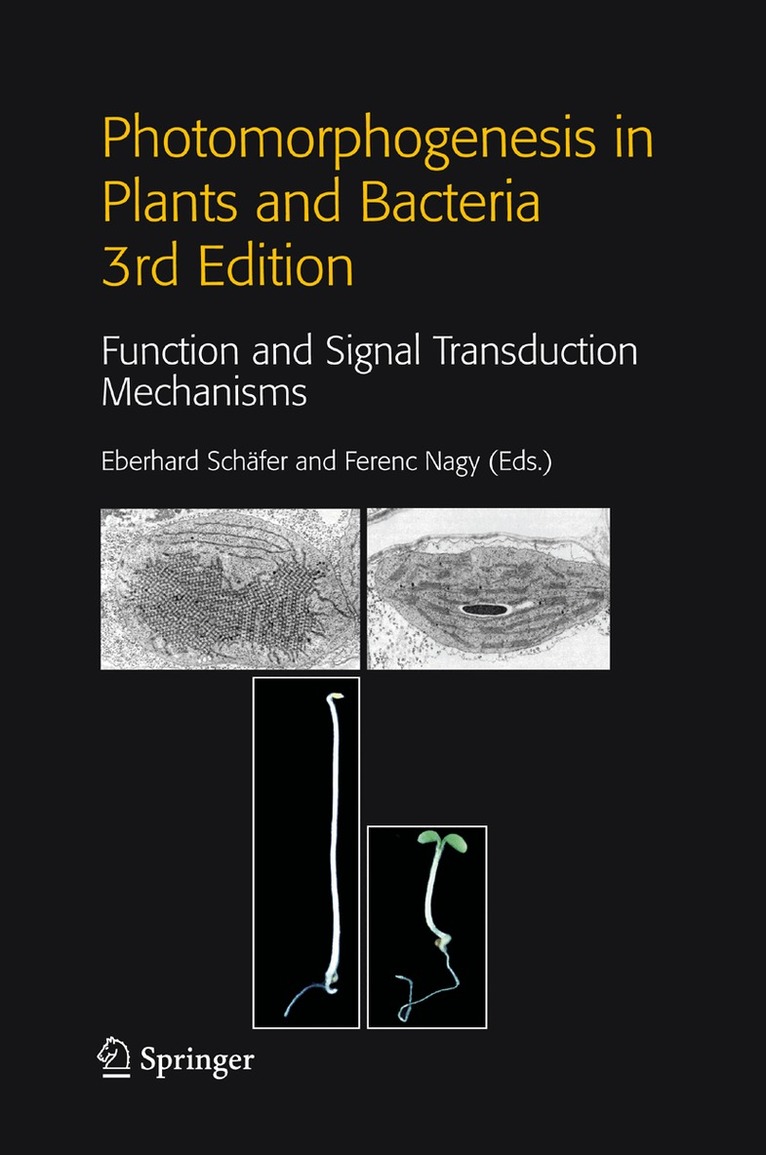
Plants as sessile organisms have evolved fascinating capacities to adapt to changes in their natural environment. Arguably, light is by far the most important and variable environmental factor. The quality, quantity, direction and duration of light is monitored by a series of photoreceptors covering spectral information from UVB to near infrared. The response of the plants to light is called photomorphogenesis and it is regulated by the concerted action of photoreceptors. The combined techniques of action spectroscopy and biochemistry allowed one of the important photoreceptors – phytochrome – to be identified in the middle of the last century. An enormous number of physiological studies published in the last century describe the properties of phytochrome and its function and also the physiology of blue and UV-B photoreceptors, unidentified at the time. This knowledge was summarized in the advanced textbook “Photomorphogenesis in Plants” (Kendrick and Kronenberg, eds., 1986, 1994). With the advent of molecular biology, genetics and new molecular, cellular techniques, our knowledge in the field of photomorphogenesis has dramatically increased over the last 15 years.
Häftad, Engelska, 2006
2 174 kr
Skickas inom 10-15 vardagar
Plants as sessile organisms have evolved fascinating capacities to adapt to changes in their natural environment. Arguably, light is by far the most important and variable environmental factor. The quality, quantity, direction and duration of light is monitored by a series of photoreceptors covering spectral information from UVB to near infrared. The response of the plants to light is called photomorphogenesis and it is regulated by the concerted action of photoreceptors. The combined techniques of action spectroscopy and biochemistry allowed one of the important photoreceptors – phytochrome – to be identified in the middle of the last century. An enormous number of physiological studies published in the last century describe the properties of phytochrome and its function and also the physiology of blue and UV-B photoreceptors, unidentified at the time. This knowledge was summarized in the advanced textbook “Photomorphogenesis in Plants” (Kendrick and Kronenberg, eds., 1986, 1994). With the advent of molecular biology, genetics and new molecular, cellular techniques, our knowledge in the field of photomorphogenesis has dramatically increased over the last 15 years.
E-bok
PDF, Engelska, 20062 741 kr
Läs direkt efter köp
Plants as sessile organisms have evolved fascinating capacities to adapt to changes in their natural environment. Arguably, light is by far the most important and variable environmental factor. The quality, quantity, direction and duration of light is monitored by a series of photoreceptors covering spectral information from UVB to near infrared. The response of the plants to light is called photomorphogenesis and it is regulated by the concerted action of photoreceptors. The combined techniques of action spectroscopy and biochemistry allowed one of the important photoreceptors – phytochrome – to be identified in the middle of the last century. An enormous number of physiological studies published in the last century describe the properties of phytochrome and its function and also the physiology of blue and UV-B photoreceptors, unidentified at the time. This knowledge was summarized in the advanced textbook “Photomorphogenesis in Plants” (Kendrick and Kronenberg, eds., 1986, 1994). With the advent of molecular biology, genetics and new molecular, cellular techniques, our knowledge in the field of photomorphogenesis has dramatically increased over the last 15 years.
E-bok
PDF, Tyska, 2011571 kr
Läs direkt efter köp
Does the intensified endeavour to achieve security in Europe conflict with the preservation of civil rights and liberties? Or is the new direction that civil rights and liberties are currently taking a philosophical, societal imperative? Is an interest in a free society supplanting the hard-won liberty of the individual? Is the security of a society without individual liberty at all conceivable? Can these observations and reflections even be understood as an organic development in modern societies, and, consequently, the "European constitutional state" already on the way to becoming a security state? Does penal law, for example, which otherwise has maximum guarantees in the interest of liberty, increasingly feature preventive policing elements? Finally, is it at all possible to reconcile liberty, security and law?The contributions to this volume deal with these issues, discussing extensively and comprehensively the tense relationship between the need for security and for liberty.
E-bok
PDF, Tyska, 20111 021 kr
Läs direkt efter köp
In general, the system of anticipatory punishment is critically assessed by penologists. Criminal law seems to be imbued with anticipatory tendencies, and the term criminal offence now nothing more than an empty phrase in the legal system. The legislative scope for describing "deeds before deeds" out of crime policy considerations, so as to encounter the risk of injury at the earliest stage possible, seems to be limitless. The German and the Hungarian criminal justice systems both stipulate the criminal offence as the penal benchmark. The definition of attempted crime, however, is different in both countries. The common features and differences, but at the same time similar observations on anticipatory punishment in the criminal law of both countries have given rise to a joint comparative law research project. The contributions in this volume are the results of this two-year project.