Flavio Corradini – författare
Visar alla böcker från författaren Flavio Corradini. Handla med fri frakt och snabb leverans.
9 produkter
Process Algebraic Approach to Software Architecture Design
Av Alessandro Aldini, Marco Bernardo m. fl.
Häftad, 2014
568 kr
Lägg i varukorg
Inthe?eldofformalmethodsincomputerscience,concurrencytheoryisreceivinga constantlyincreasinginterest.Thisisespeciallytrueforprocessalgebra.Althoughit had been originally conceived as a means for reasoning about the semantics of c- current programs, process algebraic formalisms like CCS, CSP, ACP, …
Process Algebraic Approach to Software Architecture Design
Av Alessandro Aldini, Marco Bernardo m. fl.
Inbunden, 2009
568 kr
Lägg i varukorg
Inthe?eldofformalmethodsincomputerscience,concurrencytheoryisreceivinga constantlyincreasinginterest.Thisisespeciallytrueforprocessalgebra.Althoughit had been originally conceived as a means for reasoning about the semantics of c- current programs, process algebraic formalisms like CCS, CSP, ACP, …
Process Algebraic Approach to Software Architecture Design
Av Flavio Corradini, Marco Bernardo m. fl.
E-bok, 2010
755 kr
Lägg i varukorg
Inthe?eldofformalmethodsincomputerscience,concurrencytheoryisreceivinga constantlyincreasinginterest.Thisisespeciallytrueforprocessalgebra.Althoughit had been originally conceived as a means for reasoning about the semantics of c- current programs, process algebraic formalisms like CCS, CSP, ACP, …
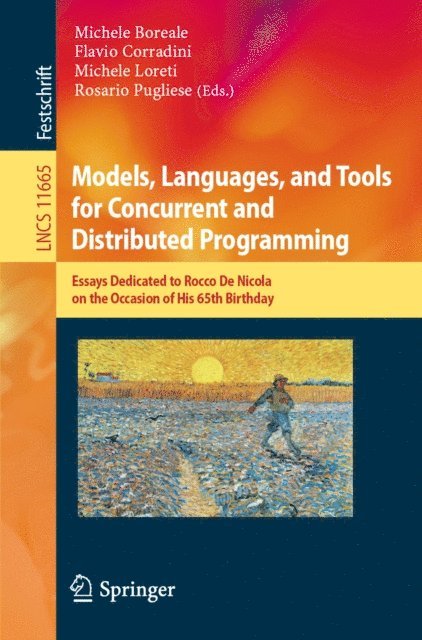
Models, Languages, and Tools for Concurrent and Distributed Programming
Essays Dedicated to Rocco De Nicola on the Occasion of His 65th Birthday
Av Michele Boreale, Flavio Corradini m. fl.
Häftad, 2019
568 kr
Lägg i varukorg
This volume was published in honor of Rocco De Nicola’s 65th birthday. The Festschrift volume contains 27 papers written by close collaborators and friends of Rocco De Nicola and was presented to Rocco on the 1st of July 2019 during a two-day symposium held in Lucca, Italy.The papers present many …
Models, Languages, and Tools for Concurrent and Distributed Programming
Essays Dedicated to Rocco De Nicola on the Occasion of His 65th Birthday
Av Rosario Pugliese, Michele Loreti m. fl.
E-bok, 2019
755 kr
Lägg i varukorg
This volume was published in honor of Rocco De Nicola’s 65th birthday. The Festschrift volume contains 27 papers written by close collaborators and friends of Rocco De Nicola and was presented to Rocco on the 1st of July 2019 during a two-day symposium held in Lucca, Italy. The papers present many …
Society 5.0
5th International Conference Society 5.0 2025, San Benedetto Del Tronto, Italy, June 25–27, 2025, Revised Selected Papers
Av Flavio Corradini, Knut Hinkelmann m. fl.
Häftad, 2026
933 kr
Lägg i varukorg
This book constitutes the revised selected proceedings from the 5th International Conference on Society 5.0, Society 5.0 2025, held in San Benedetto Del Tronto, Italy, during June 25–27, 2025.The 24 full papers presented in this volume were carefully reviewed and selected from 64 submissions. They …
Society 5.0
5th International Conference Society 5.0 2025, San Benedetto Del Tronto, Italy, June 25-27, 2025, Revised Selected Papers
Av Barbara Re, Hanlie Smuts m. fl.
E-bok, 2026
1188 kr
Lägg i varukorg
This book constitutes the revised selected proceedings from the 5th International Conference on Society 5.0, Society 5.0 2025, held in San Benedetto Del Tronto, Italy, during June 25–27, 2025.The 24 full papers presented in this volume were carefully reviewed and selected from 64 submissions. They …
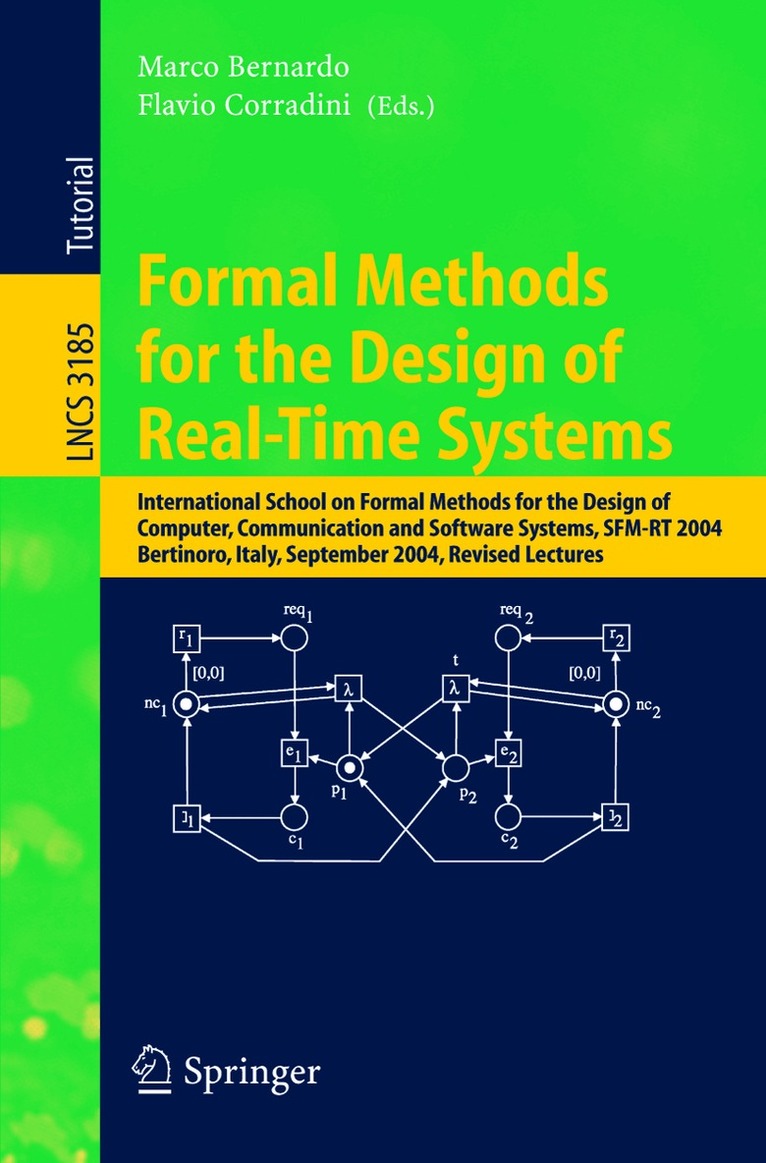
Formal Methods for the Design of Real-Time Systems
International School on Formal Methods for the Design of Computer, Communication, and Software Systems, SFM-RT 2004, Bertinoro, Italy, September 13-18, 2004, Revised Lectures
Av Marco Bernardo, Flavio Corradini
Häftad, 2004
568 kr
Lägg i varukorg
A large class of computing systems can be speci?ed and veri?ed by abstracting away from the temporal aspects of their behavior. Inreal-timesystems,instead, time issues become essential. Their correctness depends not only on which - tions they can perform, but also on the action execution time. Due …
Formal Methods for the Design of Real-Time Systems
International School on Formal Methods for the Design of Computer, Communication, and Software Systems, SFM-RT 2004, Bertinoro, Italy, September 13-18, 2004, Revised Lectures
Av Flavio Corradini, Marco Bernardo
E-bok, 2004
755 kr
Lägg i varukorg