Florian Buchner – författare
Visar alla böcker från författaren Florian Buchner. Handla med fri frakt och snabb leverans.
9 produkter
9 produkter
Inbunden, Engelska, 2010
1 084 kr
Skickas inom 10-15 vardagar
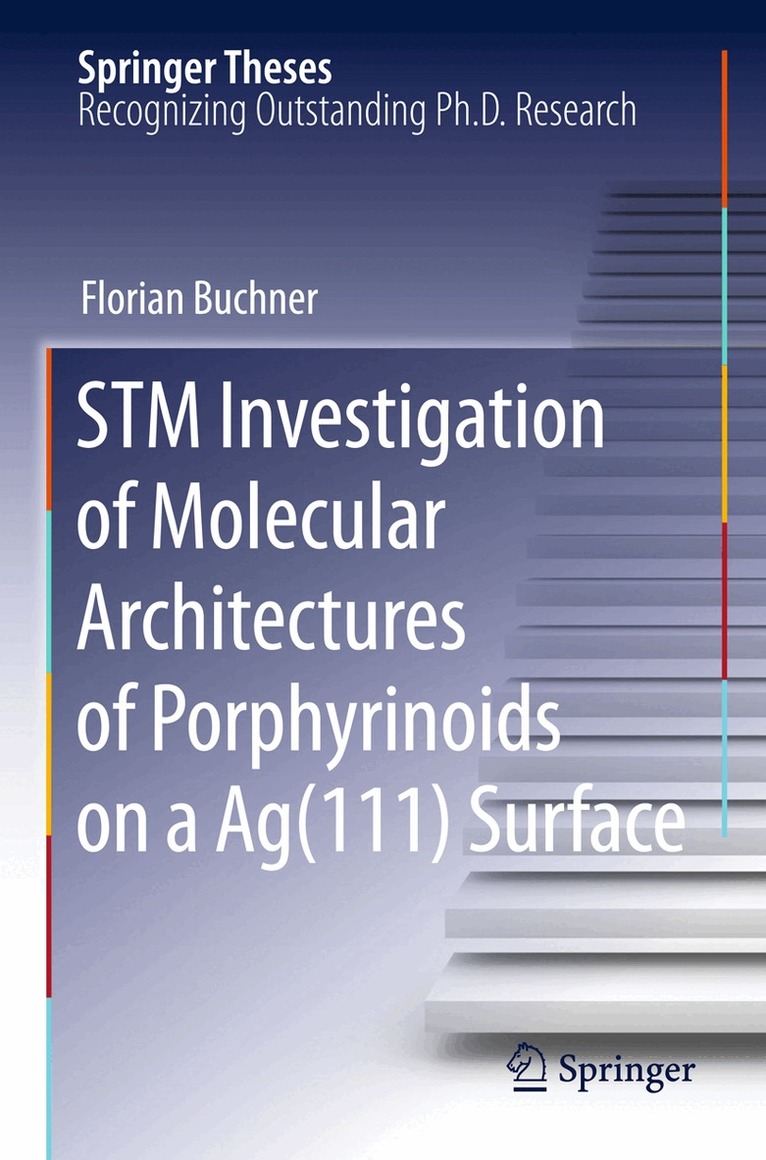
The functionalization of surfaces on the nanoscale is one of the most fascinating and at the same time challenging topics in science. It is the key to tailoring catalysts, sensors, or devices for solar energy conversion, whose functional principle is based on the interaction of an active solid surface with another (liquid or gaseous) phase. As an example, planar transition metal complexes adsorbed on solid supports are promising candidates for novel heterogeneous catalysts. An important feature of these catalysts, compared to supported metal clusters, is the fact that the active sites, i. e. , the coordinated metal centers with their vacant axial coordination sites, are well de?ned and uniform. Metalloporphyrinoids are particularly suitable in this respect because they combine a structure forming element—the rigid molecular frame, which often induces long range order—with an active site, the coordinated metal ion. Its planar coordination environment leaves two axial coordination sites available for additional ligands. If adsorbed on a surface, one of these axial sites is occupied by the underlying substrate. The resulting electronic interaction with the surface can be used to tailor the electronic structure and thereby the reactivity of the metal center. The remaining site is free for the attachment of molecules (sensor functionality) and/or operates as a reaction center (single-site catalysis). Prototype examples are omnipresent in nature, where in particular metallo-tetrapyrrols play a decisive role in important biological processes, with the most prominent examples being iron porphyrins in heme, magnesium porphyrins in chlorophyll, and cobalt corrin in vitamin B12.
E-bok
PDF, Engelska, 20101 416 kr
Läs direkt efter köp
The functionalization of surfaces on the nanoscale is one of the most fascinating and at the same time challenging topics in science. It is the key to tailoring catalysts, sensors, or devices for solar energy conversion, whose functional principle is based on the interaction of an active solid surface with another (liquid or gaseous) phase. As an example, planar transition metal complexes adsorbed on solid supports are promising candidates for novel heterogeneous catalysts. An important feature of these catalysts, compared to supported metal clusters, is the fact that the active sites, i. e. , the coordinated metal centers with their vacant axial coordination sites, are well de?ned and uniform. Metalloporphyrinoids are particularly suitable in this respect because they combine a structure forming element—the rigid molecular frame, which often induces long range order—with an active site, the coordinated metal ion. Its planar coordination environment leaves two axial coordination sites available for additional ligands. If adsorbed on a surface, one of these axial sites is occupied by the underlying substrate. The resulting electronic interaction with the surface can be used to tailor the electronic structure and thereby the reactivity of the metal center. The remaining site is free for the attachment of molecules (sensor functionality) and/or operates as a reaction center (single-site catalysis). Prototype examples are omnipresent in nature, where in particular metallo-tetrapyrrols play a decisive role in important biological processes, with the most prominent examples being iron porphyrins in heme, magnesium porphyrins in chlorophyll, and cobalt corrin in vitamin B12.
Häftad, Engelska, 2013
1 084 kr
Skickas inom 10-15 vardagar
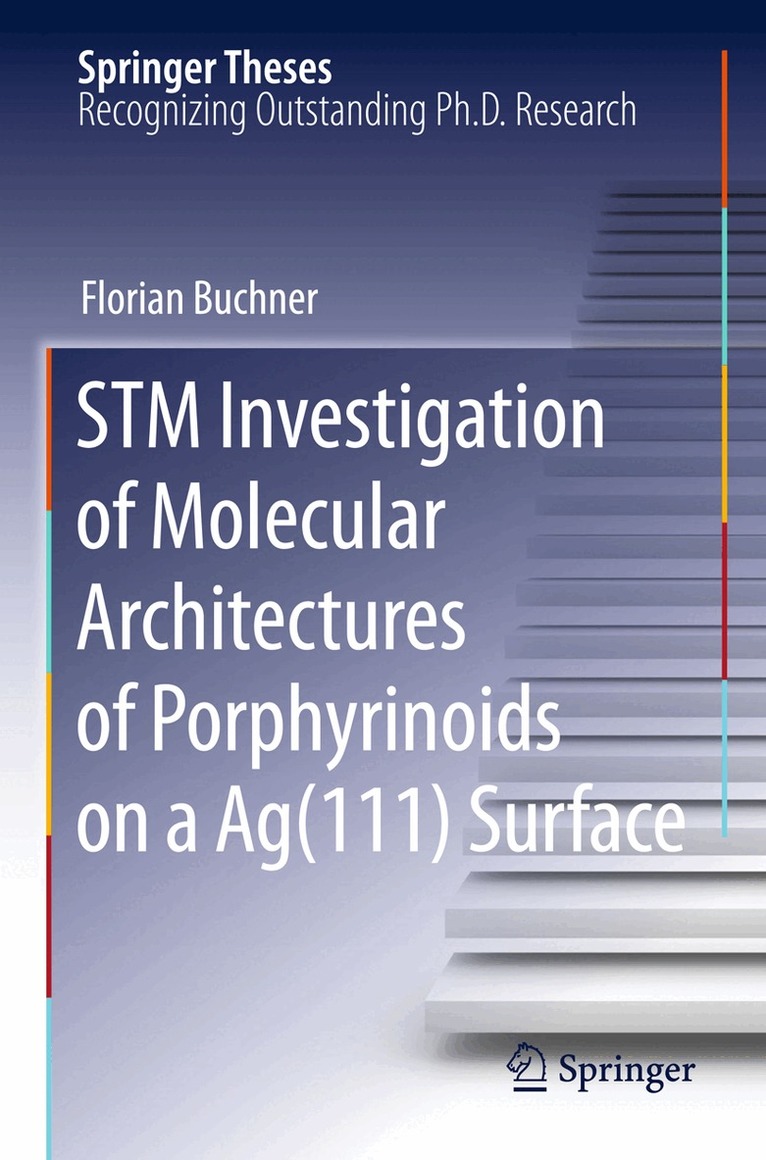
The functionalization of surfaces on the nanoscale is one of the most fascinating and at the same time challenging topics in science. It is the key to tailoring catalysts, sensors, or devices for solar energy conversion, whose functional principle is based on the interaction of an active solid surface with another (liquid or gaseous) phase. As an example, planar transition metal complexes adsorbed on solid supports are promising candidates for novel heterogeneous catalysts. An important feature of these catalysts, compared to supported metal clusters, is the fact that the active sites, i. e. , the coordinated metal centers with their vacant axial coordination sites, are well de?ned and uniform. Metalloporphyrinoids are particularly suitable in this respect because they combine a structure forming element—the rigid molecular frame, which often induces long range order—with an active site, the coordinated metal ion. Its planar coordination environment leaves two axial coordination sites available for additional ligands. If adsorbed on a surface, one of these axial sites is occupied by the underlying substrate. The resulting electronic interaction with the surface can be used to tailor the electronic structure and thereby the reactivity of the metal center. The remaining site is free for the attachment of molecules (sensor functionality) and/or operates as a reaction center (single-site catalysis). Prototype examples are omnipresent in nature, where in particular metallo-tetrapyrrols play a decisive role in important biological processes, with the most prominent examples being iron porphyrins in heme, magnesium porphyrins in chlorophyll, and cobalt corrin in vitamin B12.

Häftad, Tyska, 2015
394 kr
Skickas inom 3-6 vardagar
E-bok
PDF, Engelska, 2015232 kr
Läs direkt efter köp
Bachelor Thesis from the year 2009 in the subject Energy Sciences, grade: 2,0, University of Graz (URBI), course: Energiewirtschaft, language: English, abstract: Fossil fuels are essential for energy purposes in the world. About 80% (91,000 TWh) of the total primary energy supply and 64% (9400 TWh) of the electricity generation were produced with gas, oil and coal in 1999 (Jacobsson/Bergek, 2004: 815). However, this dominance is in context of clear environmental and climate challenges. The burning of fossil fuels is the main source of carbon dioxide emissions and it is growing with a rate of 0.5% per year. Moreover, due to the fact that those fuels are finite, it will become more difficult and more expensive to pursue an economical exploitation of these resources (Agterbosch, 2006: 13-14). The European Union is going to implement and to enhance renewable energy technologies in order to secure energy supplies and to reduce dependence (about 54% of primary energy consumption in 2005 was imported, in 2000: 51%; EEA, 2008). For this purpose a comprehensive climate change package (20/20/20 by 2020: Europe`s climate change and energy package) was introduced in 2008 (EP, 2008). According to this program each Member State of the EU has received legally binding targets to reach the 20% share of renewable energy in the EU`s overall energy consumption till 2020 (EEP, 2008a; EEP, 2008b). Consequently, the government of each Member State is trying to stimulate with various measures and efforts the development and use of renewable energy. This paper investigates the institutional and social conditions, which are responsible for the successful (and failed respectively) implementation of renewable electricity technologies of two Member States of the EU, Austria and the Netherlands. It focuses on wind energy for electricity generation, analyses the evolution of the wind power supply market and examines the liberalisation of the electricity market in both countries. The main objects of this thesis are: To investigate the way of each government, in how to boost and to enhance renewable (wind) energy in its country in the last decades. To contrast the assets with the drawbacks of each wind power policy. And, based on these insights, To analyse, how comparative are those ways and which instrument is recommendable for the other country.
Häftad, Engelska, 2015
524 kr
Skickas inom 3-6 vardagar
Häftad, Tyska, 2016
163 kr
Skickas inom 10-15 vardagar
Die Autoren stellen in diesem essential einen herausforderungsbasierten und studierendenzentrierten Ansatz der Hochschuldidaktik vor, mit dem Studierende neben fachlichen Inhalten gleichzeitig auch Problemlösungsfähigkeiten, analytische und soziale Kompetenzen sowie die Fähigkeit zur Selbstreflexion und -entwicklung erwerben und anwenden können. Basierend auf aktuellen Erkenntnissen der Motivations-, Lern- und Neurowissenschaften wird ein praxisorientiertes Lehr- und Lernmodell präsentiert, in dem Herausforderungen, aktives Handeln, Feedback und Reflexion im Zentrum stehen. Studierende sollen dabei zu selbstständigem kritischem Denken motiviert werden. Das essential enthält zahlreiche Tipps für eine die Studierenden aktivierende und motivierende Form des Lehrens und Lernens sowie konkrete Anwendungsbeispiele aus der Lehrpraxis.
E-bok
Tyska, 2016163 kr
Läs direkt efter köp
Die Autoren stellen in diesem essential einen herausforderungsbasierten und studierendenzentrierten Ansatz der Hochschuldidaktik vor, mit dem Studierende neben fachlichen Inhalten gleichzeitig auch Problemlösungsfähigkeiten, analytische und soziale Kompetenzen sowie die Fähigkeit zur Selbstreflexion und -entwicklung erwerben und anwenden können. Basierend auf aktuellen Erkenntnissen der Motivations-, Lern- und Neurowissenschaften wird ein praxisorientiertes Lehr- und Lernmodell präsentiert, in dem Herausforderungen, aktives Handeln, Feedback und Reflexion im Zentrum stehen. Studierende sollen dabei zu selbstständigem kritischem Denken motiviert werden. Das essential enthält zahlreiche Tipps für eine die Studierenden aktivierende und motivierende Form des Lehrens und Lernens sowie konkrete Anwendungsbeispiele aus der Lehrpraxis.
Häftad, Tyska, 2015
394 kr
Skickas inom 3-6 vardagar