Floribert Baudet - Böcker
Visar alla böcker från författaren Floribert Baudet. Handla med fri frakt och snabb leverans.
2 produkter
2 produkter
1 505 kr
Skickas inom 7-10 vardagar
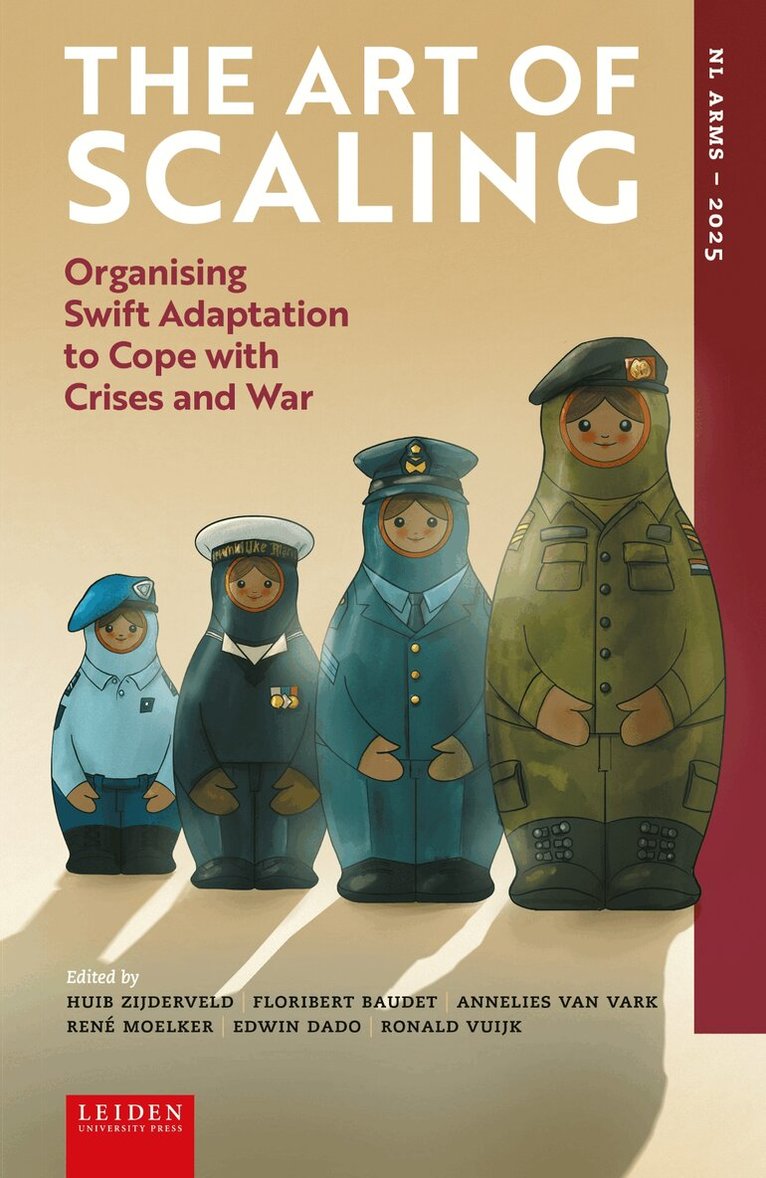
Increased existential threats demand that Western Democracies and their armed forces can swiftly scale up, rapidly expanding their capabilities to deter potential adversaries and defend borders effectively. The principle of scaling also applies to crisis response systems in general; the larger the disaster scope, the more crucial scalability becomes to alleviate suffering. From a multidisciplinary viewpoint, this book introduces fresh insights into the concept of scaling by examining scalability within security contexts. This book is structured in three parts. The first part, explores historical perspectives, demonstrating that scaling is deeply rooted in military policy, strategy and practices. The second part, ""Organising Scalability,"" highlights innovative methods and empirical examples of scaling. The final part, ""Enabling Scalability,"" outlines essential resources and popular support to implement scalability. The conclusion presents a new definition and structured process model of scalability. It emphasizes that establishing and organising scalable organizations is complex but feasible. However, it poses a critical question: is our social fabric robust enough to support scaling and are we prepared to defend our core values if war and crises come?
Perspectives on Military Intelligence from the First World War to Mali
Between Learning and Law
Inbunden, Engelska, 2017
1 841 kr
Skickas inom 10-15 vardagar
With a foreword by Michael Kowalski, Chairman of the Netherlands Intelligence Studies AssociationMany intelligence practitioners feel that the statutory footing on which intelligence agencies have been placed forms an impediment to confronting unprecedented contemporary challenges. On the basis of case studies spanning the period from the First World War to the present, this book argues that while the intelligence community in the era of globalization has indeed come to face new and complex challenges that require adaptation, operating in demanding and changing environments is not new at all. This book questions the conventional wisdom of 9/11 or the end of the Cold War as caesurae. It also argues that the ability to adapt, innovate, question and learn from past experience is crucial for the success of intelligence organizations, rather than ever-expanding funding.Agencies’ ability to reflect, adapt and learn from experience determines their subsequent capability to deliver. One key development resulting from globalization is the marked increase in cooperation between intelligence agencies of different countries on the one hand, and between investigative agencies and intelligence agencies on the other. This has led to concerns over human rights and privacy and to increased calls for accountability and improved oversight as the increase in cooperation between organizations operating globally also provides scope for the circumvention of domestic restrictions.This book proposes an instrument to assess the effectiveness of existing accountability arrangements and offers new insights into the role of (military) intelligence in a number of crises, e.g., the 1962 Cold War confrontation over Western New Guinea, and the functioning of intelligence in peacekeeping operations ranging from Srebrenica to Mali.Thematically comprehensive, it offers a mixture of historical, legal, operational, and policy aspects, analyzed through the lens of institutional learning, bringing together academic and practitioners’ perspectives. The focus lies not only on the familiar Anglo-Saxon experience but also on cases from India, the Netherlands, South East Asia, Bosnia, Lebanon, and Mali.The book is aimed at both scholars and practitioners studying and/or working in the field of civil and military intelligence, and those involved in international relations and international humanitarian law/human rights law. It brings together contributions from authors who spoke at the Conference to commemorate the 100th anniversary of the Dutch Military Intelligence and Security Service, organized by the Netherlands Intelligence Studies Association (NISA), and from a number of authors who were specifically invited to participate.About the editors:Floribert Baudet is Associate Professorof Strategy at the Netherlands Defence Academy in Breda; Eleni Braat is Assistant Professor at the Department of History and Art History at Utrecht University; Jeoffrey van Woensel is a military historian who works at the Veteraneninstituut in Doorn; and Aad Wever is an independent scholar who formerly worked at Saxion University of Applied Sciences in Enschede and Ferris State University, MI, USA, and who is now retired.Specific to this book:•Offers a mixture of historical, legal, operational, and policy aspects, analyzed through the lens of institutional learning•Brings together academic and practitioners’ perspectives•Focusses not only on the familiar Anglo-Saxon experience but also presents cases from India, the Netherlands, South East Asia, Bosnia, Lebanon, and Mali