Francesco Gullì – författare
Visar alla böcker från författaren Francesco Gullì. Handla med fri frakt och snabb leverans.
4 produkter
4 produkter
Del 6 - Lecture Notes in Energy
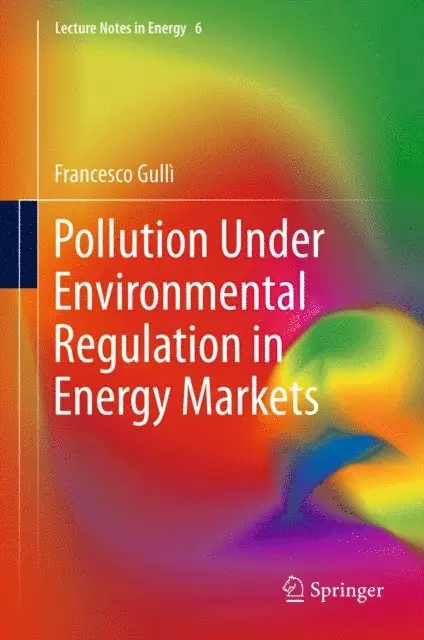
Pollution Under Environmental Regulation in Energy Markets
Inbunden, Engelska, 2012
1 071 kr
Skickas inom 10-15 vardagar
Pollution Under Environmental Regulation in Energy Markets provides a study of environmental regulation when energy markets are imperfectly competitive.
Del 6 - Lecture Notes in Energy
Pollution Under Environmental Regulation in Energy Markets
Häftad, Engelska, 2015
1 071 kr
Skickas inom 10-15 vardagar
Pollution Under Environmental Regulation in Energy Markets provides a study of environmental regulation when energy markets are imperfectly competitive. This theoretical treatment focuses on three relevant cases of energy markets. First, the residential space heating sector where hybrid regulation such as taxation and emissions trading together are possible. Second, the electricity market where transactions are organized in the form of multi-period auctions. Third, namely natural gas (input) and electricity (output) markets where there is combined imperfect competition in vertical related energy markets. The development of free or low carbon technologies supported by energy policies, aiming at increasing security of supply, is also explored whilst considering competition policies that reduce market power in energy markets thus improving market efficiency. Pollution Under Environmental Regulation in Energy Markets discusses the key issues of whether imperfect competition can lessen the ability of environmental policy to reduce pollution and/or to minimize the cost of meeting environmental targets. Policymakers, analysts and researchers gain a thorough understanding of the performance of environmental policy from Pollution Under Environmental Regulation in Energy Markets leading to better design of simulation models of performance and costs of environmental regulation.
Markets for Carbon and Power Pricing in Europe
Theoretical Issues and Empirical Analyses
Inbunden, Engelska, 2008
1 880 kr
Skickas inom 5-8 vardagar
Why do power prices seem to be correlated with the carbon price in some markets and not in others? This crucial question is at the centre of Francesco Gulli's enlightening book, through which the contributing authors investigate a number of related issues. In particular, they explore why power firms are not consistent in passing-through into power prices the opportunity cost of carbon. They also examine the relationship between the pass-through mechanism and the structure of the power market.This informative study brings together and interprets original contributions by leading experts from every EU country. Beginning with an overview of the European Union Emissions Trading System (EU ETS) along with an in-depth analysis of the early results and the theoretical issues involved, the book then goes on to explore the main European power markets via a number of empirical case studies. Overall, this volume offers a genuinely comprehensive analysis on the relationship between carbon and power markets and, as such, will prove a valuable contribution to the debate on the EU ETS and to the literature on the interaction between environmental policy and the structure of environmentally regulated markets.Markets for Carbon and Power Pricing in Europe will be of great interest to researchers and academics within general economics, environmental and energy economics. It will also be warmly welcomed by policymakers, regulators and power sector operators.
Economics and Policy of Decarbonization Carriers
Carbon Pollution-free Electrification and Fuels
Inbunden, Engelska, 2026
1 619 kr
Kommande
This book examines three scenarios of decarbonization to assess the efficiency and effectiveness of allocating carbon pollution-free sources across sectors (uses). For this purpose and looking at the EU target, the LSCOA (levelized social cost of abatement), the abatement speed (AS) and the cost of the avoided carbon cumulation (COACC) are estimated. The main conclusion is that accelerating the use of pollution-free sources in contestable end uses before the electricity supply is fully decarbonized is inefficient and ineffective compared to prioritizing their allocation to power generation, whether through renewables or carbon capture utilization and storage. Therefore, policies should focus first on decarbonizing the electricity supply. Only once this has largely been achieved, a deep penetration of pollution-free sources into contestable end uses (both “less difficult to abate and “hard to abate”) should be promoted. Following this sequence leads to lower abatement costs and reduced carbon accumulation, minimizing the cost of avoided carbon accumulation in the atmosphere. Otherwise, indiscriminate acceleration risks slowing down the overall energy transition and undermining climate objectives (including limiting global warming). Regarding the specific decarbonization pathways, direct electrification emerges as the preferable carrier, whereas hydrogen is justified as feedstock for e-fuels supply, including imports from Middle East and North Africa countries.