Francisco J. Garijo – författare
Visar alla böcker från författaren Francisco J. Garijo. Handla med fri frakt och snabb leverans.
5 produkter
5 produkter
Häftad, Engelska, 2002
1 116 kr
Skickas inom 10-15 vardagar
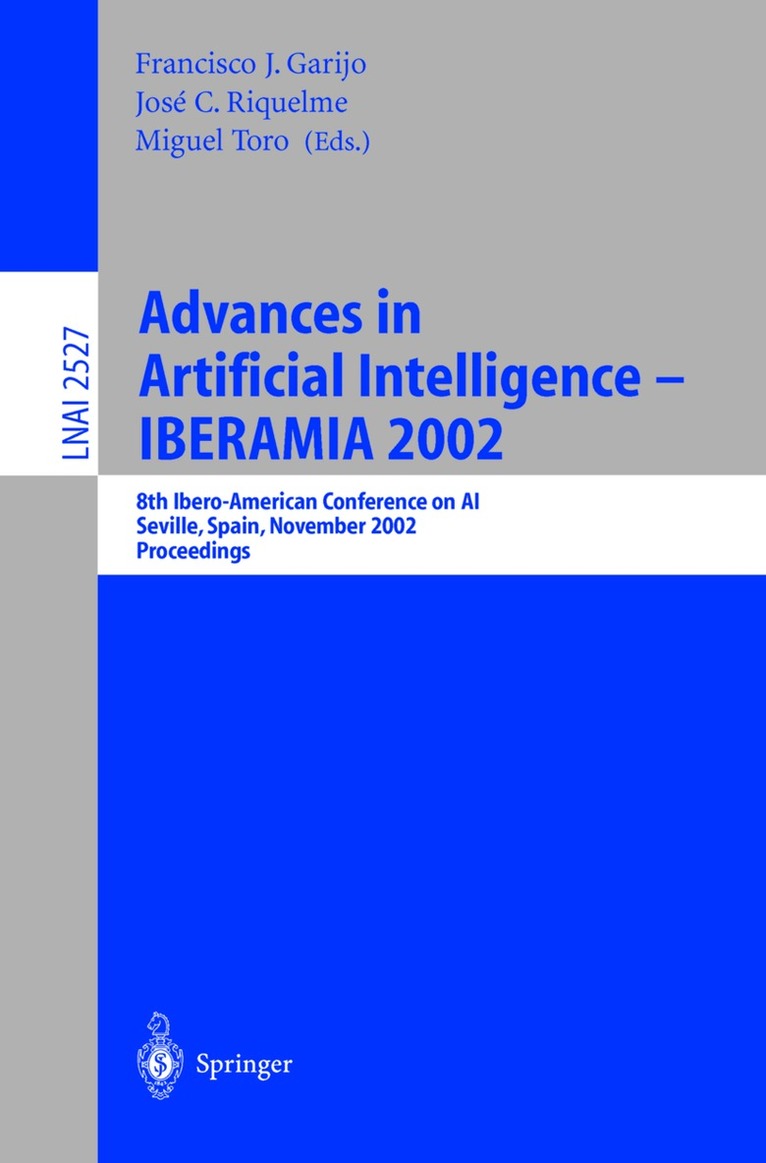
The 8th Ibero-American Conference on Artificial Intelligence, IBERAMIA 2002, took place in Spain for the second time in 14 years; the first conference was organized in Barcelona in January 1988. The city of Seville hosted this 8th conference, giving the participants the opportunity of enjoying the richness of its historical and cultural atmosphere. Looking back over these 14 years, key aspects of the conference, such as its structure, organization, the quantity and quality of submissions, the publication policy, and the number of attendants, have significantly changed. Some data taken from IBERAMIA’88 and IBERAMIA 2002 may help to illustrate these changes. IBERAMIA’88 was planned as an initiative of three Ibero-American AI associations: the Spanish Association for AI (AEPIA), the Mexican Association for AI (SMIA), and the Portuguese Association for AI (APIA). The conference was organized by the AEPIA staff, including the AEPIA president, José Cuena, the secretary, Felisa Verdejo, and other members of the AEPIA board. The proceedings of IBERAMIA’88 contain 22 full papers grouped into six areas: knowledge representation and reasoning, learning, AI tools, expert systems, language, and vision. Papers were written in the native languages of the participants: Spanish, Portuguese, and Catalan. Twenty extended abstracts describing ongoing projects were also included in the proceedings.
E-bok
PDF, Engelska, 20031 408 kr
Läs direkt efter köp
The 8th Ibero-American Conference on Artificial Intelligence, IBERAMIA 2002, took place in Spain for the second time in 14 years; the first conference was organized in Barcelona in January 1988. The city of Seville hosted this 8th conference, giving the participants the opportunity of enjoying the richness of its historical and cultural atmosphere. Looking back over these 14 years, key aspects of the conference, such as its structure, organization, the quantity and quality of submissions, the publication policy, and the number of attendants, have significantly changed. Some data taken from IBERAMIA’88 and IBERAMIA 2002 may help to illustrate these changes. IBERAMIA’88 was planned as an initiative of three Ibero-American AI associations: the Spanish Association for AI (AEPIA), the Mexican Association for AI (SMIA), and the Portuguese Association for AI (APIA). The conference was organized by the AEPIA staff, including the AEPIA president, José Cuena, the secretary, Felisa Verdejo, and other members of the AEPIA board. The proceedings of IBERAMIA’88 contain 22 full papers grouped into six areas: knowledge representation and reasoning, learning, AI tools, expert systems, language, and vision. Papers were written in the native languages of the participants: Spanish, Portuguese, and Catalan. Twenty extended abstracts describing ongoing projects were also included in the proceedings.
E-bok
PDF, Engelska, 2007734 kr
Läs direkt efter köp
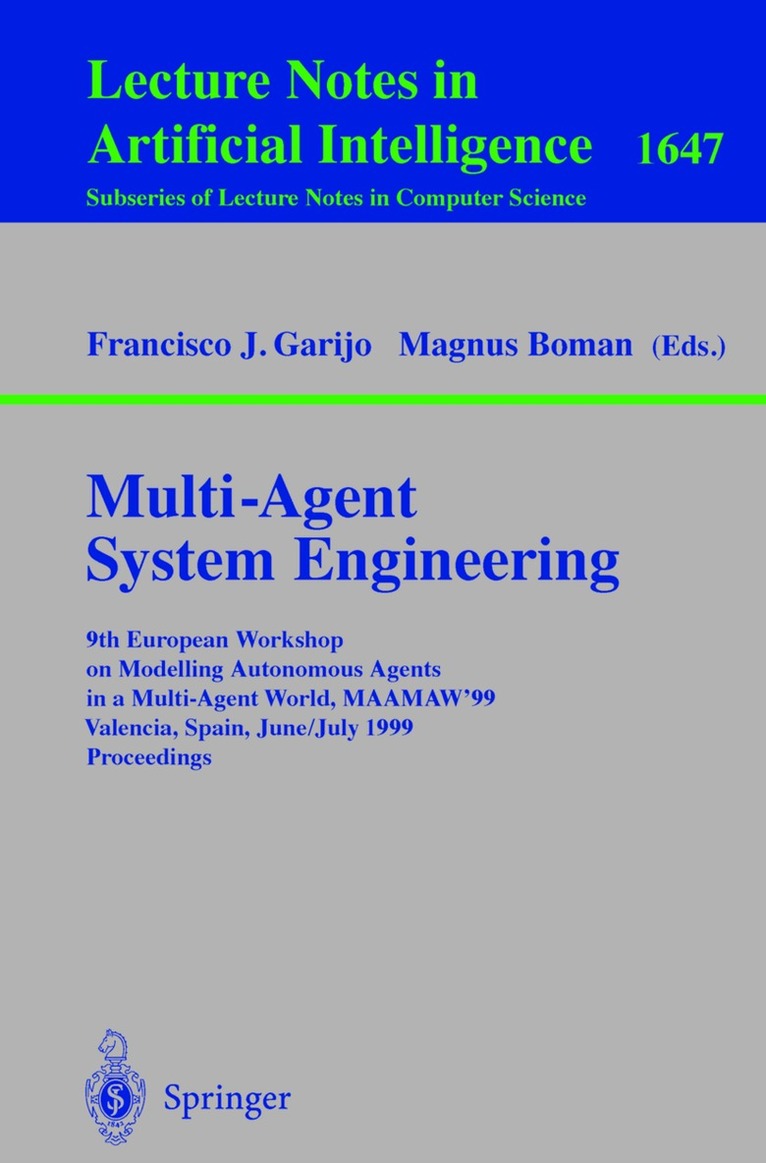
In the ten years since the first MAAMAW was held in 1989, at King''s College, Cambridge, the field of Multi-Agent Systems (MAS) has flourished. It has attracted an increasing amount of theoretical and applied research. During this decade, important efforts have been made to establish the scientific and technical foundations of MAS. MAAMAW publications are testimony to the progress achieved in key areas such as agent modelling and reasoning, multi-agent interaction and communication, and multi-agent organisation and social structure. Research results have covered a wide range of inter-related topics in each area including agent architectures, reasoning models, logics, conflict resolution, negotiation, resource allocation, load balancing, learning; social behaviour and interaction, languages and protocols, interagent and agent-human communication, social models, agent roles, norms and social laws, and static and dynamic organisational structures. The feasibility and the viability of the proposed models and techniques have been demonstrated through MAS applications in heterogeneous domains including electronic commerce, co-operative work, telecommunications, social and biological systems, robotics, office and business automation, public administration, social simulations and banking. As the applicability of the technology became understood, the multi-agent paradigm has been progressively accepted by product managers and system developers, giving rise to a considerable amount of business expectation from industry. These expectations do not rest on the concept or metaphor of agent, but on the development of MAS useful in an industrial setting, with real-time systems presenting the biggest challenge.
Häftad, Engelska, 1998
562 kr
Skickas inom 10-15 vardagar
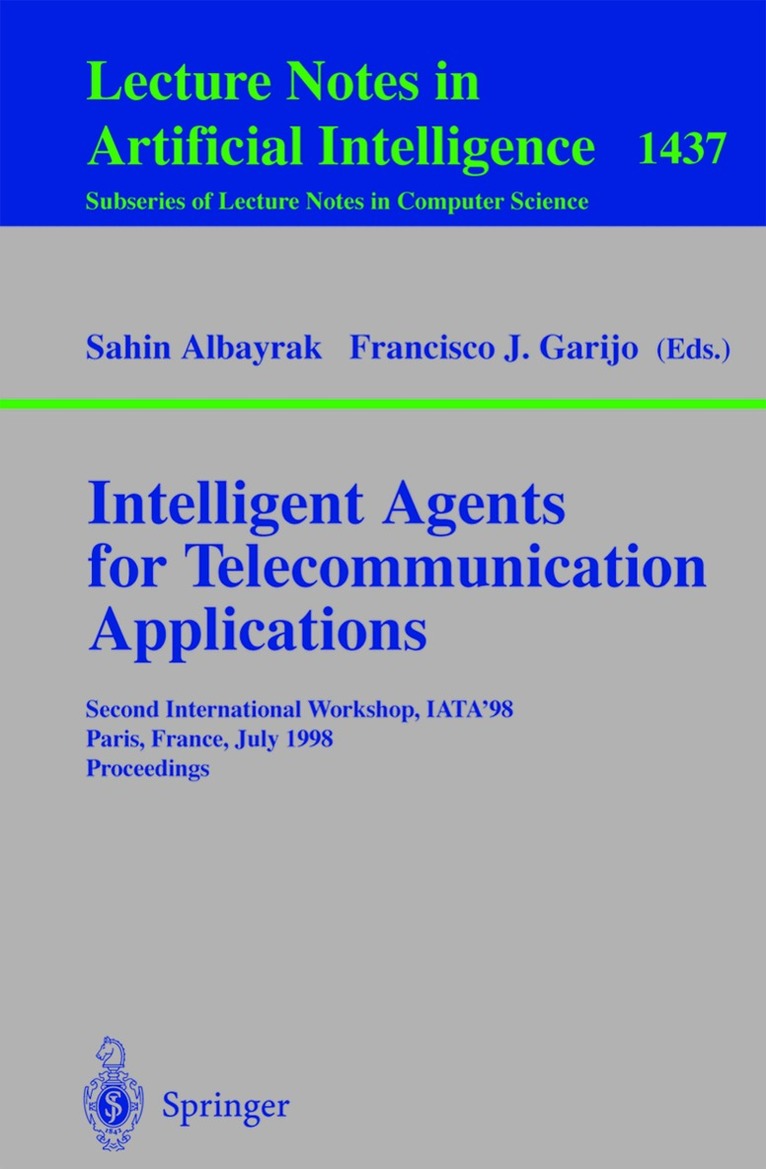
This book constitutes the refereed proceedings of the Second International Workshop on Intelligent Agents for Telecommunication Applications, IATA'98, held in Paris, France, in July 1998, in conjunction with the 1998 Agents World Conference.The book presents 17 revised full papers carefully selected for inclusion in the volume. The book is divided into topical sections on network architecture, network configuration and planning, network optimization, network management, agent-based architectures for service applications.
Häftad, Engelska, 1999
562 kr
Skickas inom 10-15 vardagar
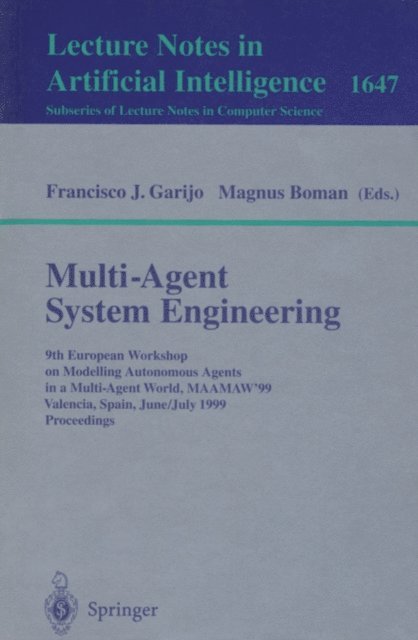
In the ten years since the first MAAMAW was held in 1989, at King's College, Cambridge, the field of Multi-Agent Systems (MAS) has flourished. It has attracted an increasing amount of theoretical and applied research. During this decade, important efforts have been made to establish the scientific and technical foundations of MAS. MAAMAW publications are testimony to the progress achieved in key areas such as agent modelling and reasoning, multi-agent interaction and communication, and multi-agent organisation and social structure. Research results have covered a wide range of inter-related topics in each area including agent architectures, reasoning models, logics, conflict resolution, negotiation, resource allocation, load balancing, learning; social behaviour and interaction, languages and protocols, interagent and agent-human communication, social models, agent roles, norms and social laws, and static and dynamic organisational structures. The feasibility and the viability of the proposed models and techniques have been demonstrated through MAS applications in heterogeneous domains including electronic commerce, co-operative work, telecommunications, social and biological systems, robotics, office and business automation, public administration, social simulations and banking. As the applicability of the technology became understood, the multi-agent paradigm has been progressively accepted by product managers and system developers, giving rise to a considerable amount of business expectation from industry. These expectations do not rest on the concept or metaphor of agent, but on the development of MAS useful in an industrial setting, with real-time systems presenting the biggest challenge.