Frank Nellen – författare
1 177 kr
Läs direkt efter köp
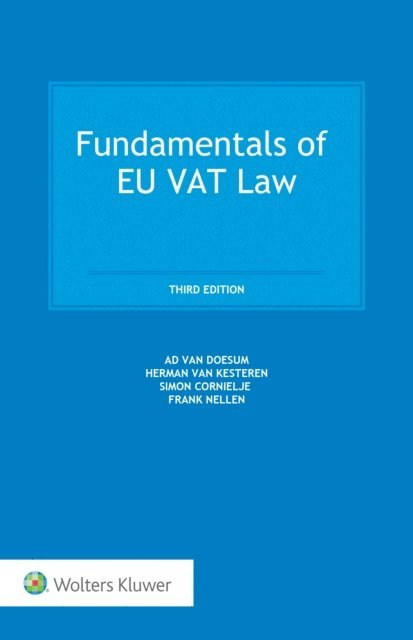
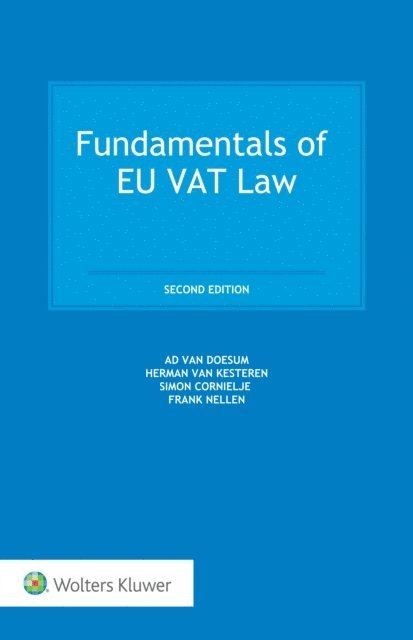
Value added tax (VAT) is responsible for generating almost EUR 1200 billion per year in tax revenues across the European Union – revenues that play a huge role in budgetary policymaking in the Member States. This extremely useful book provides not only a thorough description of the current state of EU VAT law but also a detailed explanation of the system’s rationale and its legislative provisions. It puts the elements of the system in perspective and shows how they are linked to each other. The focus lies on the rules which can be deduced from the sources of EU VAT law and on their application in practice.
The systematic presentation covers such issues and topics as the following:
sources of EU VAT law, including principles derived from CJEU case law;
principles underlying the EU VAT system;
relations among the layers of VAT law – primary and secondary EU law, national law;
how to apply the VAT legislation and case law;
allocation of taxing rights (place of supply rules),
invoicing requirements and other administrative obligations;
exemptions, the taxable amount and the new VAT rates structure;
the right of deduction of input VAT;
intra-Community transactions, importation and exportation;
e-commerce, distance sales rules, platforms and the one-stop-shop mechanism;
immovable property;
holding companies and dealings in shares; and
how far a national court must and can go in interpreting national provisions in light of the VAT Directive and the principles underlying the VAT system.
The book follows the structure of the VAT Directive/VAT determination scheme with additional topical chapters on immovable property, intra-Community transactions, importation and exportation of goods, and shares and other securities.
With its detailed attention to the meaning and interpretation of the most prominent legislative provisions and court rulings, this book serves as an incomparable guide for practitioners. Its emphasis on the rationale and systematics of the EU VAT system and abundance of references to case law and literature make it an indispensable reference for all tax law professionals, including legislators, judges and researchers.
1 177 kr
Läs direkt efter köp
Value added tax (VAT) is responsible for generating almost EUR 1200 billion per year in tax revenues across the European Union – revenues that play a huge role in budgetary policymaking in the Member States. This extremely useful book provides not only a thorough description of the current state of EU VAT law but also a detailed explanation of the system’s rationale and its legislative provisions. It puts the elements of the system in perspective and shows how they are linked to each other. The focus lies on the rules which can be deduced from the sources of EU VAT law and on their application in practice.
The systematic presentation covers such issues and topics as the following:
sources of EU VAT law, including principles derived from CJEU case law;
principles underlying the EU VAT system;
relations among the layers of VAT law – primary and secondary EU law, national law;
how to apply the VAT legislation and case law;
allocation of taxing rights (place of supply rules),
invoicing requirements and other administrative obligations;
exemptions, the taxable amount and the new VAT rates structure;
the right of deduction of input VAT;
intra-Community transactions, importation and exportation;
e-commerce, distance sales rules, platforms and the one-stop-shop mechanism;
immovable property;
holding companies and dealings in shares; and
how far a national court must and can go in interpreting national provisions in light of the VAT Directive and the principles underlying the VAT system.
The book follows the structure of the VAT Directive/VAT determination scheme with additional topical chapters on immovable property, intra-Community transactions, importation and exportation of goods, and shares and other securities.
With its detailed attention to the meaning and interpretation of the most prominent legislative provisions and court rulings, this book serves as an incomparable guide for practitioners. Its emphasis on the rationale and systematics of the EU VAT system and abundance of references to case law and literature make it an indispensable reference for all tax law professionals, including legislators, judges and researchers.
1 422 kr
Skickas inom 5-8 vardagar
1 205 kr
Läs direkt efter köp
Parties to cross-border disputes arising anywhere in the vast Portuguese-speaking world – a community of more than 230 million in a space that offers a wide array of investment opportunities across four continents – increasingly seek Portugal as their preferred seat of arbitration. A signatory to all relevant international conventions, Portugal has proven to be an ‘arbitration-friendly’ jurisdiction. This volume is the first and so far only book in English that provides a thorough, in-depth analysis of international arbitration law and practice in Portugal. Its contributing authors are among the most highly regarded legal names in the country, including scholars, arbitrators, and practitioners.
The authors describe how international arbitration proceedings are conducted in Portugal, what cautions should be taken, and what procedural strategies may be suitable in particular cases. They provide insightful answers to questions such as the following:
What matters can be submitted to arbitration under Portuguese law? What are the validity requirements for an arbitration agreement? How do the State courts interact with arbitration proceedings and what is the attitude of such courts toward international arbitration? What are the rules governing evidentiary matters in arbitration? How is an arbitration tribunal constituted? How are arbitrators appointed? How may they be challenged? How can an international arbitral award be recognized and enforced? How does the Portuguese legal system address the issue of damages and what specific damages are admitted? How are the costs of arbitration proceedings estimated and allocated?The book includes analyses of arbitration related to specific fields of the law, notably sports, administrative, tax, intellectual property rights (especially regarding reference and generic medicines), and corporate disputes. Each chapter provides, for the topics it addresses, an examination of the applicable laws, rules, arbitration practice, and views taken by arbitral tribunals and state courts as well as those of the most highly considered scholars.
As a detailed examination of the legal framework and of all procedural steps of an arbitration in Portugal, from the drafting of an arbitration agreement to the enforcement of an award, this book constitutes an invaluable resource for parties involved in or considering an international arbitration in this country. The guidance that it seeks to provide in respect of any problem likely to arise in this context can be useful to arbitrators, judges, academics, and interested lawyers.
1 163 kr
Läs direkt efter köp
Parties to cross-border disputes arising anywhere in the vast Portuguese-speaking world – a community of more than 230 million in a space that offers a wide array of investment opportunities across four continents – increasingly seek Portugal as their preferred seat of arbitration. A signatory to all relevant international conventions, Portugal has proven to be an ‘arbitration-friendly’ jurisdiction. This volume is the first and so far only book in English that provides a thorough, in-depth analysis of international arbitration law and practice in Portugal. Its contributing authors are among the most highly regarded legal names in the country, including scholars, arbitrators, and practitioners.
The authors describe how international arbitration proceedings are conducted in Portugal, what cautions should be taken, and what procedural strategies may be suitable in particular cases. They provide insightful answers to questions such as the following:
What matters can be submitted to arbitration under Portuguese law? What are the validity requirements for an arbitration agreement? How do the State courts interact with arbitration proceedings and what is the attitude of such courts toward international arbitration? What are the rules governing evidentiary matters in arbitration? How is an arbitration tribunal constituted? How are arbitrators appointed? How may they be challenged? How can an international arbitral award be recognized and enforced? How does the Portuguese legal system address the issue of damages and what specific damages are admitted? How are the costs of arbitration proceedings estimated and allocated?The book includes analyses of arbitration related to specific fields of the law, notably sports, administrative, tax, intellectual property rights (especially regarding reference and generic medicines), and corporate disputes. Each chapter provides, for the topics it addresses, an examination of the applicable laws, rules, arbitration practice, and views taken by arbitral tribunals and state courts as well as those of the most highly considered scholars.
As a detailed examination of the legal framework and of all procedural steps of an arbitration in Portugal, from the drafting of an arbitration agreement to the enforcement of an award, this book constitutes an invaluable resource for parties involved in or considering an international arbitration in this country. The guidance that it seeks to provide in respect of any problem likely to arise in this context can be useful to arbitrators, judges, academics, and interested lawyers.